BMW 120D Fuel Economy Guide: Real-World MPG, Driving Tips, and Efficiency Factors
The BMW 120D is widely known for offering a strong balance between performance and fuel efficiency. As a diesel-powered hatchback, it was designed to deliver strong torque while maintaining low running costs, making it a popular choice for both daily commuting and long-distance driving.
However, real-world fuel economy depends on several factors beyond factory figures. Driving style, maintenance condition, traffic conditions, and even tire quality all play a role in determining how efficiently the car performs.
To understand how efficiency changes in real ownership conditions, it helps to look at practical examples such as this BMW 120D project build, where a used diesel BMW’s condition and maintenance directly influenced its performance and running efficiency.
Why the BMW 120D Is Fuel Efficient
The BMW 120D achieves good fuel economy due to several engineering factors:
- Turbocharged diesel engine design
- High torque at low RPM
- Efficient combustion process
- Optimized gearing for motorway cruising
These characteristics allow the engine to use less fuel while maintaining strong performance.
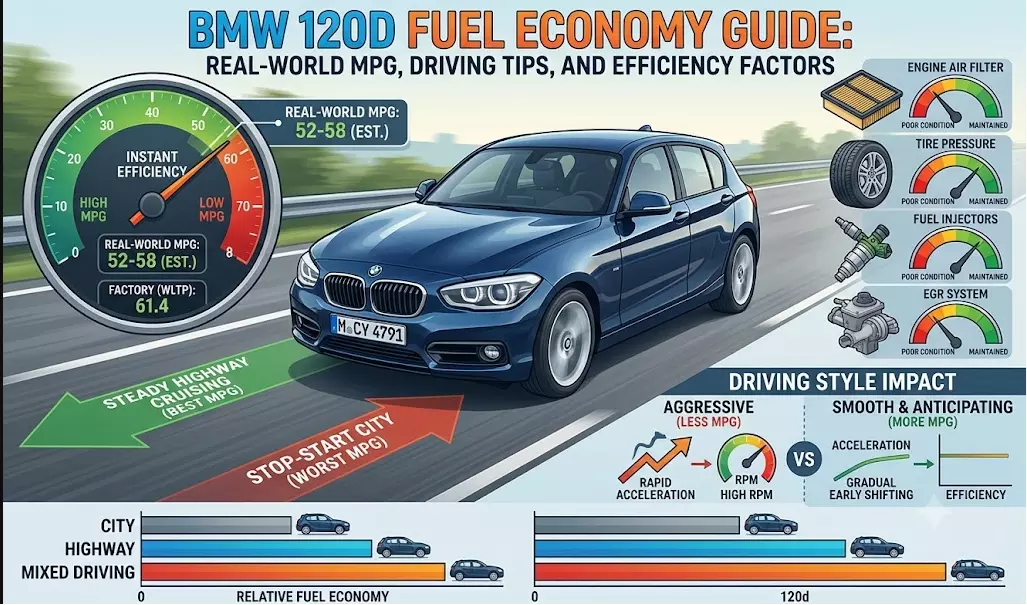
Factory vs Real-World Fuel Economy
While official figures are useful, real-world driving often tells a different story.
Factory Expectations
Manufacturers typically test under ideal conditions, including:
- Smooth driving
- Controlled temperatures
- Minimal load
This results in higher MPG figures than most drivers experience daily.
Real-World Driving
In real conditions, fuel economy is affected by:
- Traffic congestion
- Short trips
- Aggressive acceleration
- Vehicle maintenance condition
As a result, actual MPG is usually lower than official ratings.
City Driving Fuel Economy
City driving is the most fuel-intensive environment for the BMW 120D.
Why City MPG Is Lower
- Frequent stopping and starting
- Low-speed operation
- Engine warm-up cycles
- Idle time at traffic lights
Typical City Behavior
- Higher fuel consumption
- Reduced efficiency during short trips
- Increased carbon buildup risk
Short urban journeys are the least efficient use case for diesel engines.
Highway and Long-Distance Efficiency
The BMW 120D performs best on highways and long trips.
Why Highway Driving Improves MPG
- Steady engine speed
- Optimized gear ratios
- Reduced braking and acceleration
- Efficient turbo operation
Benefits
- Significantly better fuel economy
- Lower engine stress
- Reduced carbon buildup
This is where the 120D shows its full efficiency potential.
Factors That Affect Fuel Economy
Several variables influence how efficiently the BMW 120D performs.
Engine Condition
Poor maintenance reduces fuel efficiency.
Common issues include:
- Dirty air filters
- Clogged EGR valve
- Intake carbon buildup
- Worn injectors
Tire Condition
Tire pressure and quality directly affect rolling resistance.
- Underinflated tires reduce MPG
- Worn tires increase resistance
Driving Style
Driving habits are one of the biggest factors.
- Smooth acceleration improves MPG
- Aggressive driving reduces efficiency
- High RPM usage increases fuel consumption
Vehicle Load
Heavier loads require more fuel.
- Extra passengers
- Heavy cargo
- Roof racks or modifications
Maintenance Impact on Fuel Economy
Proper maintenance plays a critical role in efficiency.
Oil Quality
Fresh oil reduces engine friction and improves performance.
Air and Fuel Filters
Clean filters ensure proper airflow and combustion.
EGR System
A clogged EGR valve can reduce efficiency significantly.
Turbo Health
A well-functioning turbo ensures optimal combustion efficiency.
Driving Habits for Better MPG
Improving fuel economy is often about driving behavior.
Smooth Acceleration
Avoid sudden throttle inputs.
Early Gear Shifts
Keep RPM levels low when possible.
Maintain Steady Speed
Constant speed improves efficiency on highways.
Anticipate Traffic
Reducing unnecessary braking improves fuel economy.
Tire Choice and Efficiency
Tires influence rolling resistance and overall MPG.
Fuel-Efficient Tires
Designed to reduce resistance and improve economy.
Performance Tires
Offer better grip but may reduce fuel efficiency slightly.
Tire Pressure
Correct pressure is essential for optimal performance.
Weight and Aerodynamics
Extra weight and poor aerodynamics reduce efficiency.
Weight Factors
- Heavy aftermarket parts
- Excess cargo
- Roof accessories
Aerodynamic Drag
- Roof racks
- Open windows at high speed
- Body modifications
Reducing drag improves highway MPG significantly.
Read: Tata Punch: The Small SUV That Quietly Became a Big
Diesel-Specific Efficiency Benefits
Diesel engines naturally offer better efficiency than petrol engines.
Key Advantages
- Higher energy density of diesel fuel
- Strong low-end torque
- Lower RPM cruising
This makes the BMW 120D ideal for long-distance drivers.
Common Problems That Reduce MPG
Certain mechanical issues can significantly affect fuel economy.
EGR Blockage
Reduces airflow and combustion efficiency.
Injector Wear
Causes inefficient fuel delivery.
Turbo Issues
Reduces engine efficiency and power output.
Carbon Build-Up
Restricts airflow and reduces performance.
Real-World Ownership Insight
Many drivers only fully understand fuel economy after experiencing real ownership conditions. A well-maintained BMW 120D can be extremely efficient, while a poorly maintained one may consume significantly more fuel than expected.
A useful example of how condition and maintenance affect performance can be seen in this BMW 120D project build, where restoration and servicing played a key role in improving overall drivability and efficiency.
Final Thoughts
The BMW 120D remains a highly efficient diesel hatchback when properly maintained and driven correctly. Its combination of torque, diesel economy, and highway efficiency makes it an excellent long-distance vehicle.
However, real-world fuel economy depends heavily on maintenance and driving habits. Owners who prioritize smooth driving, regular servicing, and proper mechanical care will achieve the best results.
With the right approach, the BMW 120D continues to deliver excellent fuel efficiency even in today’s used car market.