Blockchain in Insurance: Transforming Claims, Policies, and Trust Through Decentralized Technology
The insurance industry depends on accurate information, trusted records, timely verification, and efficient coordination between multiple parties.
Insurers, policyholders, brokers, healthcare providers, repair companies, assessors, and other stakeholders may all participate in the lifecycle of an insurance policy or claim.
Many insurance processes still involve extensive documentation, manual verification, data reconciliation, and communication across separate systems.
Blockchain technology is being explored as a way to improve selected processes involving shared records, automated workflows, data verification, and auditability.
A professional Blockchain Development Company can help insurance businesses explore customized blockchain applications designed for their operational requirements.
HyprForge supports blockchain consulting, smart contract development, Web3 applications, decentralized platforms, cryptocurrency development, and customized digital solutions.
What Is Blockchain in Insurance?
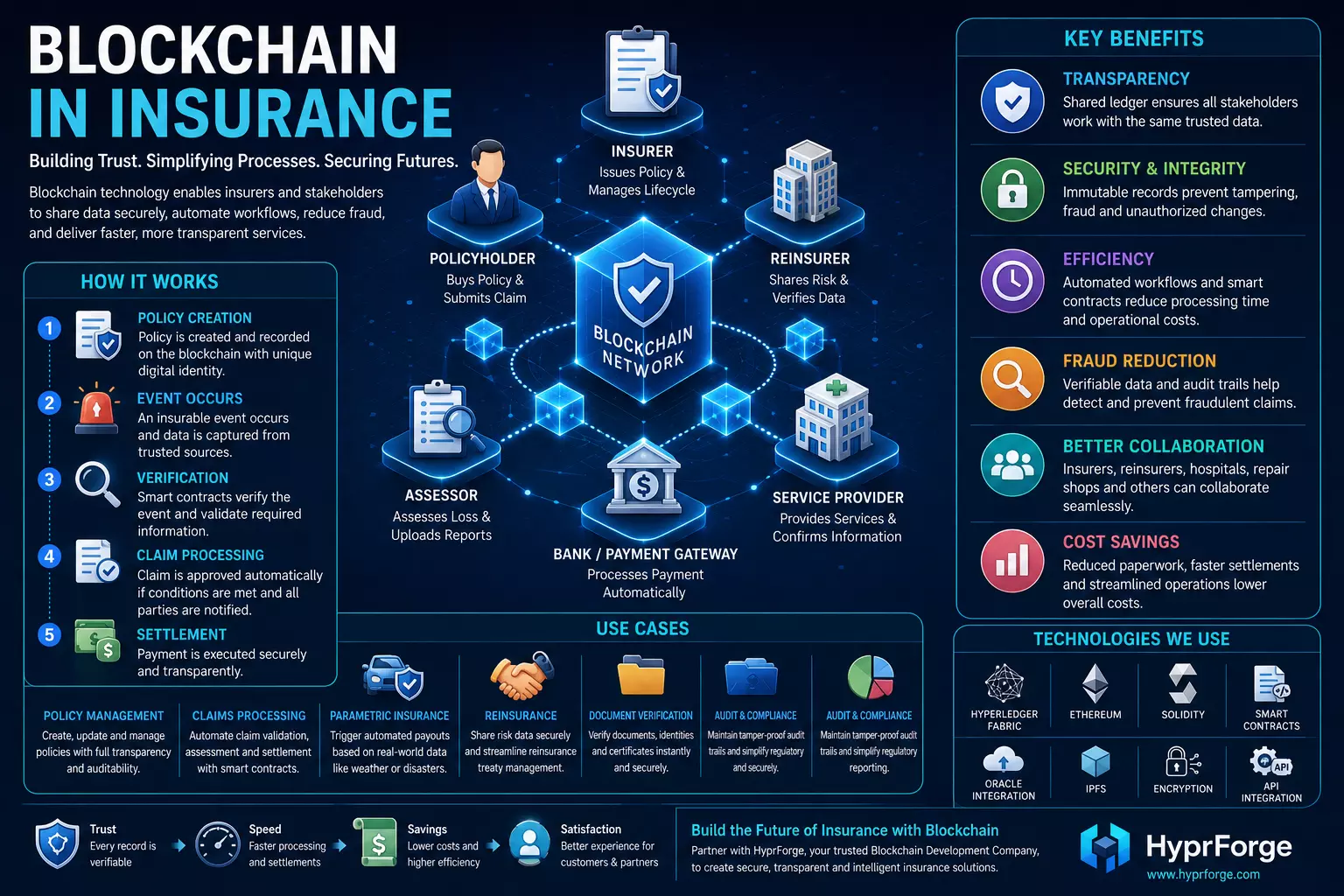
Blockchain in insurance refers to the use of distributed ledger technology for selected insurance-related processes. A blockchain network can provide a shared, tamper-evident record of defined transactions or events between authorized participants.
Potential applications include:
- Policy management
- Claims processing
- Fraud detection support
- Automated settlements
- Identity and credential verification
- Reinsurance coordination
- Document verification
- Audit trails
A simplified workflow may look like:
Blockchain does not replace the expertise of insurers, assessors, regulators, or legal professionals. Instead, it can provide technical infrastructure for specific processes where verifiable records and coordination between multiple parties are valuable.
Why Is the Insurance Industry Exploring Blockchain?
Insurance operations often require different organizations to exchange and verify information. This can create challenges involving duplicated data, slow workflows, administrative costs, and inconsistent records.
Potential business challenges include:
- Manual claims processing
- Document fraud
- Repeated data entry
- Complex approval processes
- Delayed information sharing
- Difficult reconciliation
- Limited visibility across systems
A Blockchain Consulting Company can help insurers evaluate whether blockchain is appropriate for a particular use case and identify where a conventional database may be a better solution.
The objective should always be practical business improvement rather than blockchain adoption for its own sake.
Read: Top 7 Blockchain Frameworks Every Developer Should
Blockchain for Insurance Policy Management
Insurance policies contain important information about coverage, terms, eligibility, and policy status.
A blockchain developer company can develop systems for recording selected policy-related events and creating verifiable digital records.
A blockchain-enabled policy platform may support:
- Policy issuance records
- Status updates
- Authorized amendments
- Renewal workflows
- Document references
- Audit trails
Sensitive customer and policy information should be protected through encryption, access controls, and appropriate off-chain storage. Not all insurance data should be stored directly on a blockchain.
Smart Contracts for Automated Insurance Workflows
Smart contracts are among the most discussed blockchain applications in insurance.
A blockchain smart contract development agency can develop smart contracts that automate predefined actions when validated conditions are met.
Potential applications include:
- Automated claim workflows
- Policy administration
- Eligibility checks
- Payment calculations
- Approval processes
- Event-based notifications
For example, a smart contract may trigger a predefined workflow when it receives validated information from an approved source.
However, automation depends on the accuracy of the information provided to the system. External data must come from reliable and appropriately governed sources.
Parametric Insurance Applications
Parametric insurance is one area where automated systems may be particularly relevant.
Instead of assessing every loss through a traditional process, a parametric product can use predefined conditions associated with a measurable event, subject to the applicable policy terms.
A potential digital workflow could involve:
Blockchain infrastructure may provide a record of selected events and automated business rules. However, the product design, data source, policy wording, legal framework, and regulatory requirements remain critical.
Fraud Detection and Data Verification
Insurance fraud can involve false claims, altered documents, duplicate submissions, or inaccurate information.
A Blockchain Development Agency can develop systems that create verifiable records for selected documents and events.
Possible features include:
- Cryptographic document verification
- Timestamped records
- Authorized participant access
- Transaction history
- Digital audit trails
Blockchain does not automatically detect whether information is true. It can help preserve and verify records once information has been entered into the system. Strong validation processes are still required before data is recorded.
Reinsurance and Multi-Party Coordination
Insurance companies may work with reinsurers and other organizations that require access to selected information.
A blockchain technology development company can build platforms that support defined workflows between authorized participants.
Potential benefits may include:
- Shared records
- Reduced reconciliation work
- Improved event tracking
- Defined permissions
- More consistent transaction histories
Permissioned blockchain systems may be appropriate when participation is limited to known organizations and sensitive commercial information must be protected.
Web3 Development for Insurance Platforms
Web3 technologies can support new types of decentralized applications and digital services.
A Web3 Development Agency can help businesses develop compatible applications involving:
- Digital identity
- Verifiable credentials
- Smart contracts
- Decentralized records
- User-controlled digital permissions
A Web3 Development Company can combine blockchain infrastructure with traditional technologies such as cloud platforms, APIs, databases, analytics systems, and secure web applications.
The technology should remain easy to use for customers who may have no experience with blockchain or digital wallets.
Web Development for Insurance Applications
A successful insurance platform requires a clear and accessible user experience.
A professional Web Development Agency can build:
- Customer portals
- Policy dashboards
- Claims applications
- Document management systems
- Agent interfaces
- Administrative panels
- Analytics dashboards
A Web Development Company can integrate these applications with blockchain networks, smart contracts, payment systems, identity services, APIs, and existing insurance infrastructure.
The goal is to make complex processes easier for customers and operational teams.
Cryptocurrency Development in Insurance Ecosystems
Some blockchain ecosystems may use tokens, wallets, or digital assets.
Cryptocurrency development can support selected technical features such as:
- Blockchain-based payments
- Digital wallet integration
- Tokenized platform ecosystems
- Automated digital transactions
However, insurance businesses should carefully determine whether cryptocurrency functionality is genuinely necessary.
Any token, cryptocurrency, or digital asset product should be evaluated for applicable legal, financial, tax, consumer-protection, and regulatory requirements.
Decentralized Finance and Insurance Technology
Certain blockchain ecosystems may explore decentralized financial models and smart-contract-based risk applications.
A Decentralized Exchange Development Company can provide expertise in compatible decentralized transaction infrastructure.
A Decentralized Exchange Software Development Company can develop platforms involving smart contracts, wallets, blockchain transactions, and decentralized application architecture.
When selecting a dex development company, businesses should carefully evaluate security, compliance requirements, governance, and the suitability of decentralized infrastructure for their specific insurance model.
Security in Blockchain Insurance Development
Insurance systems manage valuable financial and personal information. Security must therefore be a priority.
A comprehensive security strategy should address:
- Data encryption
- Strong authentication
- Role-based access controls
- API protection
- Private key management
- Smart contract testing
- Infrastructure monitoring
- Backup and recovery
- Incident response
Blockchain technology should be treated as one part of a broader cybersecurity architecture.
Scalability and Integration
Insurance companies often rely on established enterprise systems.
A blockchain application may need to integrate with:
- Policy management software
- Claims systems
- Customer relationship platforms
- Payment infrastructure
- Identity verification systems
- Data analytics platforms
- External information providers
A hybrid architecture can combine blockchain technology with cloud infrastructure, secure databases, APIs, and off-chain processing to support scalability and performance.
Why Choose HyprForge?
HyprForge helps businesses explore customized blockchain and Web3 solutions for modern digital ecosystems.
The company supports blockchain consulting, smart contract development, cryptocurrency applications, decentralized platforms, Web3 development, and blockchain-enabled web solutions.
For businesses searching for a bockchain app development company, HyprForge can help develop customized applications designed around security, scalability, integration, automation, and user experience.
Conclusion
Blockchain technology offers promising possibilities for selected insurance applications, including policy management, claims workflows, document verification, multi-party coordination, and automated processes.
However, successful implementation requires more than deploying smart contracts or a blockchain network.
Insurance businesses need reliable data sources, clear business rules, strong security, effective governance, and compliance with applicable regulations.
By working with an experienced Blockchain Development Company, insurance organizations can explore practical blockchain solutions that support digital transformation and modern operational workflows.
As insurance technology continues to evolve, carefully designed blockchain applications may help create more connected, verifiable, efficient, and transparent systems for selected insurance processes.