BLDC Fan Full Form: Meaning, Technology, Benefits, and Why It Matters
The modern home is rapidly adopting energy-efficient appliances, and ceiling fans are no exception. Among the latest innovations, BLDC Fan Full Form have gained massive popularity due to their low power consumption, silent operation, and smart features.
But before understanding why these fans are so efficient, it’s important to start with the basics.
BLDC Fan Full Form
BLDC Fan Full Form is Brushless Direct Current Fan.
A BLDC fan uses a Brushless Direct Current (BLDC) motor instead of the traditional AC induction motor found in conventional ceiling fans. This motor technology is the core reason behind the fan’s superior efficiency and performance.
What Is a BLDC Motor?
A BLDC motor (Brushless Direct Current motor) is an electric motor that operates on direct current (DC) electricity and does not use mechanical brushes for commutation. Instead, it relies on an electronic controller to switch the current through the motor windings.
In a BLDC fan, the AC power supplied to your home is first converted into DC power using an internal electronic circuit. This DC power then drives the motor, resulting in minimal energy loss.
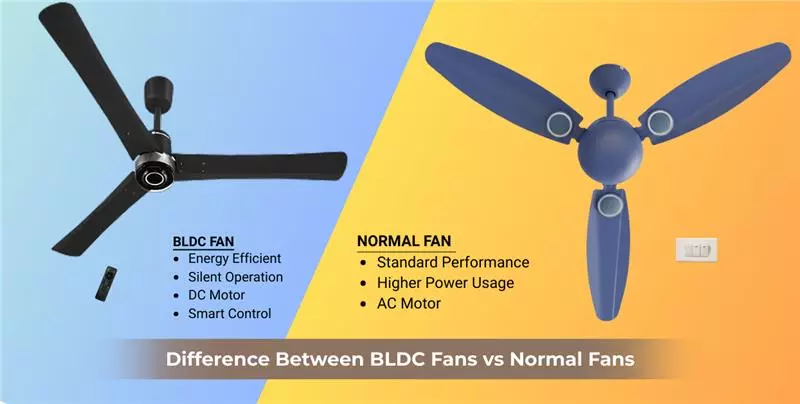
Difference Between BLDC Fan and Normal Fan
Understanding the difference between a BLDC fan and a conventional fan helps clarify why BLDC fans are becoming the preferred choice.
Motor Type
- BLDC Fan: Uses a Brushless DC motor
- Normal Fan: Uses an AC induction motor
Power Consumption
- BLDC Fan: Typically consumes 25–35 watts at full speed
- Normal Fan: Consumes around 70–90 watts
Noise Level
- BLDC Fan: Extremely quiet
- Normal Fan: Produces noticeable humming noise
Speed Control
- BLDC Fan: Electronic and precise
- Normal Fan: Mechanical regulator or basic electronic control
How Does a BLDC Fan Work?
The working mechanism of a BLDC fan is based on electronic commutation rather than mechanical commutation.
AC to DC Conversion:
The fan receives standard AC power from the mains. An internal rectifier converts this AC power into DC.
Electronic Controller:
A microcontroller precisely controls the current supplied to the motor coils.
Magnetic Rotation:
Permanent magnets on the rotor interact with the stator windings, producing smooth rotational motion.
Efficient Speed Regulation:
Speed changes are handled electronically, which eliminates energy loss common in traditional regulators.
This advanced working principle is the reason BLDC fans consume significantly less electricity.
Why Is BLDC Fan Technology Important?
With rising electricity costs and increasing awareness about energy conservation, BLDC technology plays a critical role in reducing household power consumption.
A ceiling fan often runs for 8–12 hours daily, especially in warm climates. Even a small reduction in wattage can lead to significant annual savings. BLDC fans address this issue by combining efficiency with performance.
Power Consumption of BLDC Fans
One of the biggest highlights of a BLDC fan is its ultra-low power usage.
- At full speed, most BLDC fans consume around 28–35 watts
- At lower speeds, consumption can drop to 10–15 watts
In comparison, a standard fan consumes nearly three times more power at full speed. Over a year, this difference can translate into substantial savings on electricity bills.
Energy Savings Over Time
Although BLDC fans are more expensive initially, the savings over time often justify the cost.
For example:
- A normal fan consuming 80 watts used for 10 hours daily consumes about 292 units per year
- A BLDC fan consuming 30 watts under the same conditions uses about 110 units per year
The difference of 182 units annually per fan adds up quickly, especially in homes with multiple fans.
Features of BLDC Fans
BLDC fans are not just energy-efficient; they also come with advanced features that enhance user convenience.
Remote Control Operation
Most BLDC fans include a remote control, allowing users to change speed, turn the fan on or off, and activate special modes without using a wall regulator.
Inverter Compatibility
BLDC fans consume very little power, making them ideal for use with home inverters or solar systems. They can run for much longer during power cuts compared to normal fans.
Consistent Speed
Unlike traditional fans, BLDC fans maintain a constant speed even when voltage fluctuates.
Timer and Sleep Modes
Many models offer timer settings and sleep modes for better energy management.
Noise and Comfort Level
Another major advantage of BLDC fans is their silent operation. Since there are no brushes and minimal mechanical friction, the motor produces very little noise.
This makes BLDC fans ideal for:
- Bedrooms
- Study rooms
- Offices
- Hospitals and libraries
The smooth airflow also enhances overall comfort.
Design and Aesthetics
BLDC fans are usually designed with modern interiors in mind. They feature:
- Sleek blades
- Minimalistic bodies
- Premium finishes
Manufacturers often focus on aesthetics to match contemporary home décor, making these fans both functional and visually appealing.
Maintenance and Durability
BLDC fans require less maintenance compared to traditional fans.
Fewer Moving Parts
The absence of brushes reduces wear and tear, increasing the motor’s lifespan.
Less Heat Generation
Lower heat production protects internal components and ensures long-term reliability.
Longer Warranty
Many manufacturers offer extended warranties on BLDC motors, reflecting their confidence in the technology.
Environmental Benefits of BLDC Fans
Using BLDC fans contributes positively to the environment.
- Reduced electricity consumption lowers carbon emissions
- Supports sustainable living
- Ideal for green buildings and energy-efficient homes
By switching to BLDC fans, households can reduce their overall environmental footprint.
Applications of BLDC Fans
BLDC fans are suitable for various settings:
- Residential Homes: Bedrooms, living rooms, kitchens
- Commercial Spaces: Offices, conference rooms
- Institutional Buildings: Schools, hospitals
- Solar-Powered Homes: Due to low energy requirements
Their versatility makes them a practical choice for both urban and rural environments.
Limitations of BLDC Fans
Despite their advantages, BLDC fans do have a few limitations.
- Higher Initial Cost: More expensive than standard fans
- Electronic Dependency: Repairs can be costlier if control boards fail
- Limited DIY Repairs: Requires professional servicing in most cases
However, these limitations are often outweighed by long-term savings and performance benefits.
Future of BLDC Fan Technology
As energy efficiency becomes a priority worldwide, BLDC fan technology is expected to dominate the ceiling fan market.
Advancements in electronics, integration with smart home systems, and reduced manufacturing costs will likely make BLDC fans more affordable and accessible.
Government energy-efficiency programs and consumer awareness are also accelerating the adoption of BLDC appliances.
Read: Why Businesses Are Investing in Custom Food Delivery
Conclusion
The **BLDC fan full form—Brushless Direct Current Fan—**represents more than just a technical term. It signifies a shift toward smarter, quieter, and more energy-efficient cooling solutions.
By using advanced motor technology, BLDC fans drastically reduce power consumption while offering superior performance and convenience.
Although the initial investment is higher, the long-term benefits in terms of electricity savings, durability, and comfort make BLDC fans a worthwhile choice for modern homes.
As technology continues to evolve, BLDC fans are set to become the new standard in energy-efficient cooling.