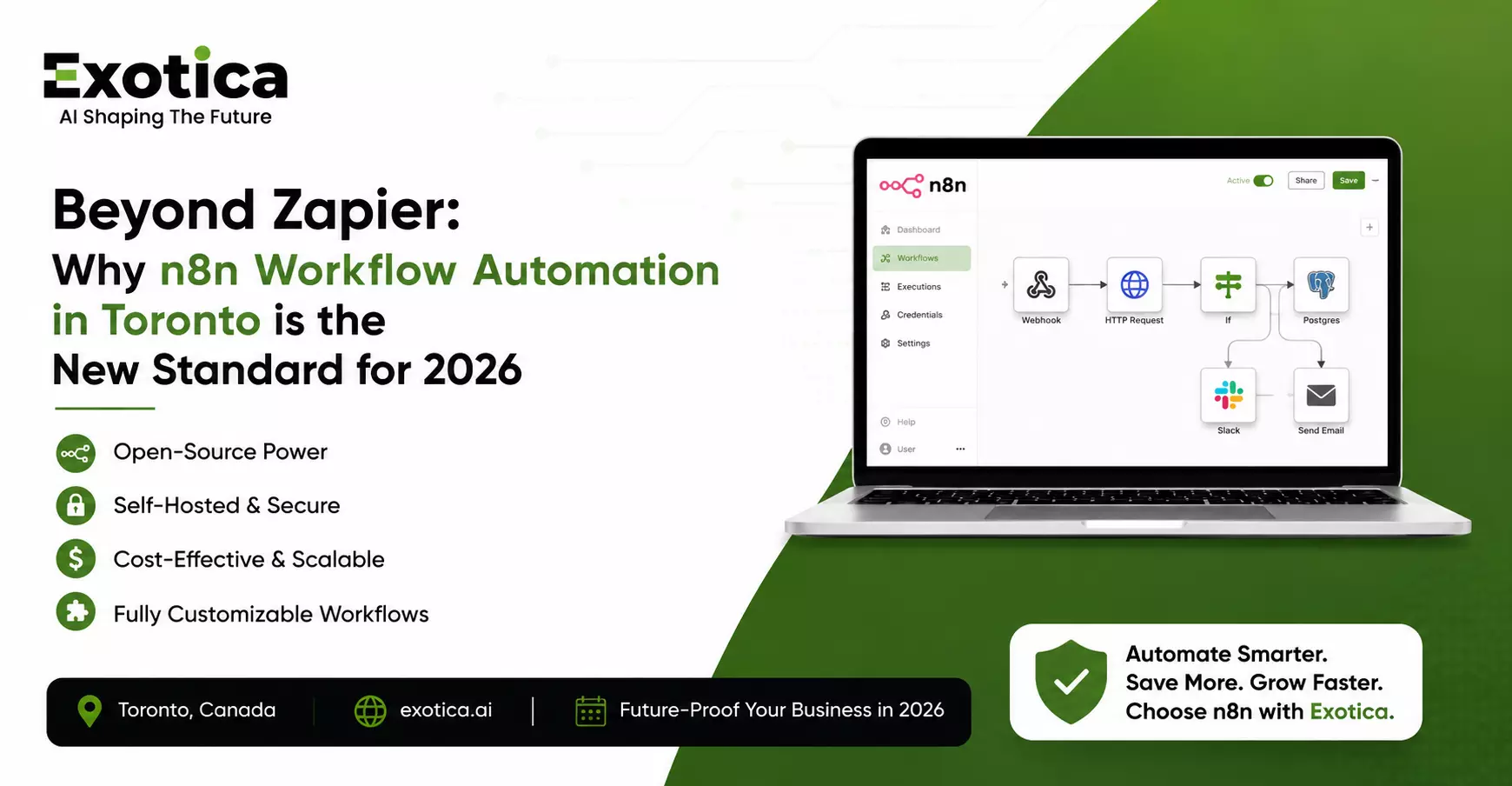
Beyond Zapier: Why n8n Workflow Automation in Toronto is the New Standard for 2026
If you audit the daily operations of a typical mid-sized business in Toronto right now, you will spot a glaring inefficiency: highly paid professionals acting as human middleware. They are downloading CSV files from Shopify, pasting client data into HubSpot, manually cross-referencing Stripe payments, and updating project statuses in Monday.com.
Toronto’s business ecosystem in 2026 is facing a distinct paradox: software budgets have never been higher, yet teams are still losing dozens of hours a week to manual tasks. The traditional advice—"just buy another SaaS tool"—has officially failed.
Instead of solving bottlenecks, we’ve created a new problem known as tool sprawl. Today, the real competitive advantage doesn't come from the applications you purchase; it comes from how intelligently you force those applications to communicate.
This realization is driving a massive architectural shift across the Greater Toronto Area (GTA). Companies are abandoning rigid, expensive automation platforms and moving toward open-source, logic-based orchestration.
The 2026 Shift: Why Basic Automation Is Breaking Down
The core issue with legacy automation tools lies in their rigidity and their billing architecture. Most consumer-grade automation platforms charge per execution or per task.
If you have a workflow that requires 15 steps—such as extracting data from an email, scoring a lead using AI, querying a database, and updating a CRM—you are charged for every single micro-action. When scaling a growing company, this token-based economy becomes rapidly cost-prohibitive.
Furthermore, standard tools operate as black boxes. When a multi-step sequence fails, diagnosing the error is notoriously difficult because you lack deep execution visibility.
In contrast, node-based platforms offer visual canvases where developers can see the exact JSON data passing between every single node. If an API call fails or a system returns an unexpected payload, the system flags the exact point of failure.
This level of granular control is precisely why forward-thinking IT leaders are seeking out expert n8n workflow automation in Toronto to build resilient systems that don't crash when a single variable changes.
The Strategic Mechanics of Advanced Node-Based Orchestration
To understand why this infrastructure is replacing older middleware, you have to look at the underlying mechanics of modern automation architecture.
Escaping the "Per-Task" Pricing Trap
Platforms like n8n operate on a fundamentally different economic model. Because it is a self-hostable platform, businesses aren't penalized for building complex, highly intelligent workflows.
A 30-step conditional logic tree costs the same to run as a 2-step data sync. This freedom allows developers to build proper error handling, loop logic, and automated retries without worrying about spiking monthly software bills.
PIPEDA Compliance and Data Sovereignty
For Canadian businesses—especially those located on Bay Street operating in finance, healthcare, and legal sectors—data sovereignty is non-negotiable. Sending sensitive client data through US-based servers to trigger a workflow can easily violate the Personal Information Protection and Electronic Documents Act (PIPEDA).
By utilizing self-hosted environments (such as Docker deployments on local Canadian servers), organizations keep their data entirely within their own network. This gives compliance officers peace of mind while still allowing the operational agility of a modern API ecosystem.
True Code Customization
While visual drag-and-drop builders are fantastic for deployment speed, there are times when you need custom logic.
Advanced orchestration allows developers to inject raw JavaScript or Python directly into the node sequence. If an off-the-shelf integration doesn't exist for a legacy Canadian banking portal, an architect can simply write a custom API bridge natively within the workflow.
3 Real-World Scenarios Transforming GTA Businesses
To illustrate the actual business impact, let’s look at how deploying n8n workflow automation for Toronto-based companies is actively reshaping different departments from the ground up.
1. AI-Driven Lead Qualification for B2B Tech
In competitive markets like Toronto real estate or Enterprise B2B tech, speed-to-lead dictates conversion rates. A modern inbound pipeline doesn’t just move a name from a web form to a CRM.
When a lead comes in, the workflow instantly queries external databases to enrich the profile. It then passes the enriched data through a Large Language Model (LLM) with specific instructions to score the lead based on company size, budget signals, and intent.
If the lead is a high-priority match, the system automatically drafts a hyper-personalized email and pings the correct sales director on Slack. If it’s a low-tier lead, it gets routed to an automated nurture sequence. This entire process happens autonomously in under four seconds.
2. Intelligent Customer Support Triage
Support teams are historically bogged down by password resets, invoice requests, and basic tier-one troubleshooting. By integrating an orchestration layer, incoming support tickets are intercepted before hitting a human agent.
The workflow uses an AI agent equipped with Retrieval-Augmented Generation (RAG) to scan the company's internal knowledge base. If the AI can resolve the ticket with 95% confidence based on existing documentation, it responds to the customer immediately.
If the issue is complex or requires empathy, the workflow categorizes the ticket, summarizes the sentiment, and escalates it to the appropriate human agent.
3. Revenue Operations and Dunning Automation
Failed credit card payments and expired invoices are a silent revenue killer for local SaaS and service-based companies. Instead of relying on a finance manager to manually chase down late payments, a smart pipeline can sync a CRM with payment processors like Stripe.
When a payment fails, the workflow checks the client’s history. It triggers a polite automated email on day one, escalates to an SMS reminder on day three, and eventually creates a task for the account manager to call the client directly on day seven.
By removing the manual tracking from accounts receivable, businesses consistently shrink their collection cycles.
Read: AI Automation Explained: Benefits, Challenges, and the
Embedding Agentic AI into Daily Operations
The most significant shift in 2026 is the transition from deterministic automation (where outcomes are strictly predefined) to agentic AI workflows.
Previously, an automation could only do exactly what it was programmed to do. Today, workflows feature AI agents capable of making micro-decisions based on context. For instance, a marketing research workflow can be instructed to scrape competitor pricing pages every week.
The AI node will read the unstructured data, determine if a competitor has launched a new promotional tier, and generate a competitive analysis brief for the executive team.
However, leaving AI unchecked is a massive operational risk. The best architects design these systems with "human-in-the-loop" checkpoints. The AI does 99% of the heavy lifting—gathering data, writing the code, or drafting the response—but a human must click "approve" before the final action is executed.
This blends the incredible speed of artificial intelligence with the necessary safety of human oversight.
Migrating Your Stack: The First 30 Days
Transitioning an entire company's workflow infrastructure isn't an overnight task. A successful migration requires a structured, phased approach rather than a risky "rip-and-replace" mentality.
Phase 1: The Automation Audit
Before writing a single line of script or dragging a node onto the canvas, businesses must map their existing processes. This involves identifying the most time-consuming bottlenecks—typically data entry, lead routing, or invoice processing. The goal is to find the operational friction points where automation can immediately return hours back to the team.
Phase 2: Parallel Deployment
When moving off older middleware, it’s critical to run the new system in parallel with the old one for a short period. This testing phase allows engineers to monitor webhook reliability, evaluate API latency, and ensure that custom error-handling protocols trigger correctly without disrupting daily operations.
Phase 3: Team Adoption and Documentation
A workflow is only as good as the team's ability to trust it. Comprehensive documentation ensures that if a webhook fails or an API endpoint updates, the internal team knows exactly which node to investigate and how the logic is structured.
What to Look for When Upgrading Your Infrastructure
If your team is drowning in repetitive tasks, buying another app won't save you. You need a centralized nervous system that connects the software you already pay for.
When evaluating your options, prioritize strategy over generic templates. Pre-built templates are fine for simple side projects, but enterprise operations require robust, custom architecture. You need comprehensive error handling, secure webhooks, strict API key management, and workflows that adapt to your specific operational nuances.
The companies dominating their respective industries aren't necessarily the ones with the largest headcounts. They are the ones that have systematically eliminated manual, repetitive work from their daily operations.
By investing in dedicated workflow architecture, businesses free their human talent to do what humans do best: build relationships, design strategies, and drive growth.