The End of the Cash Register: Why the Best Restaurant Billing Software is the Real Main Course
It’s 8:00 PM on a Friday. The dining room is a symphony of clinking silverware, loud conversation, and the soft glow of smartphone flashlights illuminating perfectly plated dishes. In the kitchen, the 'ticket' printer is a machine gun firing paper orders. This is the energy every restaurateur craves.
But for the veteran operator, this scene also represents a high-wire act. Every shouted order is a potential miscommunication. Every split bill at table twelve is a friction point.
Every minute a customer waits for their check is a minute that costs the venue money. The physical cash register, once the centerpiece of commerce, is becoming a quaint, inefficient relic.
As a journalist who has spent a decade interviewing chefs, owners, and consultants, I can confidently tell you that the single biggest difference between a struggling bistro and a scaling brand is no longer just the menu. It is the intelligence behind the counter.
The search isn't just for a 'point of sale'; it is for the best restaurant billing software to act as the digital central nervous system of the operation.
The Myth of 'Functional' Billing
For too long, the industry has accepted 'functional' as acceptable. A POS that processes a transaction is functional.
But in the razor-thin margin environment of modern hospitality (often hovering around 3–5% net profit), 'functional' is a slow death.
When operators go looking for the best restaurant billing software, they often make a mistake.
They look for the lowest entry cost. The reality is that the true cost of a bad billing system isn't the software subscription; it's the cost of lost data, slow table turnover, inventory shrinkage, and customer dissatisfaction.
A system that cannot communicate instantly with the kitchen (the KDS) means wasted food. A system that cannot manage split checks with a single swipe creates a five-minute bottleneck per table.
A system that doesn't track inventory in real-time is an open invitation for internal theft and stockouts of your signature ingredient on a busy weekend.
Legacy systems processing transactions is not enough; the best restaurant billing software doesn't just process orders; it manages the entire ecosystem.
The Hospitality Multiplier: Speed and Personalization
We must redefine the purpose of billing software. In a world of embedded finance and ubiquitous digital payments, the technology must disappear into the background to let the hospitality shine.
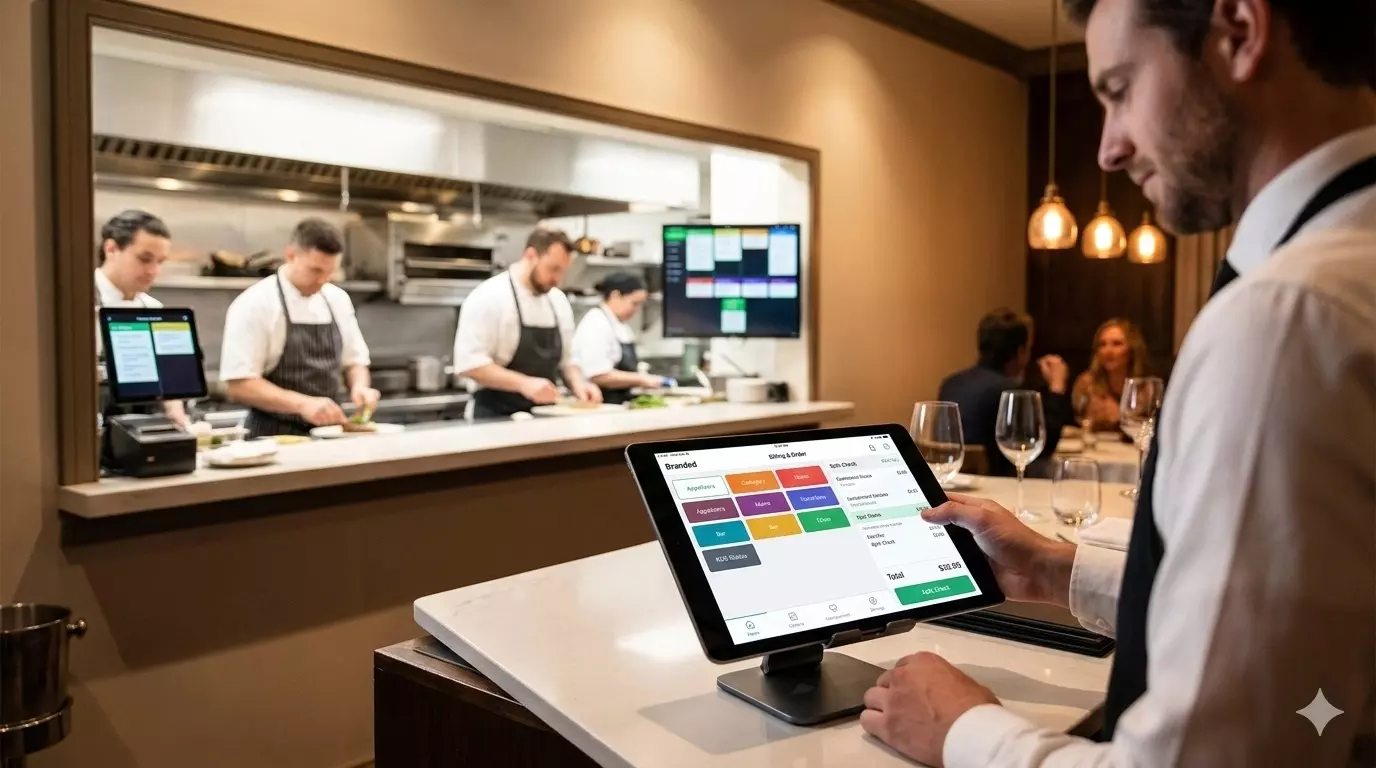
When a server can take an order on a handheld device that instantly updates the KDS, the kitchen starts cooking faster.
This is how you increase table turnover by 15–20%. When the check can be presented and paid via a QR code at the table, the guest leaves happier.
But the best part of the best restaurant billing software is how it handles the most stressful point of the guest journey: the final minutes.
If a server spends five minutes adjusting a complex, 12-person split check, they are invisible to their other five tables. The customer at table seven can't order another glass of wine.
The customer at table nine is frustrated that their water is empty. By automating these processes, modern billing software allows your staff to focus on being hosts, not transaction processing clerks.
Data: The Ingredient You Never Order
This is where the thought leadership shifts from simple efficiency to true strategic advantage. The best restaurant billing software is essentially a silent business partner providing actionable intelligence, not just receipts.
Many software solutions designed for this modernization—such as those from operators like Raseed—understand this intersection of tech and strategy. Modern platforms are designed specifically to turn the raw transaction stream into a powerful data tool.
Imagine knowing exactly which dish is your most profitable based on dynamic ingredient costs. Imagine knowing which server is the master of upselling the cocktail program. Imagine seeing which hours of the day are truly your most profitable, allowing you to optimize labor schedules.
Modern billing systems track not just sales, but the entire cost structure. Sticking with legacy tech is like trying to cook with one hand tied behind your back.
Read: Best Free Accounting Software to Manage Your Finances
The Hybrid Era: Adapting to the New Marketplace
The modern restaurant is no longer defined by its four walls. It is a hybrid model, combining high-touch dine-in hospitality with the frantic logistics of third-party delivery services (UberEats, Deliveroo).
If you are managing your dine-in orders on one system, your delivery tablet is on another, and your direct-ordering website is on a third, you are running three different businesses poorly.
The true definition of the best restaurant billing software in the 2020s is integration. It must act as the omni-channel hub.
Every order—whether from a waiter’s hand, a guest’s phone, or a delivery aggregator—must flow into one centralized kitchen queue and be tracked against one unified inventory pool.
If you are manually reconciling data across multiple systems, you have a data catastrophe waiting to happen.
Final Thoughts: A Strategic Imperative
We are witnessing a bifurcation in the industry. Restaurants that view their technology as a utility—a fixed expense to minimize—are struggling.
The ones that view their digital tools as a strategic imperative—an investment in ROI—are the ones that are growing.
The search for the best restaurant billing software isn't a tech chore; it’s a strategic imperative. The transition from a legacy POS to a modern, integrated restaurant management platform is the single most impactful operational decision you can make.
The cash register is dead. In its place is a powerful tool to let you reclaim your margins, empower your staff, and focus on the main course: hospitality.