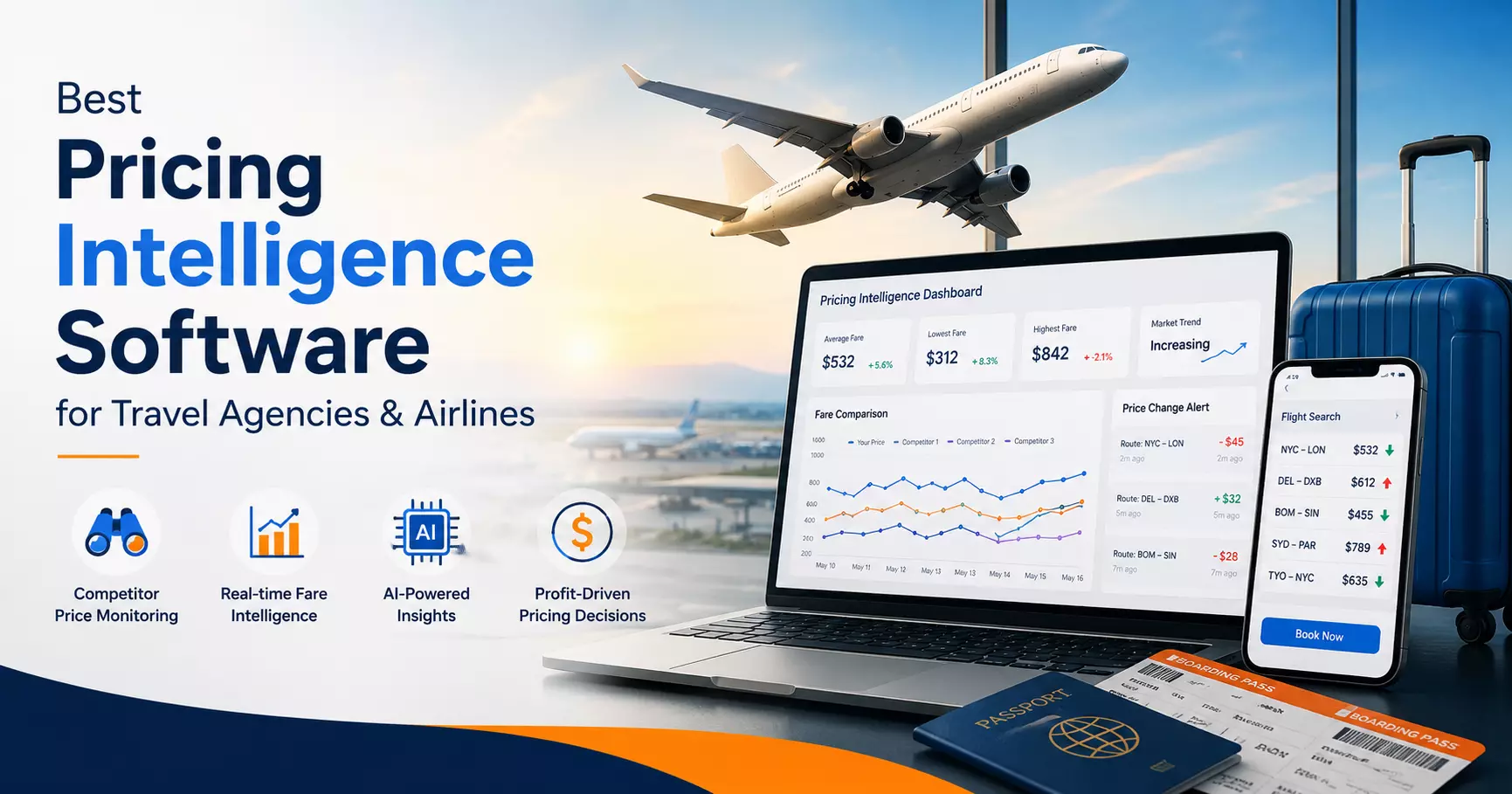
Best Pricing Intelligence Software for Travel Agencies & Airlines
Pricing intelligence software for travel agencies and airlines tracks competitor fares, hotel rates, and package prices in real time, giving revenue teams the data they need to adjust pricing before demand shifts hurt bookings.
The best platforms combine automated competitor price monitoring, AI-driven product matching across OTAs and booking engines, and repricing tools that respond to market movement within minutes rather than days.
Why Travel Pricing Has Become So Hard to Manage
Travel pricing moves faster than almost any other category. Airfares shift by the hour based on route demand, seasonality, and competitor seat availability.
Hotel rates swing across dozens of OTAs and direct channels simultaneously. Tour operators juggle package pricing, seasonal promotions, and destination-specific demand curves all at once.
For travel agencies and airlines still relying on manual spreadsheets or periodic rate checks, this creates a structural disadvantage.
By the time a pricing team notices a competitor dropped fares on a popular route, bookings have already moved elsewhere. This is why travel pricing software has shifted from a nice-to-have into a core piece of revenue management infrastructure in 2026.
What Pricing Intelligence Software Actually Does for Travel Businesses
Airline pricing software and travel price intelligence tools solve three problems that manual processes cannot keep up with.
1. Visibility
Competitor price monitoring software continuously scans OTAs, airline portals, metasearch engines, and direct booking sites to show exactly where a business stands relative to the market at any given moment.
2. Speed
Airline price monitoring software flags fare changes on competing routes as they happen, so revenue teams can react within the same booking window instead of after the fact.
3. Accuracy at scale
Matching a flight route, hotel room type, or vacation package to its true competitive equivalent across dozens of platforms is not a task humans can reliably do by hand.
AI-powered product matching solves this by identifying comparable listings even when naming conventions, dates, or inclusions differ slightly between platforms.
Read: Why You Should Switch to Space Rental Software in 2026
What to Look for in a Travel Pricing Intelligence Tool
Choosing the right platform comes down to a handful of practical criteria rather than a long feature checklist.
Coverage across every booking channel. A useful tool tracks pricing across OTAs, metasearch platforms, direct websites, and resellers at once, since travel businesses rarely sell through a single channel.
Matching accuracy for complex inventory. Flights, hotel rooms, and packages are harder to match than standard retail products because of variable dates, fare classes, and bundled inclusions. Matching accuracy directly determines how trustworthy the pricing data is.
Real-time or near-real-time updates. Travel demand changes by the hour. A tool that refreshes data daily is already behind the market.
Automated repricing capability. Visibility alone is not enough. The strongest platforms let teams set rules that automatically adjust pricing based on competitor movement, demand signals, and inventory levels.
Flexible delivery models. Larger airlines and OTAs often need raw data feeds through an API, while smaller agencies may prefer a full SaaS dashboard. A platform offering SaaS, DaaS, and API options can serve both without forcing a rebuild later.
Global scalability. Travel is inherently international, so a tool needs to track pricing across multiple countries and currencies without losing accuracy.
PriceIntelGuru: A Strong Fit for Travel Agencies and Airlines
PriceIntelGuru stands out as one of the best pricing intelligence software options for travel agencies and airlines because it was built to handle the exact complexity travel pricing presents: fragmented channels, constantly shifting fares, and products that are difficult to match across platforms.
The platform is designed to serve the full range of travel sellers, including airlines, hotels, online travel agencies, tour operators, and cruise lines, each of which faces its own version of the same core challenge: staying competitive while pricing changes by the hour across dozens of channels.
The platform delivers AI-powered product matching with 99.2% accuracy, which matters enormously in travel, where a single route or room type might appear under different names, dates, or bundled terms across ten different booking sites.
This level of accuracy means pricing teams can trust the competitive data they are acting on, rather than second-guessing whether two listings are actually comparable.
For airlines, this means matching fare classes and routes across competing carriers. For OTAs and hotels, it means matching room types and rate plans across supplier and direct channels. For tour operators, it means comparing package inclusions and seasonal offers that rarely line up exactly between providers.
PriceIntelGuru tracks more than 10 million products across over 50 countries, giving airlines, OTAs, and tour operators the global reach travel pricing demands.
For agencies selling packages across multiple regions or airlines competing on international routes, this scale is essential rather than optional.
The platform continuously monitors pricing across OTAs, airline portals, hotel booking engines, and metasearch platforms, giving travel businesses a single view of where they stand across every channel their customers actually book through.
On the automation side, PriceIntelGuru's Smart Repricing feature allows travel businesses to adjust fares and rates automatically based on competitor activity, demand signals, occupancy, and booking windows, instead of waiting for a human to manually update prices after the market has already moved.
This is particularly valuable during peak travel seasons and demand spikes, when fare and rate changes need to happen faster than a manual process can support.
Businesses using this kind of automated approach have seen 15 to 30% improvement in margins and up to 28% faster revenue growth, figures that reflect how much manual pricing delays actually cost in a category as time-sensitive as travel.
The platform is also available across SaaS, DaaS, and API delivery models, so airlines with in-house data teams can pull raw pricing feeds directly, while agencies without dedicated technical resources can rely on a ready-to-use dashboard built around travel-specific pricing and market analytics.
How Travel Businesses Typically Use Pricing Intelligence Day to Day
In practice, revenue teams use these tools to monitor fare and rate changes across competing airlines or OTAs each morning, adjust pricing rules before peak booking windows open, and review dashboards that highlight where they are priced above or below the market on specific routes or packages.
Tour operators lean on the same data to time seasonal promotions, while OTAs use it to close pricing gaps between what suppliers charge and what competitors display to consumers.
The common thread across all of these use cases is that pricing decisions move from reactive guesswork to data-backed action, which compounds over a full booking season into meaningfully better margins.
Getting Started with Pricing Intelligence
Travel agencies and airlines evaluating pricing intelligence software should start by mapping out which channels matter most to their business, whether that is OTA visibility, direct-to-consumer fare tracking, or package pricing across multiple regions.
From there, matching accuracy and update frequency should carry more weight in the decision than a long list of secondary features, since those two factors determine whether the pricing data can actually be trusted and acted on quickly.
For travel businesses ready to see how automated pricing intelligence works in practice, PriceIntelGuru's team can walk through how the platform tracks fares, rates, and packages across your specific channels and competitive set.