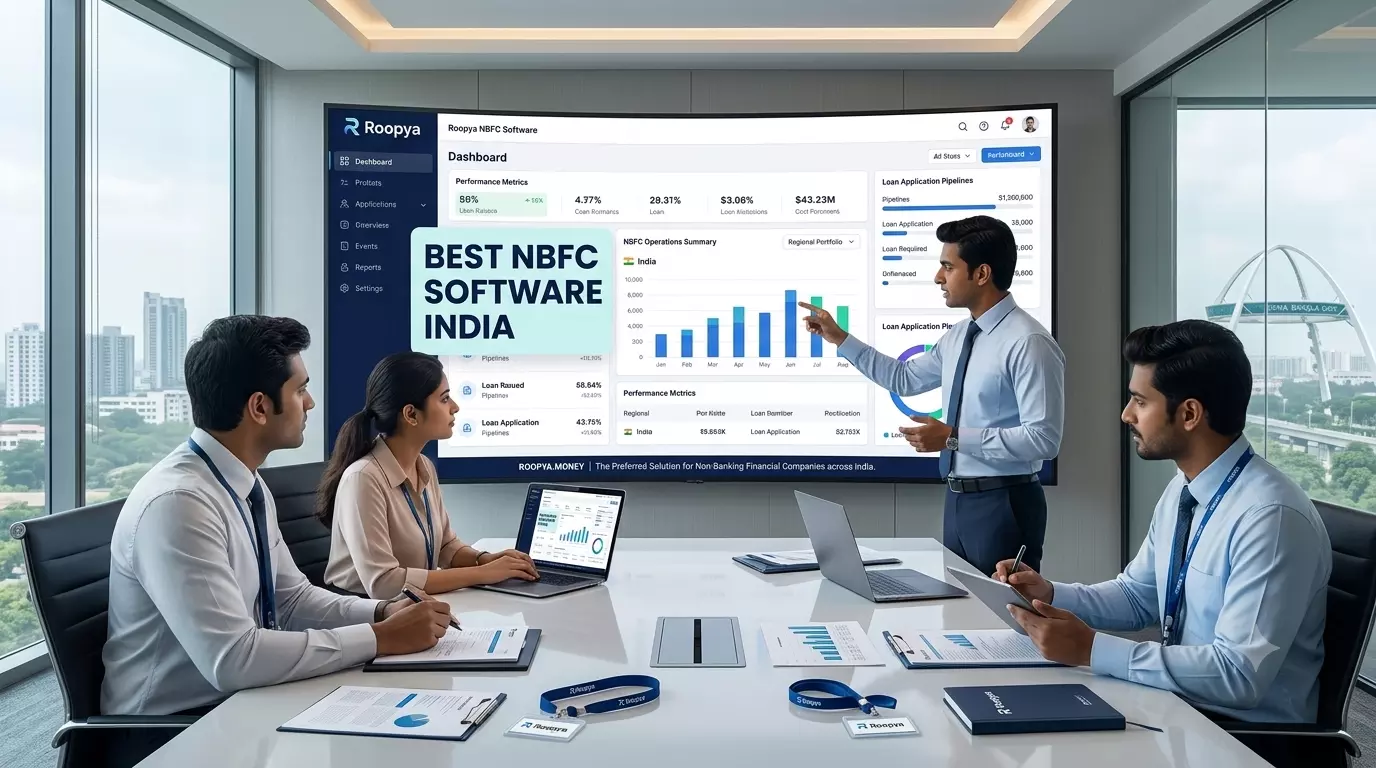
Best NBFC Software in India: Complete Guide to Choosing the Right Lending Technology Platform
Non-Banking Financial Companies (NBFCs) have become the backbone of credit distribution in India, serving millions of borrowers who are underserved by traditional banks.
From MSME lending and gold loans to personal loans, vehicle finance, and microfinance, NBFCs today originate a massive share of retail credit in the country. But as loan books grow and regulatory scrutiny from the Reserve Bank of India (RBI) intensifies, manual processes and outdated systems quickly become a bottleneck.
This is where NBFC software becomes indispensable. A modern NBFC software platform is no longer a "nice to have" — it is the operational backbone that determines how fast you can disburse loans, how well you manage risk, how efficiently you collect repayments, and how confidently you stay compliant with regulatory reporting.
Choosing the best NBFC software in India can be the difference between a lending business that scales smoothly and one that struggles with defaults, compliance gaps, and customer dissatisfaction.
In this guide, we break down everything you need to know about NBFC software in India — what it does, why it matters, the features that separate great platforms from mediocre ones, and why Roopya.money has emerged as a trusted choice for lenders across the country.
What Is NBFC Software?
NBFC software, also known as a Loan Management System (LMS) or Lending Management Platform, is a digital solution that automates and manages the entire lending lifecycle — from customer onboarding and credit underwriting to loan disbursement, repayment tracking, collections, and regulatory reporting.
Instead of relying on spreadsheets, physical files, and disconnected tools, NBFCs use this software to centralize every stage of the loan journey into one system. This includes:
- Digital customer onboarding and KYC verification
- Credit bureau integration and underwriting
- Loan origination and approval workflows
- Disbursement and loan accounting
- EMI scheduling and repayment tracking
- Collections and recovery management
- NPA classification and provisioning
- RBI regulatory reporting and audit trails
Essentially, NBFC software acts as the operating system of a lending business, connecting every department — sales, credit, operations, collections, and compliance — onto a single source of truth.
Why NBFCs in India Need Specialized Software
India's NBFC sector operates under a unique blend of opportunity and complexity. Understanding why specialized software matters requires looking at the specific pressures NBFCs face.
1. Regulatory Complexity
The RBI has tightened its scale-based regulatory framework for NBFCs, requiring more granular reporting, stricter provisioning norms, and enhanced governance standards.
Manual compliance tracking increases the risk of errors, penalties, and reputational damage. Purpose-built NBFC software automates regulatory reporting formats and keeps audit trails ready for inspection.
2. Scale and Speed of Lending
Digital lending in India has accelerated dramatically, with borrowers expecting loan approvals within minutes rather than days. NBFCs that still rely on manual underwriting and paperwork lose customers to competitors offering instant, app-based loan journeys. Software-driven automation compresses the loan cycle from days to hours.
3. Diverse Loan Products
Unlike banks, many NBFCs specialize in niche lending categories — gold loans, two-wheeler loans, education loans, supply chain finance, or microfinance.
Each product has distinct underwriting logic, repayment structures, and risk parameters. Generic banking software often can't handle this diversity, but purpose-built NBFC platforms are designed with configurable product engines.
4. Collections and NPA Management
Asset quality is the single biggest determinant of an NBFC's financial health. Without systemic tracking of overdue accounts, early warning signals, and collections workflows, delinquencies can spiral into non-performing assets. Automated reminders, field collection apps, and predictive risk scoring help NBFCs intervene before an account turns bad.
5. Co-Lending and Partnership Models
With the rise of co-lending arrangements between banks and NBFCs, and Business Correspondent (BC) partnerships, lenders need software capable of managing multi-party loan books, revenue-sharing calculations, and reconciliation across partners — something spreadsheets simply cannot handle reliably at scale.
Key Features to Look for in the Best NBFC Software
When evaluating NBFC software providers in India, here are the core capabilities that separate industry-leading platforms from basic tools:
Loan Origination System (LOS)
A strong LOS should support digital application forms, e-KYC, document upload, credit bureau pulls (CIBIL, Experian, CRIF Highmark), and configurable approval workflows that reduce manual touchpoints.
Loan Management System (LMS)
Once a loan is disbursed, the LMS should handle EMI scheduling, interest accrual, part-payments, foreclosures, penal charges, and complete loan accounting with minimal manual intervention.
Credit Underwriting & Rule Engine
Look for a configurable rules engine that lets your credit team adjust scoring logic, eligibility criteria, and risk thresholds without needing developer support for every change.
Collections & Recovery Module
Automated payment reminders via SMS/WhatsApp/email, a field collections app for agents, bucket-wise overdue tracking, and settlement workflows are essential for protecting portfolio quality.
Regulatory & Compliance Reporting
The platform should generate RBI-mandated reports, support NPA classification as per regulatory norms, and maintain audit-ready documentation trails.
API-First Architecture
Modern NBFCs frequently integrate with credit bureaus, payment gateways, e-NACH/e-mandate providers, digital signature services, and co-lending partners. An API-first design ensures these integrations are fast and reliable rather than custom-built each time.
Analytics & Dashboards
Real-time dashboards for portfolio health, disbursement trends, collection efficiency, and branch-wise performance help management make faster, data-backed decisions.
Multi-Product & Multi-Branch Support
As NBFCs expand into new loan products or geographies, the software should scale without requiring a system overhaul.
Security and Data Protection
Given the sensitivity of financial and personal data, robust encryption, role-based access control, and compliance with data protection norms are non-negotiable.
Common Challenges NBFCs Face Without the Right Software
Many NBFCs, especially those transitioning from manual or semi-digital operations, run into recurring problems:
- Fragmented systems: Separate tools for origination, servicing, and collections that don't talk to each other, leading to data mismatches and duplicate work.
- Slow loan turnaround times: Manual underwriting and paperwork-heavy processes that frustrate borrowers and push them toward faster digital competitors.
- Compliance risk: Missed regulatory deadlines or inconsistent reporting formats that invite RBI scrutiny.
- Poor visibility into portfolio health: Lack of real-time dashboards, making it difficult to spot early delinquency trends.
- Scalability issues: Systems built for a small loan book that buckle under the weight of growth, forcing costly migrations later.
This is precisely the gap that a well-built, India-specific NBFC software platform like Roopya.money is designed to close.
Read: Registrar and Share Transfer Agent: Regulatory Focus
Why Roopya.money Is Among the Best NBFC Software Choices in India
Roopya.money has been built specifically with the operational realities of Indian NBFCs in mind — not adapted from a generic global banking product. Here's what sets it apart:
End-to-End Lending Lifecycle Coverage: Roopya.money brings loan origination, underwriting, disbursement, servicing, and collections onto a single unified platform, eliminating the need to stitch together multiple disconnected tools.
Configurable for Any Loan Product: Whether you're running gold loans, personal loans, MSME finance, or vehicle loans, the platform's configurable product engine adapts to your specific underwriting rules and repayment structures instead of forcing a one-size-fits-all approach.
Built-In Regulatory Compliance: Reporting formats aligned with RBI's scale-based regulatory framework help reduce the manual burden on compliance teams and lower the risk of reporting errors.
Fast Implementation: Rather than months-long deployment cycles typical of legacy banking software, Roopya.money is designed for faster go-live timelines, so lenders can start disbursing through the new system sooner.
Scalable Architecture: The platform is built to support growing loan books, multiple branches, and expanding product lines without requiring a system migration down the line.
Data-Driven Collections: Automated reminders, collections workflows, and portfolio dashboards help NBFCs stay ahead of delinquencies rather than reacting to them after the fact.
For NBFCs evaluating technology partners, the right question isn't just "which software has the most features," but "which platform understands the Indian lending regulatory environment and can grow alongside my business." That combination of local regulatory depth and scalable technology is where Roopya.money positions itself as a strong choice.
How to Choose the Right NBFC Software: A Practical Checklist
Before signing up with any vendor, NBFCs should evaluate the following:
- Does it support your specific loan products (gold loan, MSME, personal loan, etc.) out of the box, or will it require expensive customization?
- How quickly can it be implemented — weeks or months?
- Does it have pre-built integrations with credit bureaus, payment gateways, and e-mandate providers?
- Is regulatory reporting automated or will your compliance team still need to compile reports manually?
- What does the collections module look like — does it include a field agent app and automated reminder workflows?
- Can the system scale as your loan book and branch network grow?
- What is the total cost of ownership, including implementation, licensing, and support fees?
- What kind of customer support and SLAs does the vendor offer post-implementation?
Running through this checklist with any shortlisted vendor, including Roopya.money, will help you make an informed, future-proof decision.
The Future of NBFC Technology in India
Looking ahead, several trends are shaping how NBFC software will evolve:
- AI-driven underwriting that uses alternative data sources (utility payments, GST filings, transaction history) to assess creditworthiness for thin-file borrowers.
- Embedded finance and API-based lending, where NBFCs plug their lending engine directly into partner platforms like e-commerce sites, payment apps, or B2B marketplaces.
- Predictive collections analytics that flag at-risk accounts before they become delinquent, rather than after.
- Deeper regulatory automation as RBI reporting requirements continue to expand in granularity.
NBFCs that invest in adaptable, API-first software today will be better positioned to take advantage of these shifts without needing a full platform replacement.
Choosing the best NBFC software in India is one of the most consequential decisions a lending business will make. The right platform doesn't just digitize paperwork — it transforms how fast you can grow, how well you manage risk, and how confidently you meet regulatory obligations. With rising borrower expectations and tightening RBI oversight, NBFCs can no longer afford fragmented, manual systems.
Roopya.money brings together loan origination, servicing, collections, and compliance into one configurable, scalable platform built for the realities of Indian lending. If you're evaluating NBFC software for your business, it's worth seeing the platform in action.
Ready to modernize your lending operations? Book a free demo at roopya.money today.
Frequently Asked Questions (FAQ)
Q1. What is NBFC software?
NBFC software is a digital platform that automates the lending lifecycle for Non-Banking Financial Companies, covering loan origination, underwriting, disbursement, repayment tracking, collections, and RBI regulatory reporting.
Q2. Why do NBFCs in India need dedicated lending software?
NBFCs deal with diverse loan products, strict RBI compliance requirements, and the need for fast loan approvals. Dedicated software automates these processes, reducing manual errors, speeding up disbursement, and keeping compliance audit-ready.
Q3. What features should I look for in the best NBFC software?
Key features include a loan origination system, loan management system, configurable credit underwriting rules, automated collections workflows, RBI compliance reporting, API integrations, and real-time analytics dashboards.
Q4. How long does it take to implement NBFC software like Roopya.money?
Implementation timelines vary based on the complexity of your loan products and existing data, but modern platforms like Roopya.money are designed for faster go-live compared to legacy banking systems, often within a matter of weeks.
Q5. Can NBFC software handle multiple loan products such as gold loans, MSME loans, and personal loans?
Yes. A well-designed NBFC software platform uses a configurable product engine that can support multiple loan types with different underwriting rules, interest structures, and repayment schedules, all within a single system.
Q6. Is NBFC software useful for small and mid-sized NBFCs, or only large ones?
NBFC software benefits lenders of all sizes. Smaller NBFCs gain efficiency and compliance readiness early on, while larger NBFCs need it to manage scale, multiple branches, and complex portfolios.
Q7. Does Roopya.money support RBI compliance reporting?
Roopya.money is built with reporting structures aligned to RBI's regulatory requirements for NBFCs, helping reduce the manual effort involved in compliance and audit preparation.
Q8. How does NBFC software help reduce NPAs?
By providing early warning signals, automated repayment reminders, bucket-wise overdue tracking, and a dedicated collections module, NBFC software helps lenders intervene earlier and reduce the chances of loans slipping into non-performing status.