Best Computer Training Institute in Delhi - IFDA Institute
Businesses today generate an enormous amount of information every day. Customer purchases, website activity, social media interactions, financial records, advertising results, and employee performance all produce data that can reveal something useful about a business.
The real challenge is understanding what that information means. This is where data analytics comes into the picture.
A Data Analytics Course in Delhi can be a useful starting point for anyone who wants to understand how raw information is collected, organized, examined, and converted into meaningful business insights.
Unlike a purely theoretical subject, data analytics involves practical problem-solving and the use of technology to answer questions that businesses face every day.
Understanding the Role of Data Analytics
Data analytics is not simply about looking at numbers or creating attractive charts. It involves asking the right questions and using available information to find reliable answers.
For example, an online store may want to know why sales have decreased, which products are performing well, or which type of customer is most likely to make another purchase.
An analyst studies the available information, identifies useful patterns, checks for inconsistencies, and presents the findings in a way that business teams can understand. This process helps organizations make decisions based on evidence rather than assumptions.
For someone considering a career in this field, learning how to think analytically is just as important as learning software.
Important Skills Covered in Data Analytics Training
A comprehensive Data Analytics Course introduces learners to several technical and analytical skills.
The exact curriculum can vary, but beginners generally start by understanding data handling and gradually move toward more advanced analysis.
Spreadsheet applications such as Microsoft Excel remain important in many organizations. Advanced Excel can be used to organize large datasets, perform calculations, compare information, create summaries, and prepare reports.
Functions, PivotTables, conditional formatting, charts, and data management techniques can make everyday reporting much more efficient.
Another major skill is SQL for data analysis. SQL allows professionals to work with information stored in databases.
Instead of manually searching through thousands of records, an analyst can write queries to retrieve particular information, combine tables, filter results, and calculate useful metrics.
These skills provide a strong foundation before moving into programming and business intelligence tools.
Read: Top 10 Best Data Science Courses in Delhi with 100%
Learning Python for Data Analysis
Python has become an increasingly useful tool for people working with large or complex datasets.
In a professional Data Analyst Training program, learners can be introduced to Python fundamentals and libraries commonly used for handling data.
Python can help with repetitive tasks, data preparation, exploratory analysis, and visualization. Libraries such as Pandas make it easier to work with structured datasets, while NumPy supports numerical operations.
The objective is not simply to learn programming syntax but to understand how programming can make analytical work faster and more organized.
For beginners, Python may initially seem challenging, but regular practice with small datasets can make the learning process much easier.
Turning Numbers into Visual Stories
Imagine receiving a spreadsheet containing thousands of sales records.
Reading every row would not be an efficient way to understand business performance. A well-designed visualization can reveal the important information much more quickly.
This is why data visualization has become an important part of analytics. Charts, graphs, reports, and interactive dashboards can help people recognize changes, comparisons, and unusual patterns.
Power BI is widely used for business reporting and dashboard creation. Learners can use it to connect data sources, prepare information, create visual reports, and present key performance indicators.
Good dashboard design is not about adding as many graphs as possible. It is about presenting relevant information clearly and making the report easy to interpret.
Projects Make Learning More Useful
One of the most valuable parts of learning analytics is applying concepts to realistic situations. A classroom exercise may teach a particular Excel function, but a project can show why that function is useful.
For example, learners can work with sales data and investigate monthly performance, customer behavior, product demand, or regional results. Another project might involve examining marketing data to determine which campaigns generated better responses.
Working on these kinds of assignments helps students understand the complete analytical process. It also gives them material for a data analyst portfolio, which can be useful when applying for internships, jobs, or freelance assignments.
Who Should Consider Learning Data Analytics?
You do not have to come from one particular academic background to start exploring this field. Students, graduates, working professionals, business owners, and career changers can all benefit from learning analytical skills.
Someone who enjoys working with numbers may naturally find the field interesting, but mathematics is not the only requirement.
Curiosity, logical reasoning, attention to detail, communication, and the ability to understand a business problem are equally important.
If you are searching for a Data Analyst Course Near Me, it is worth looking at the practical side of the program rather than choosing an institute based only on its location. Check whether students receive project experience, software practice, trainer guidance, and opportunities to build a portfolio.
Career Possibilities After Learning Data Analytics
Data is used in almost every modern industry, which means analytical skills can be applied in different professional environments.
Depending on their skills and experience, learners can explore positions such as Junior Data Analyst, Reporting Analyst, Business Analyst, MIS Analyst, Data Visualization Analyst, or Business Intelligence Analyst.
Analytics is relevant to banking, retail, e-commerce, marketing, logistics, education, healthcare, finance, technology, and many other sectors.
Some professionals eventually specialize in areas such as customer insights, marketing analytics, financial reporting, or business intelligence.
Career growth usually depends on a combination of technical ability, practical experience, communication, and understanding of the industry in which the analyst works.
Choosing the Right Data Analytics Institute in Delhi
Selecting a suitable Data Analytics Institute in Delhi requires some research. A useful course should have a logical curriculum rather than simply listing numerous tools.
Students should understand why a particular tool is used and how different technologies fit into an actual analytics workflow.
Practical assignments, instructor feedback, updated learning material, portfolio development, and exposure to real datasets can make the learning experience considerably more valuable. A course should also allow beginners enough time to practice instead of rushing through multiple technologies.
Build Your Analytics Skills with IFDA Institute
For learners looking to develop job-oriented analytical skills, the IFDA Institute offers a Data Analyst Course in Delhi designed around commonly used tools and practical concepts.
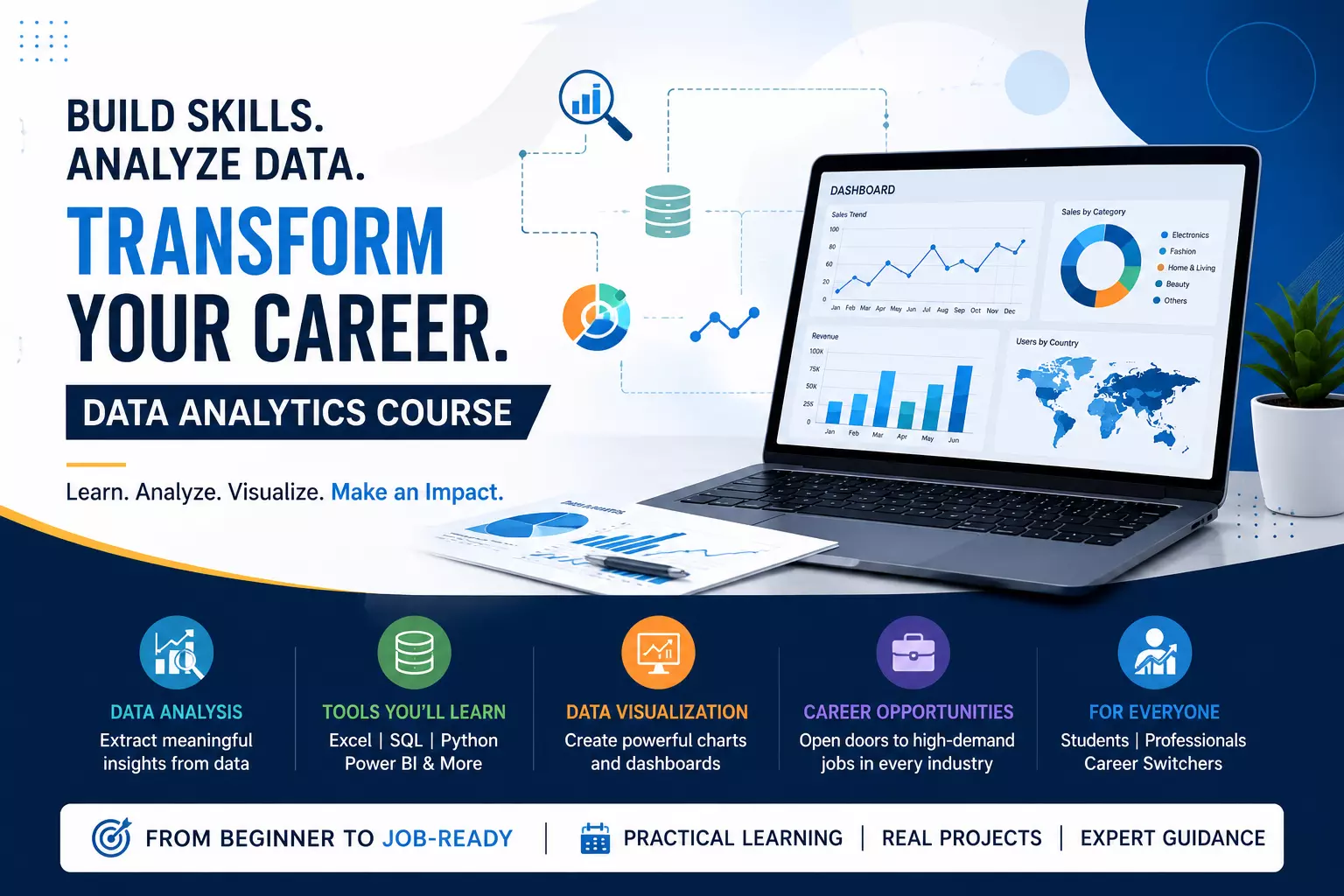
Learners can develop skills in areas such as Excel, SQL, Python, Power BI, data visualization, reporting, and dashboard development.
The focus of structured training should be to help learners understand how to approach a problem from the beginning—starting with the available data, preparing it properly, finding useful information, and finally presenting the results in a clear format.
Final Thoughts
Data analytics offers an interesting combination of technology, business understanding, and problem-solving. It allows professionals to work with information that can influence real decisions, rather than simply producing numbers for the sake of reporting.
For anyone planning to enter this field, a structured Data Analyst Course in Delhi can provide a clear learning path.
Starting with fundamentals and gradually developing skills in Excel, SQL, Python, Power BI, reporting, and visualization can help learners become more confident with real-world data.
The most important step, however, is consistent practice. Tools will continue to change, but the ability to ask meaningful questions, examine information carefully, and communicate useful findings will remain at the heart of good data analysis.