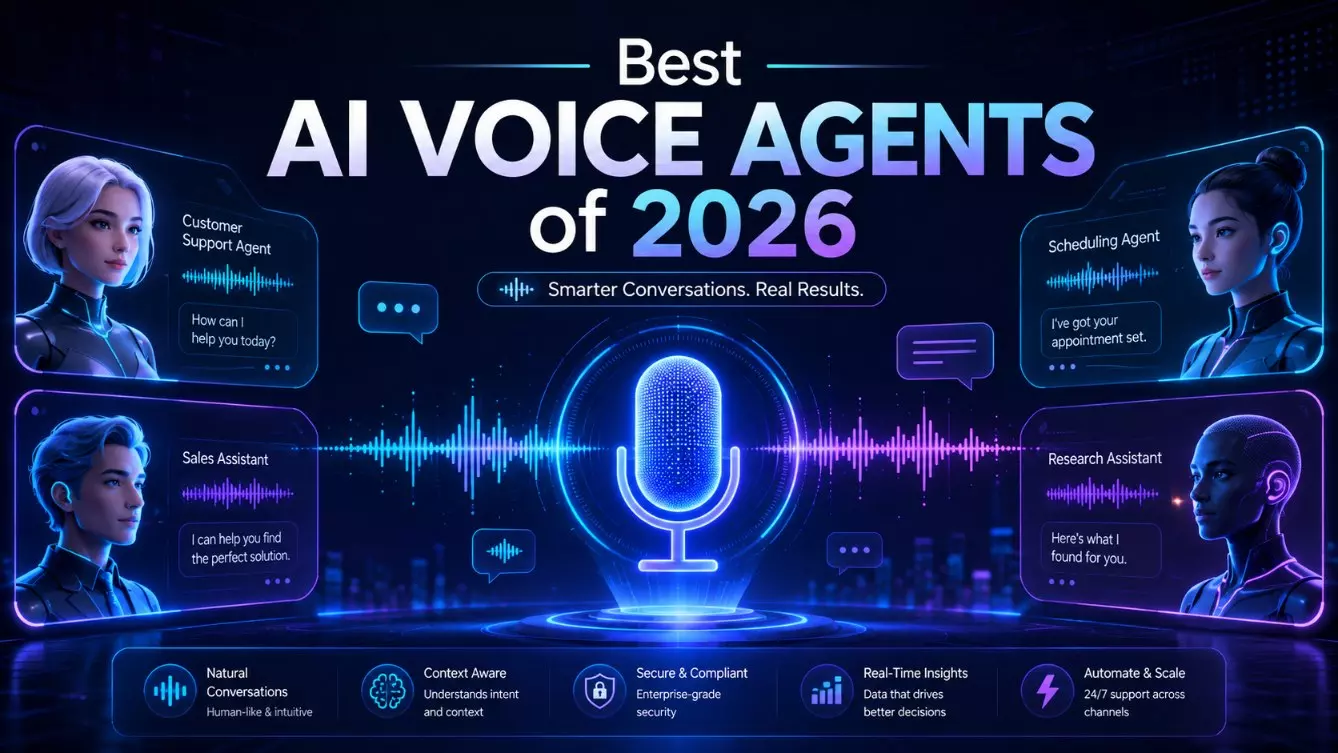
Best AI Voice Agents of 2026: Low Latency, Accuracy, and Reviews
In 2026, AI voice agents have become essential tools for businesses, customer service, and personal assistance.
These intelligent systems can understand, process, and respond to human speech in real-time, making communication faster and more efficient.
But with so many options available, how do you choose the best AI voice agent? Key factors to consider include low latency, accuracy, user reviews, and integration capabilities.
Low latency ensures responses are quick, creating a seamless conversational experience. Accuracy determines how well the AI understands your commands or questions, and reviews provide insight into real-world performance.
The leading AI voice agents of 2026, like Google’s Dialogflow CX, Microsoft’s Azure Cognitive Services, and Amazon’s Alexa for Business, combine these qualities effectively.
These platforms leverage advanced natural language processing (NLP), machine learning models, and cloud computing to offer reliable voice interactions.
Additionally, modern AI voice agents now support multiple languages, sentiment detection, and emotional recognition, enhancing the quality of customer interactions. They are also increasingly customizable, allowing businesses to train the agent for specific industry terminology, tone, and workflow automation.
What is an AI Call Center Agent?
An AI Call Center Agent is a virtual assistant powered by artificial intelligence that handles customer interactions over the phone or through chat.
These agents can answer queries, provide support, guide users through troubleshooting, and even process transactions without human intervention.
AI call center agents leverage speech recognition, text-to-speech (TTS), and machine learning algorithms to interact naturally with customers.
They can handle multiple calls simultaneously, reducing wait times and improving overall efficiency. For businesses, this means lower operational costs and better customer satisfaction.
Key benefits of AI call center agents include:
- 24/7 availability: They can operate around the clock without fatigue.
- Scalability: Capable of managing thousands of interactions simultaneously.
- Consistency: Provides uniform service quality every time.
- Data collection: Captures insights from customer conversations to improve service and sales strategies.
AI call center agents are particularly useful in industries like banking, e-commerce, healthcare, and telecom, where customer queries are frequent and repetitive.
By automating routine tasks, human agents can focus on complex problem-solving and personalized interactions.
What is Voice Agent Latency and How to Improve?
Voice agent latency is the delay between a user speaking and the AI responding. High latency disrupts communication, making conversations feel unnatural.
Low latency, on the other hand, ensures smooth, real-time interactions, crucial for call centers, virtual assistants, and real-time translation apps.
Factors contributing to voice agent latency include:
- Network delay: Slow internet or unstable connections increase response time.
- Processing time: Complex AI models require computation to interpret speech and generate responses.
- Data routing: Calls or requests routed through multiple servers can add delays.
How to improve voice agent latency:
- Optimize WebRTC Applications: WebRTC (Web Real-Time Communication) is widely used for real-time voice and video interactions. By reducing unnecessary signaling, compressing data, and using high-performance servers, WebRTC applications can achieve lower latency.
- Edge Computing: Processing requests closer to the user reduces travel time for data.
- Lightweight Models: Using AI models optimized for speed without sacrificing accuracy helps reduce processing delays.
- Load Balancing: Distributing traffic evenly across servers prevents bottlenecks.
- Monitoring and Analytics: Continuously track latency metrics to identify and fix issues quickly.
By addressing these factors, businesses can provide a more natural and satisfying experience to their users.
How to Reduce Latency in WebRTC Applications
WebRTC Applications are at the core of modern real-time communication, including AI voice agents. Reducing latency is critical for seamless interactions. Here are practical strategies:
- Optimize Media Streams: Adjust audio codecs, reduce bitrate, and use adaptive streaming for varying network conditions.
- Use UDP Protocols: UDP reduces overhead compared to TCP, allowing faster delivery of voice data.
- Implement Peer-to-Peer Connections: Direct connections between users reduce server round-trips and latency.
- Prioritize Voice Traffic: Network Quality of Service (QoS) settings can prioritize audio packets over less critical data.
- Server Placement: Deploy WebRTC servers geographically closer to users to minimize propagation delay.
Combining these strategies ensures that WebRTC applications deliver responsive voice communications suitable for customer support, telemedicine, and online education.
Choosing the Best AI Voice Agent in 2026
When selecting the best AI voice agent, consider these factors:
- Latency: Lower latency leads to faster and more natural conversations.
- Accuracy: Ability to recognize speech correctly and respond contextually.
- Customization: Can the agent be trained for your industry or brand?
- Integration: Does it connect with existing CRM, ERP, or helpdesk software?
- Scalability: Can it handle high volumes of simultaneous interactions?
- Security: Supports encrypted communications and protects customer data.
- Reviews: Real-world user feedback can highlight potential issues and strengths.
Popular AI voice agents like Google Dialogflow CX, Microsoft Azure Cognitive Services, Amazon Lex, and IBM Watson Assistant offer a mix of low latency, high accuracy, and extensive integration capabilities.
Enterprises often choose these platforms based on their existing tech ecosystem, global presence, and reliability.
Read: Top Voice AI Platforms Driving Customer Experience Innovation
Practical Tips to Improve Voice Agent Performance
- Continuous Training: Regularly update the AI with new data to improve understanding and reduce errors.
- Short, Clear Commands: Encourage users to speak clearly and in concise sentences.
- Error Handling: Implement fallback responses and human handoffs for complex queries.
- Regular Testing: Simulate real-world interactions to measure latency and accuracy.
- Feedback Loop: Collect user feedback to refine responses and enhance satisfaction.
Optimizing voice agent latency and accuracy improves not only efficiency but also user trust and engagement.
Frequently Asked Questions (FAQs)
What makes an AI voice agent different from a traditional IVR system?
Unlike traditional Interactive Voice Response (IVR) systems, AI voice agents understand natural language, context, and can provide dynamic responses instead of rigid menu-based interactions.
Can AI call center agents replace human agents entirely?
AI agents are ideal for repetitive tasks, FAQs, and initial customer interactions, but complex problem-solving and emotional support still benefit from human intervention.
Why is latency important for voice agents?
High latency disrupts conversation flow, making the interaction feel slow and frustrating. Low latency ensures natural, real-time communication.
How do WebRTC applications help in reducing latency?
WebRTC enables peer-to-peer connections and real-time audio/video streaming, reducing the time data travels between endpoints and servers.
How can I measure the performance of my AI voice agent?
Metrics like response time, latency, speech recognition accuracy, user satisfaction scores, and call resolution rates help evaluate performance effectively.
Conclusion:
The best AI voice agents of 2026 combine low latency, high accuracy, and reliable performance, enhancing customer interactions and business efficiency.
Understanding voice agent latency, optimizing WebRTC applications, and carefully selecting the right platform ensures seamless, human-like conversations.
As AI continues to advance, businesses leveraging these agents gain a competitive edge in customer service and operational efficiency.