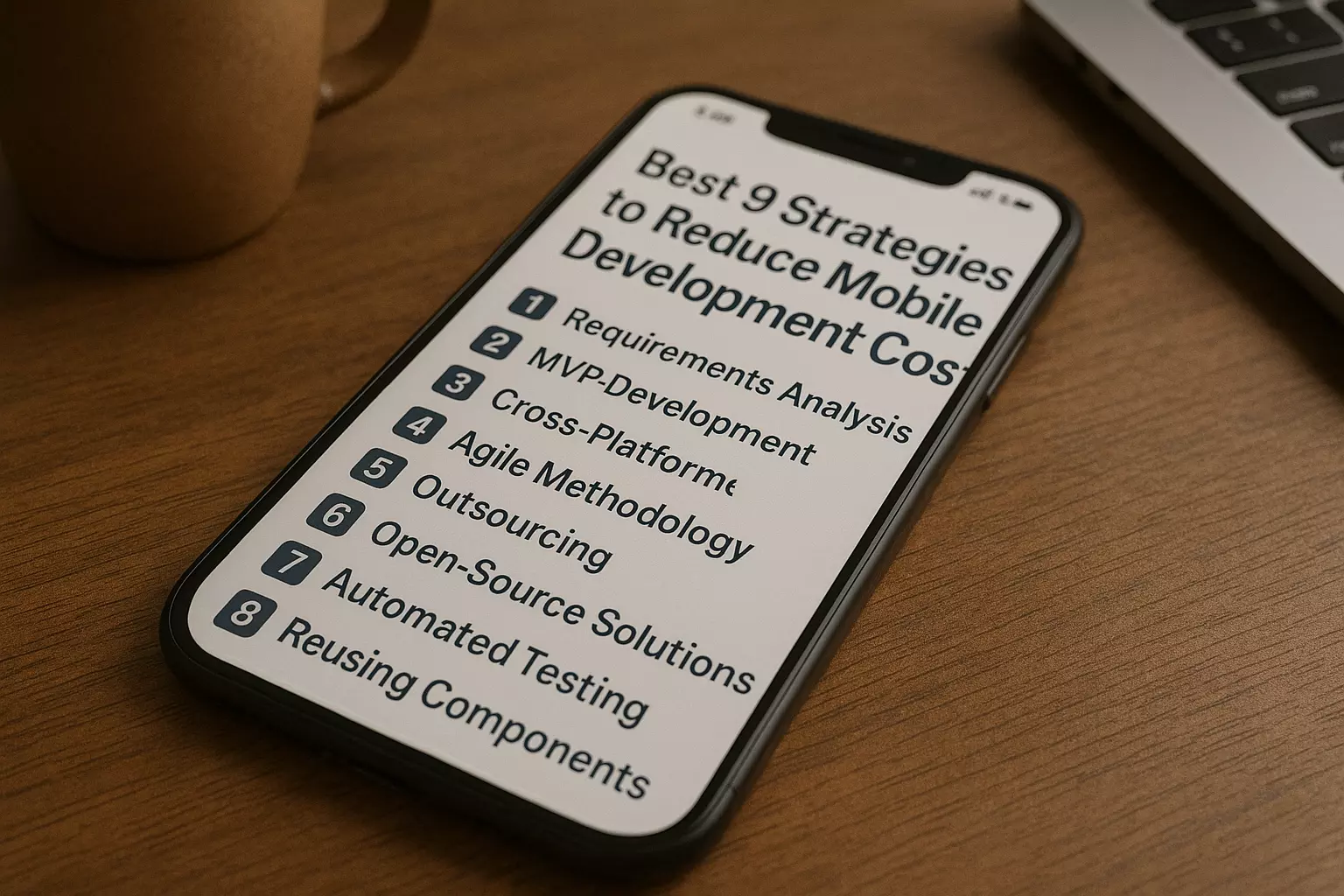
Best 9 Strategies to Reduce Mobile App Development Costs
Developing a mobile application is a significant investment for any business, whether it's a startup or an established enterprise. While the potential return on investment can be substantial, runaway costs can quickly derail a project.
For a Mobile App Development Company, optimizing expenditure without compromising quality is a constant balancing act. This article outlines nine effective strategies to significantly reduce mobile app development costs, ensuring a greater return on your investment.
1. Start with a Minimum Viable Product (MVP)
One of the most common pitfalls in app development is trying to build a feature-rich, perfect product from day one. This often leads to ballooning budgets and delayed launches. An MVP is a simplified version of your app with only the core functionalities necessary to solve a fundamental user problem and deliver value.
- How it saves costs:Reduced Initial Investment: By focusing on essential features, you drastically cut down the initial development time and resources.
- Early Market Validation: An MVP allows you to launch faster, gather real user feedback, and validate your core idea before investing heavily in non-essential features. This prevents costly redesigns or even abandoning a concept that lacks market demand.
- Iterative Development: Feedback from the MVP can guide subsequent feature additions, ensuring that every new development addresses a proven user need, avoiding wasted effort on unwanted functionalities.
2. Define Clear Requirements and Scope
Ambiguity is the enemy of cost-efficiency in software development. Vague requirements and a constantly shifting project scope (often known as "scope creep") are major contributors to budget overruns.
- How it saves costs:Prevent Rework: Detailed documentation of features, user flows, and technical specifications minimizes misunderstandings between stakeholders and the development team. This reduces the need for costly reworks later in the development cycle.
- Accurate Estimations: Clear requirements enable a Mobile App Development Company to provide more accurate time and cost estimates, leading to better budget management.
- Controlled Scope: A well-defined scope acts as a contract, preventing uncontrolled feature additions that can extend timelines and inflate costs. Any new feature requests can then be properly evaluated for their impact on the budget and schedule.
3. Opt for Cross-Platform Development
Building separate native applications for iOS and Android can double development efforts, time, and cost. Cross-platform development frameworks allow you to write a single codebase that can be deployed on multiple operating systems.
- How it saves costs:Single Codebase: Developing and maintaining one codebase instead of two significantly reduces development hours, testing efforts, and ongoing maintenance costs.
- Wider Audience Reach: You can target both major mobile platforms simultaneously, reaching a broader user base with a single investment.
- Faster Time-to-Market: With one development cycle, your app can be released to both app stores much quicker.
- Considerations: While typically more cost-effective, complex apps requiring deep native integrations or extremely high performance might still benefit from native development. However, for most business applications, modern cross-platform frameworks like Flutter, React Native, and .NET MAUI offer excellent performance and user experience.
4. Leverage Open-Source Tools and Libraries
The open-source community provides a vast ecosystem of free and readily available tools, libraries, and frameworks that can be integrated into your app, eliminating the need to build every component from scratch.
- How it saves costs:Reduced Development Time: Utilizing pre-built components for common functionalities (e.g., authentication, payment gateways, analytics, UI elements) saves significant development time and effort.
- Lower Licensing Fees: Avoids the costs associated with proprietary software licenses.
- Community Support: Open-source projects often have active communities that provide support, documentation, and regular updates, reducing reliance on paid third-party support.
- Considerations: While beneficial, always ensure the chosen open-source solutions are well-maintained, secure, and compatible with your project's technology stack.
5. Prioritize UI/UX Simplicity
A complex, highly customized, and animation-rich user interface (UI) and user experience (UX) can significantly drive up development costs. While a great UI/UX is crucial for success, simplicity can often be more effective and cost-efficient.
- How it saves costs:Fewer Design Hours: Simpler designs require less time from UI/UX designers and are quicker for developers to implement.
- Reduced Development Complexity: Fewer custom animations, intricate transitions, and complex interactions translate to less coding and fewer potential bugs.
- Faster Loading Times: Simple UIs often lead to lighter apps that load faster and perform better, enhancing user satisfaction.
- Ease of Use: A clean and intuitive interface often improves user adoption and reduces the need for extensive tutorials or support.
- Strategy: Focus on intuitive navigation, clear calls to action, and a minimalist aesthetic that highlights core functionalities without overwhelming the user.
6. Implement Agile Development Methodology
The Agile methodology, characterized by iterative development cycles (sprints), continuous feedback, and flexible planning, is highly effective in managing costs and ensuring project success.
- How it saves costs:Early Issue Detection: Regular sprints and frequent testing mean bugs and inconsistencies are identified and fixed early, when they are cheapest to resolve.
- Adaptability to Change: Agile allows for flexibility in adapting to market changes or new user feedback without derailing the entire project, avoiding costly reworks.
- Transparent Progress: Stakeholders have continuous visibility into the development process, fostering better communication and preventing misalignments that can lead to wasted effort.
- Efficient Resource Allocation: Resources are allocated based on current priorities, ensuring optimal use of the development team's time.
7. Strategic Outsourcing
For many businesses, building an in-house mobile app development team can be prohibitively expensive due to recruitment costs, salaries, benefits, and infrastructure. Strategic outsourcing to a specialized Mobile App Development Company can offer a highly cost-effective alternative.
- How it saves costs:Access to Skilled Talent: Outsourcing provides access to a global pool of skilled developers and designers at competitive rates.
- Reduced Overhead: Eliminates the need for hiring, training, and managing an in-house team, along with associated office space and equipment costs.
- Scalability: Easily scale your development resources up or down based on project needs, without the long-term commitments of full-time employees.
- Focus on Core Business: Allows your internal team to focus on their core competencies while the app development is handled by experts.
- Considerations: When outsourcing, prioritize clear communication channels, transparent project management, and a reputable partner with a proven track record.
8. Automate Testing and Quality Assurance (QA)
Manual testing can be time-consuming and prone to human error, especially as an app grows in complexity. Investing in automated testing frameworks significantly reduces the cost and time associated with quality assurance.
- How it saves costs:Faster Testing Cycles: Automated tests can be run quickly and repeatedly, allowing for more frequent testing throughout development.
- Early Bug Detection: Identifying bugs early in the development cycle (e.g., through unit tests, integration tests) is much cheaper than fixing them after release.
- Consistent Quality: Automated tests ensure consistent quality across different app versions and device types.
- Reduced Manual Effort: Frees up QA engineers to focus on more complex exploratory testing.
- Tools: Utilize tools like Selenium, Appium, Espresso (Android), XCUITest (iOS), and integrated testing frameworks within Flutter and React Native.
Read: Trusted Mobile App Development Professionals in Pune
9. Plan for Post-Launch Maintenance and Updates
While not directly a development cost reduction strategy, factoring in post-launch maintenance from the outset can prevent significant unforeseen expenses down the line. A poorly maintained app can lead to escalating bug fixes, security vulnerabilities, and ultimately, user churn.
- How it saves costs:Proactive Bug Fixing: Regular updates and monitoring can address minor issues before they escalate into major problems requiring extensive and costly overhauls.
- Security Patches: Timely security updates protect your app from vulnerabilities and potential data breaches, which can incur massive financial and reputational damage.
- OS Compatibility: Ensuring your app remains compatible with new operating system versions avoids forced, expensive re-development later.
- User Retention: A well-maintained app with regular feature enhancements keeps users engaged, reducing the cost of acquiring new users.
- Strategy: Allocate a portion of your initial budget for ongoing maintenance, support, and future updates. A reputable Mobile App Development Company will include this in their project planning.
Conclusion
Reducing mobile app development costs isn't about cutting corners; it's about smart planning, strategic choices, and efficient execution. By embracing strategies such as starting with an MVP, defining clear requirements, opting for cross-platform development, leveraging open-source tools, prioritizing UI/UX simplicity, adopting Agile methodologies, strategically outsourcing, automating testing, and planning for post-launch maintenance, businesses can significantly optimize their investment.
These practices empower a Mobile App Development Company to deliver high-quality, impactful applications within budget, ensuring long-term success in the dynamic mobile market.