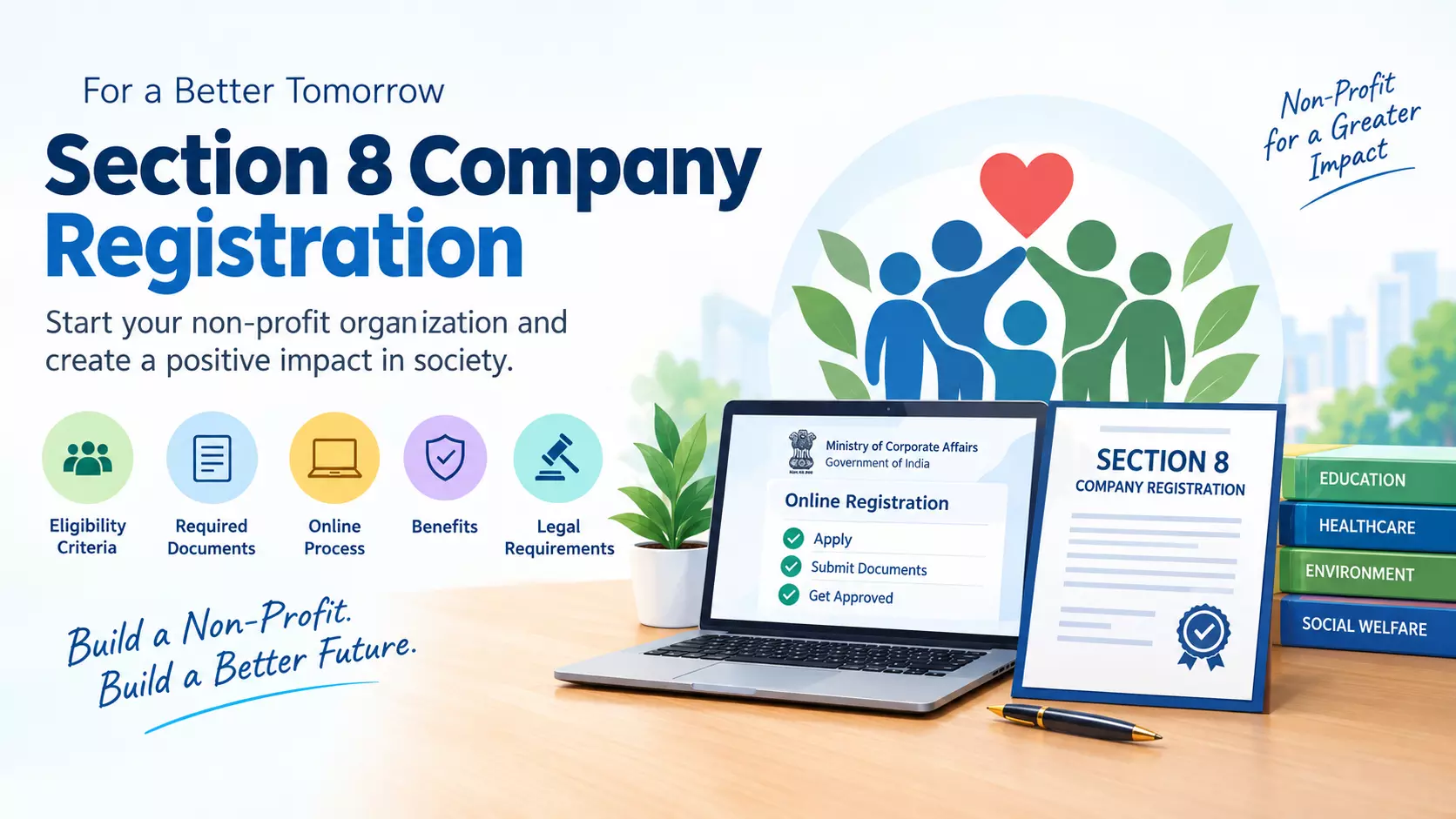
Benefits of Section 8 Company Registration for NGOs and Non-Profit Organizations
Starting a non-profit organization is an important step toward creating positive social change.
Whether the objective is to promote education, support underprivileged communities, improve healthcare, protect the environment, or empower women, choosing the right legal structure is essential for long-term success.
In India, Section 8 Company Registration is a popular option for individuals and groups seeking to establish a legally recognized non-profit organization.
A Section 8 Company is formed under Section 8 of the Companies Act, 2013, to promote charitable and socially beneficial objectives.
Unlike conventional companies that distribute profits among shareholders, a Section 8 Company must apply its profits and income toward its stated objectives and cannot distribute dividends to its members.
For NGOs, charitable institutions, and other non-profit organizations, this structure offers several advantages, including a formal legal identity, improved credibility, organized governance, and opportunities to work with donors and institutional partners.
What Is Section 8 Company Registration?
Section 8 Company Registration is the legal process of incorporating a non-profit company in India under the Companies Act, 2013.
Such companies may be established to promote activities such as education, science, art, sports, research, social welfare, environmental protection, charity, and other similar objectives.
A Section 8 Company can be registered as a company limited by shares or a company limited by guarantee, subject to applicable legal requirements. Its primary purpose must be to advance its approved objectives rather than generate profits for private distribution.
One of the key features of a Section 8 Company is that its income and profits must be used to further its objectives. Members cannot receive dividends from the company's profits.
This structure is suitable for founders who want to build a professionally managed non-profit organization with a clear legal framework and defined responsibilities.
Key Benefits of Section 8 Company Registration for NGOs
1. Separate Legal Identity
One of the most significant benefits of Section 8 Company Registration is that the organization receives a separate legal identity after incorporation.
This means the company can operate in its own name, maintain a bank account, enter into contracts, acquire or hold property where legally permitted, and conduct activities independently of its individual members.
A separate legal identity also helps establish clear distinctions between the organization's assets, obligations, and the personal affairs of its founders or members. This can support continuity when office-bearers or directors change.
For NGOs planning to expand their activities, work with institutional partners, or manage multiple projects, this legal structure provides an organized foundation.
2. Greater Credibility and Public Trust
Trust is essential for every non-profit organization. Donors, volunteers, beneficiaries, and institutional partners generally want to understand how an organization is managed and whether its activities are transparent.
A Section 8 Company is incorporated through a formal process and must comply with applicable company-law requirements. Its governance structure includes directors, defined objectives, statutory records, and prescribed reporting obligations.
These features can help demonstrate organizational seriousness and accountability.
For example, an NGO working in rural education may find it easier to present its legal status, governance arrangements, and financial records when approaching corporate donors or institutional partners.
However, incorporation alone does not guarantee funding or public trust. An organization must also maintain transparent accounts, follow applicable laws, and demonstrate the actual impact of its work.
3. No Minimum Paid-Up Capital Requirement
Another important advantage is that a Section 8 Company does not have a prescribed minimum paid-up share capital requirement under the Companies Act, 2013.
This can make the structure accessible to founders who want to establish a non-profit organization without meeting a fixed minimum capital threshold.
The organization must still have adequate financial resources to conduct its activities, meet incorporation expenses, maintain statutory compliance, and support its stated objectives.
The absence of a minimum paid-up capital requirement should therefore not be confused with an absence of financial responsibilities.
4. Opportunities to Receive Donations and Grants
A registered non-profit organization may approach individuals, charitable foundations, companies, and institutional donors for financial support, subject to applicable eligibility and compliance requirements.
Section 8 Company Registration provides a formal legal structure that can help an NGO document its activities, maintain accounts, and demonstrate its organizational identity to potential donors.
Organizations may also explore eligible government schemes, institutional grants, and corporate social responsibility (CSR) funding opportunities.
However, Section 8 registration does not automatically qualify an organization for tax-exempt donations, government grants, or CSR funding.
Additional registrations, approvals, eligibility conditions, and due diligence may apply.
For example, tax exemptions and donor deductions may require separate approval under the relevant provisions of the Income-tax Act, while eligibility for CSR funding depends on applicable rules and conditions.
5. Potential Eligibility for Tax Benefits
Tax efficiency is an important consideration for non-profit organizations. A Section 8 Company may be able to apply for relevant income-tax registrations or approvals if it meets the prescribed conditions.
For example, eligible organizations may seek registration under Section 12AB to obtain tax exemption on qualifying income, subject to compliance with the applicable provisions of the Income-tax Act.
Similarly, eligible organizations may apply for approval under Section 80G, which can allow donors to claim deductions for qualifying donations in accordance with tax law.
These benefits are not automatic upon incorporation. The organization must meet the relevant conditions, obtain the necessary approvals, maintain appropriate records, and comply with applicable filing requirements.
Founders should assess their intended activities and funding model before applying for tax-related registrations.
6. Better Governance and Accountability
Effective governance is vital for an NGO that handles public donations, grants, or community projects. A Section 8 Company operates within a defined corporate governance framework.
Its directors are responsible for overseeing the organization's affairs, ensuring that activities remain aligned with its objectives, and meeting applicable statutory obligations.
The company must maintain prescribed records and comply with relevant filing, accounting, audit, and reporting requirements.
This framework encourages more systematic decision-making and financial accountability. It can also help reduce confusion about responsibilities among founders, directors, and other stakeholders.
For organizations that expect to grow, governance practices established at the beginning can make it easier to manage projects and maintain consistent standards as operations expand.
7. No Distribution of Profits to Members
Instead, income and profits must be applied toward promoting the organization's stated objectives, subject to applicable law.
This requirement helps distinguish a genuine non-profit organization from a conventional commercial enterprise.
For example, if an organization earns income from permitted activities or receives donations for educational projects, the funds must be managed and used in accordance with its objectives and legal obligations.
This restriction can also help reassure donors and partners that the organization is structured to pursue its mission rather than provide private financial returns to its members.
8. Perpetual Succession and Operational Continuity
A Section 8 Company has a continuing legal existence, independent of changes in its individual members or directors.
If a founder resigns, a director changes, or a member leaves, the company's legal identity does not automatically come to an end.
This continuity can be valuable for NGOs working on long-term projects, such as school development, healthcare initiatives, environmental conservation, or community welfare programmes.
It also helps an organization preserve its institutional records, relationships, assets, and ongoing commitments despite changes in leadership.
9. Opportunities to Build Corporate and Institutional Partnerships
Companies, foundations, and other institutions often assess an NGO's legal status, governance, financial management, and eligibility before entering into partnerships.
Section 8 Company Registration can provide a structured legal foundation for presenting these details.
Eligible organizations may explore partnerships involving CSR initiatives, employee volunteering, community development, research, education, and other social-impact activities.
The company structure can also support formal agreements and project documentation.
Nevertheless, a Section 8 Company must meet the relevant CSR eligibility conditions and any other requirements imposed by the funding organization. Incorporation by itself does not guarantee a corporate partnership.
10. Suitable for Long-Term Social Impact Projects
Many NGOs aim to achieve results over several years rather than through one-time charitable activities.
Section 8 Company Registration can support this objective by providing a formal structure for planning, governance, financial management, and organizational continuity.
For instance, an NGO focused on skill development can establish defined programmes, maintain project records, enter into permitted partnerships, and track the use of funds.
A formal structure may also help the organization communicate its objectives and activities more clearly to stakeholders.
When supported by sound management and transparent reporting, this can contribute to a more sustainable approach to social development.
Read: Hassle-Free GST Registration Services Online
Who Should Consider Section 8 Company Registration?
Section 8 Company Registration may be appropriate for:
- NGOs working in education, healthcare, poverty alleviation, or community development.
- Charitable organizations promoting social welfare and public benefit.
- Organizations supporting environmental protection and sustainability.
- Institutions working in science, research, art, culture, or sports.
- Social enterprises whose primary objectives qualify under Section 8.
- Founders seeking a structured, professionally governed non-profit organization.
The most suitable legal structure depends on the organization's objectives, management plans, funding requirements, and compliance capacity. In some cases, a public charitable trust or registered society may be more appropriate.
Basic Requirements for Section 8 Company Registration
Before starting the registration process, founders should understand the principal requirements.
1. Charitable or qualifying objectives: The proposed organization must have eligible objectives, such as promoting education, social welfare, charity, research, or environmental protection.
2. Members and directors: The number of members and directors depends on the type of company being incorporated and the applicable legal requirements.
3. Constitutional documents: The organization must prepare its Memorandum of Association (MOA) and Articles of Association (AOA), setting out its objectives and governance rules.
4. Identity and address documents: Required documents generally include identity and address proofs of the proposed directors and subscribers, together with applicable registered-office documentation.
5. Incorporation application: The prescribed application and supporting documents must be submitted to the Ministry of Corporate Affairs (MCA) through the applicable incorporation process.
The exact documentation and procedure may vary according to the proposed structure and the circumstances of the applicants.
Conclusion
Section 8 Company Registration offers a valuable legal framework for NGOs and non-profit organizations seeking to build credibility, establish clear governance, and pursue charitable or socially beneficial objectives in India.
Its key benefits include a separate legal identity, no prescribed minimum paid-up capital requirement, organizational continuity, structured accountability, and opportunities to approach eligible donors and institutional partners.
Eligible organizations may also pursue separate tax registrations and approvals where applicable.
However, registration is only the first step. Long-term success depends on responsible governance, transparent financial management, compliance with statutory requirements, and a genuine commitment to the organization's mission.
Founders should carefully evaluate their objectives and operational needs before choosing a legal structure.
With appropriate planning and compliance support, a Section 8 Company can provide a strong foundation for creating meaningful and sustainable social impact.