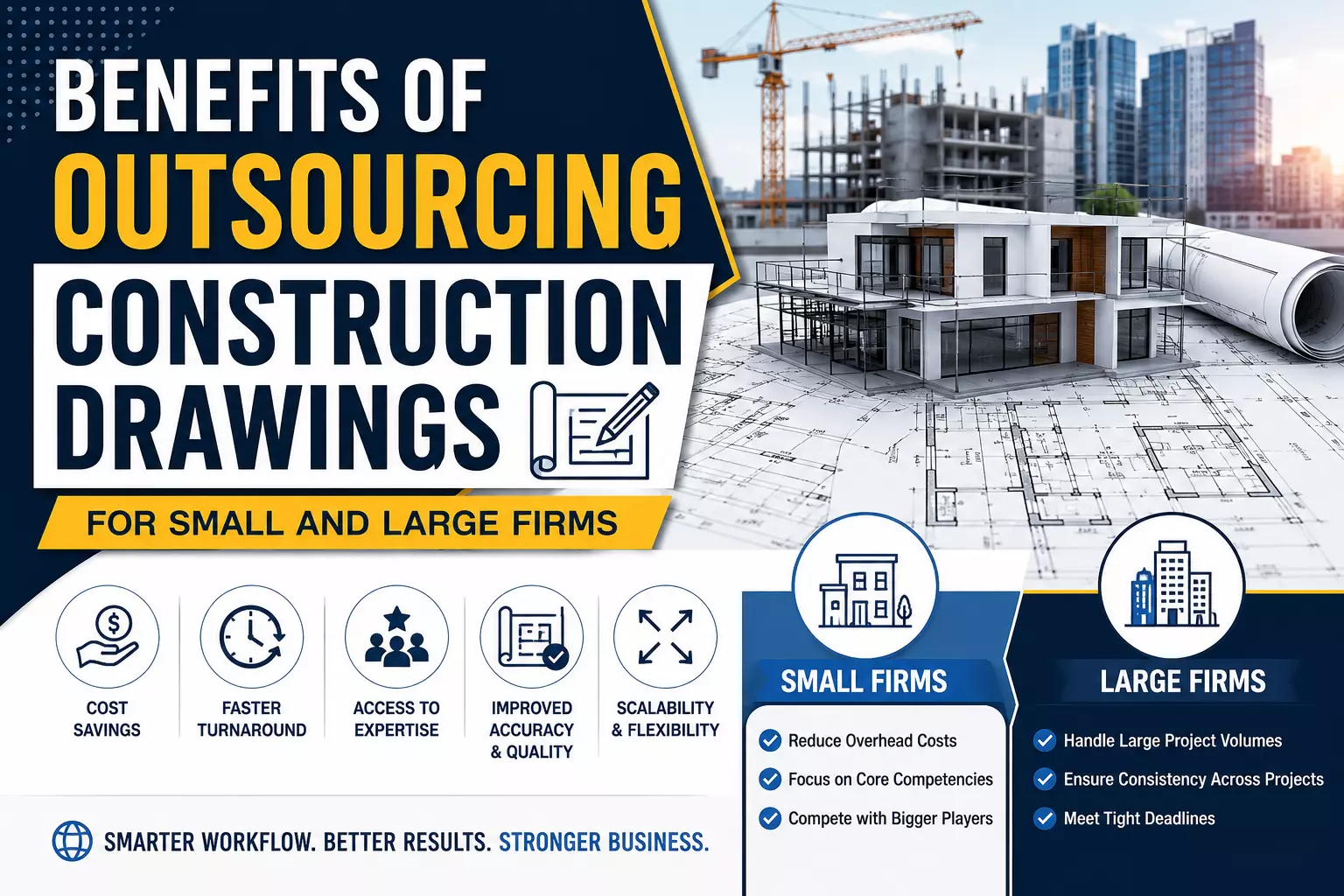
Benefits of Outsourcing Construction Drawings for Small and Large Firms
Outsourcing construction drawings helps both small and large firms reduce overhead costs, access specialized CAD/BIM expertise, and scale their workforce based on project demand—without the burden of fixed staffing costs or software investments.
Archdraw Outsourcing is one provider helping firms of all sizes unlock these advantages.
Construction projects are getting more complex. Tighter deadlines, stricter compliance requirements, and the growing adoption of Building Information Modeling (BIM) have raised the bar for what quality construction documentation looks like. For many firms, keeping up with that demand in-house is expensive, slow, and unsustainable.
Outsourcing construction drawings has emerged as a practical solution—not just for cost-cutting, but as a genuine strategic move.
Whether you run a small residential firm or manage a large commercial operation, delegating your drawing production to a specialized partner can free up capacity, sharpen quality, and improve your bottom line.
This post breaks down exactly how that works, and what to look for when choosing the right outsourcing partner.
What Are Construction Drawings, and Why Do They Matter?
Construction drawings are the technical documents that guide every stage of a build. They span several disciplines: architectural drawings define the spatial layout and aesthetics; structural drawings specify the load-bearing systems; and MEP (mechanical, electrical, and plumbing) drawings detail the building's service infrastructure.
Together, these documents govern planning, procurement, execution, and final handover. When they're accurate, projects run smoothly.
When they're not, the consequences are serious—rework, budget blowouts, safety risks, and legal disputes. The quality of your drawings isn't just a documentation issue; it directly affects project outcomes.
The Core Benefits of Outsourcing Construction Drawings
How does outsourcing reduce costs for construction firms?
The most immediate benefit is cost reduction. Hiring full-time drafters means paying salaries, benefits, and training costs—plus software licenses for tools like AutoCAD, Revit, and Navisworks, which can run into thousands of dollars annually.
Outsourcing converts these fixed costs into project-based expenditure, so you only pay for what you need, when you need it.
Firms also gain access to global talent pools, where competitive pricing doesn't mean compromised quality. Providers like Archdraw Outsourcing leverage skilled teams in cost-effective regions, passing those savings directly to clients.
Can outsourcing speed up drawing production and turnaround times?
Yes—and significantly. Outsourcing partners operating across different time zones can work while your local team is offline, creating a near 24/7 production cycle. A set of drawings submitted at the end of your business day can be ready for review the next morning.
Beyond time zones, specialized outsourcing firms have refined workflows built specifically around drawing production. They're not juggling site visits, client calls, or project management—they're focused entirely on delivering accurate documents, fast.
What specialized expertise do outsourcing partners bring to the table?
Outsourcing firms invest heavily in staying current. That means up-to-date software, certified BIM professionals, and teams with experience across diverse project types—from healthcare facilities to high-rise commercial developments.
For firms without the budget to maintain that expertise in-house, partnering with a provider like Archdraw Outsourcing offers access to skills that would otherwise be out of reach.
How does outsourcing support scalability during peak project periods?
Staffing for peak demand is a familiar headache. Hiring ahead of a busy period means carrying overhead when work slows down; hiring reactively means falling behind. Outsourcing solves this by letting firms scale their drawing capacity up or down based on actual project load—no over-hiring, no redundancies.
Specific Benefits for Small Construction Firms
Small firms often face a straightforward constraint: limited resources competing against larger, better-equipped rivals. Outsourcing construction drawings helps level that playing field.
By avoiding the upfront investment in software, hardware, and specialized staff, small firms can redirect capital toward business development and client relationships. They can also bid on larger, more complex projects—confident that their drawing output will meet the required standard—without building out an in-house team to support that ambition.
The operational benefit is equally valuable. When principals and project managers aren't bogged down in documentation, they can focus on what drives growth: site coordination, client satisfaction, and winning new work.
Specific Benefits for Large Construction Firms
For large firms, the logic is different—but equally compelling. At scale, the challenge isn't access to resources; it's allocating them effectively. Outsourcing routine or high-volume drawing tasks frees senior in-house staff to focus on strategic work: design leadership, client advisory, and complex problem-solving.
There's also a risk dimension. Over-reliance on a single internal team creates vulnerability. Staff turnover, illness, or unexpected departures can stall a project mid-stream. Distributing drawing production across an outsourcing partner reduces that dependency and ensures continuity.
Large firms also benefit from the fresh perspectives and diverse methodologies that external teams bring. Exposure to international standards and varied project types often surfaces quality improvements that internal teams—working within established habits—might miss.
Challenges to Anticipate (and How to Address Them)
Outsourcing construction drawings isn't without its considerations. Communication across time zones and cultures requires clear protocols—defined briefing templates, regular check-ins, and shared project management platforms like Procore or BIM 360.
Quality control is another common concern. The solution is upfront rigor: detailed specifications, phased reviews, and pilot projects before full engagement. Reputable providers will welcome this structure.
Data security and intellectual property must also be addressed contractually. NDAs, secure file transfer systems, and clearly defined ownership clauses should be standard in any outsourcing agreement.
Read: High-Quality 2D Drafting Services for Construction & Design
How to Choose the Right Outsourcing Partner for Construction Drawings
Not all outsourcing providers are equal. When evaluating options, look for:
- A strong portfolio with experience across your project types and scales
- Software proficiency in the tools your firm uses (AutoCAD, Revit, BIM, etc.)
- Robust QA processes with clearly defined revision and sign-off procedures
- Responsive communication and collaboration through shared platforms
- Verified references from firms similar to yours in size and scope
Archdraw Outsourcing, for example, combines technical expertise with dedicated client management—making the transition from in-house to outsourced drawing production straightforward and low-risk.
Make Outsourcing Work for Your Firm
Outsourcing construction drawings has moved well beyond a cost-cutting measure. For small firms, it's a growth enabler. For large firms, it's an efficiency tool. For both, it's a way to stay competitive as project complexity and client expectations continue to rise.
The key is treating it as a strategic partnership, not a transactional arrangement. Choose a provider with the right expertise, establish clear processes from the outset, and you'll quickly see the returns—in faster turnaround times, improved drawing quality, and a team that's freed up to focus on what they do best.
Frequently Asked Questions
What types of construction drawings can be outsourced?
Most drawing types can be outsourced, including architectural, structural, and MEP drawings, as well as shop drawings, as-built documentation, and BIM modeling. The right outsourcing partner will have expertise across all major disciplines and software platforms.
Is outsourcing construction drawings suitable for small firms with limited budgets?
Small firms are often the biggest beneficiaries. Outsourcing eliminates the need for costly software licenses and full-time drafting staff, converting fixed overhead into flexible, project-based costs. This makes high-quality drawing production accessible without significant capital investment.
How do I protect my project data when outsourcing construction drawings?
Work with providers who offer formal NDAs, use secure file transfer systems, and have documented data protection policies. Ensure your contract includes clear clauses on intellectual property ownership before any work begins.
How long does it take to onboard an outsourcing partner for construction drawings?
Onboarding timelines vary, but most reputable firms—including Archdraw Outsourcing—can begin production within days of a completed briefing. A structured pilot project is a good way to test compatibility before committing to a larger engagement.
What's the difference between outsourcing and hiring a freelance drafter?
Freelancers offer flexibility but typically work individually, which limits capacity and introduces key-person risk. Outsourcing firms provide a full team, formal QA processes, software infrastructure, and consistent availability—making them a more reliable choice for ongoing or high-volume drawing needs.