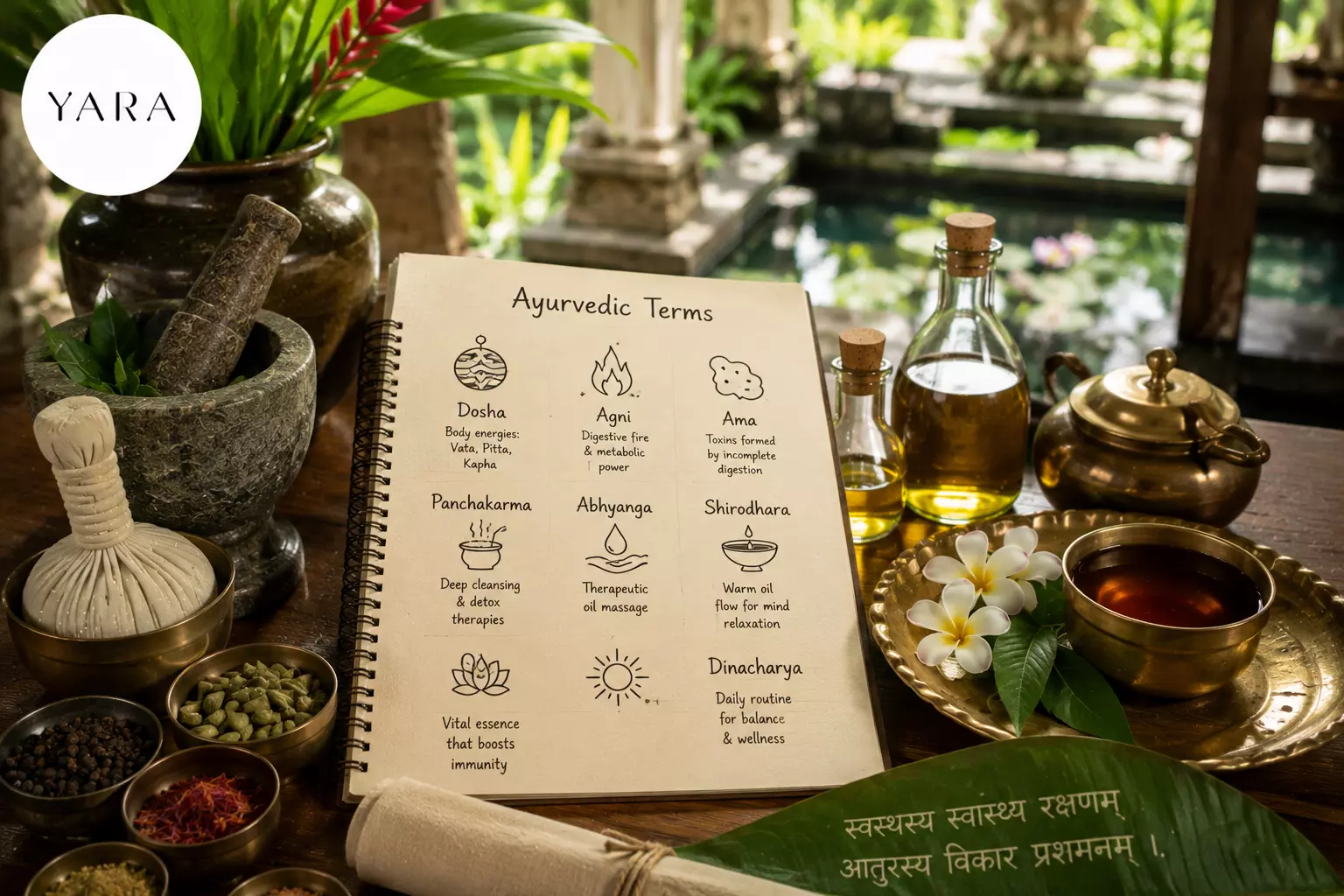
Ayurvedic Healing Therapies in Bali: A Beginner's Glossary of Terms
Booking your first Ayurvedic healing therapy in Bali often means running into a wall of unfamiliar Sanskrit terms within the first five minutes of a consultation.
Dosha, agni, Virechana, Shirodhara — the vocabulary alone can make a genuinely simple conversation feel intimidating, and it's easy to nod along without fully understanding what's actually being recommended for you.
This glossary exists to close that gap. Rather than a random alphabetical list, it's organised by how these terms actually build on each other, starting with the foundational concepts, moving through the doshas, the classical therapies, and the individual treatments you'll see on a retreat menu, right through to a few terms worth double-checking before you book.
Keep this open during your first consultation if you need to, or read it beforehand so you walk in already speaking the same language as your practitioner.
Foundational Concepts You'll Hear First
Ayurveda refers to the broader traditional medical system this entire practice comes from, originating in India thousands of years ago and documented in classical texts. Everything else in this glossary, including Panchakarma treatment in Bali, sits underneath this larger system.
Dosha describes one of the three fundamental energies — vata, pitta, and kapha — believed to govern physical and mental processes in the body. Every consultation for Ayurvedic healing therapies in Bali starts here, since your dosha shapes which therapies and diet actually suit you.
Prakriti is your natural, baseline constitution — the dosha balance you were essentially born with. Vikriti, by contrast, is your current state of imbalance, which can shift due to stress, travel, diet, or season, and often differs from your prakriti. Practitioners assess both, since your prakriti sets the baseline while your vikriti tells them what actually needs treating right now.
Agni refers to digestive fire, the body's capacity to properly process food and, by extension, generate energy. Weak or irregular agni is considered a major contributing factor behind everything from fatigue to skin issues.
Ama is the term for toxins believed to accumulate in the body, often as a result of weak agni failing to fully digest food and experience. Much of Panchakarma exists specifically to clear ama before other treatment can be fully effective.
Ojas describes the body's core reserve of vitality and resilience. Depleted ojas is often cited as a root cause of chronic fatigue and low immunity, and rebuilding it is a central goal of longer-term Ayurvedic treatment.
Dinacharya is the concept of daily routine — waking, eating, and sleeping at consistent times aligned with the body's natural rhythms. Retreats build their daily schedules around this principle, and it's often the single practice guests are encouraged to continue once they're home.
The Three Doshas, Explained Simply
Vata governs movement, circulation, and the nervous system. When imbalanced, it tends to show up as anxiety, dry skin, irregular digestion, and disrupted sleep, and it responds well to warmth, routine, and grounding treatment.
Pitta governs metabolism, digestion, and transformation. Imbalance here often looks like irritability, inflammation, acidity, and skin flare-ups, and it calls for cooling, calming therapies rather than anything intense or stimulating.
Kapha governs structure, lubrication, and immunity. Excess kapha tends to present as sluggishness, congestion, and heaviness, and it typically responds best to stimulating, more active treatment.
Read: Best Ayurveda Diabetes Doctors in India – Heal Wellness
Panchakarma Phases You'll Move Through
Purvakarma is the preparatory phase of a Panchakarma program, generally lasting three to seven days and involving oil massage and steam therapy to loosen toxins before the main treatment begins.
Snehana refers specifically to the oleation portion of Purvakarma — daily oil massage, and sometimes small internal doses of medicated ghee, meant to soften tissue in preparation for purification.
Swedana is herbal steam therapy, typically paired with Snehana to further open the body's channels ahead of the main treatment phase.
Paschatkarma is the recovery and reintegration phase that follows the main purification therapy, where food and normal activity are gradually reintroduced. Rushing this phase is one of the most common mistakes first-timers make.
The Five Classical Panchakarma Therapies
Vamana is therapeutic vomiting, used to clear excess kapha, generally reserved for clinical settings rather than a typical wellness retreat.
Virechana is purgation therapy, used to clear excess pitta, and it's one of the more commonly offered core therapies in Panchakarma treatment in Bali.
Basti refers to medicated enemas, used to address vata imbalance, and it's considered one of the most important therapies in the entire Panchakarma system given how strongly vata is believed to reside in the colon.
Nasya is the administration of medicated oils or herbs through the nose, used to treat head, sinus, and nervous system-related concerns, and it comes in gentler (Snehana) and stronger, more cleansing (Virechana) forms.
Raktamokshana is bloodletting therapy, historically used for certain blood-related skin conditions, though it's rarely offered outside a clinical setting today.
Common Individual Treatments You'll See on a Retreat Menu
Abhyanga is the classical full-body warm oil massage, used as a foundational therapy across nearly every kind of Ayurvedic treatment, from general relaxation to targeted support for pain, fatigue, or anxiety.
Shirodhara involves a continuous, slow stream of warm oil poured across the forehead, primarily used for calming the nervous system and easing a racing or overactive mind.
Udvartana is a dry, stimulating herbal powder massage, generally used for kapha-related sluggishness or as part of a detox-focused treatment plan.
Kati Basti, Janu Basti, and Greeva Basti are localized oil-retention therapies, where warm medicated oil is pooled within a dough boundary over the lower back, knee, or neck respectively, typically used for chronic, localized pain in that specific area.
Rasayana refers to rejuvenative therapy, often involving specific herbal tonics and formulations aimed at rebuilding depleted ojas over a sustained period, frequently continued well beyond a retreat stay.
Program and Practitioner Terms Worth Knowing
BAMS stands for Bachelor of Ayurvedic Medicine and Surgery, the formal medical qualification held by properly trained Ayurvedic practitioners, typically earned through years of study in India. This is worth asking about directly when evaluating any Ayurvedic retreat in Bali.
Sattvic describes food that's fresh, light, and easy to digest, forming the basis of most meal plans during treatment. Kitchari, a spiced combination of rice and mung dal, is the signature sattvic dish you'll encounter throughout most programs.
Dosha assessment or consultation refers to the intake process every legitimate program should begin with, typically including questions about digestion, sleep, and stress, along with a pulse or tongue check to determine your current imbalance.
Vaidya is a traditional term for an Ayurvedic physician, used in some contexts alongside or in place of "practitioner" when referring to someone with genuine medical training in the system.
Terms Worth Double-Checking Before You Book
A few terms get used loosely in wellness marketing, and it's worth knowing the difference before you assume you're booking the real thing. "Ayurvedic massage" can mean anything from a genuinely medicated, dosha-specific treatment to a standard oil massage with an Ayurvedic label attached for marketing purposes, so it's worth asking specifically whether the oils and technique were chosen based on your consultation.
Similarly, a session marketed as "one-hour Panchakarma" is almost never genuine Panchakarma, since the real protocol requires a multi-day sequence of preparation, main therapy, and recovery.
What's usually being offered under that label is closer to an Ayurvedic-inspired massage than the actual clinical process, which is a distinction worth understanding clearly rather than assuming from the name alone.
Conclusion
Walking into a consultation for Ayurvedic healing therapy in Bali with even a rough understanding of these terms changes the entire conversation.
Instead of nodding along, you can ask sharper questions, understand exactly why a particular therapy is being recommended for you, and recognize when a retreat's marketing language doesn't quite match what it's actually delivering.
None of this vocabulary is complicated once it's broken down. It's simply unfamiliar the first time around, and a little preparation goes a long way toward feeling genuinely informed rather than just along for the ride.
Ready to Put This Vocabulary to Use?
If you're preparing for your first consultation and want to understand exactly which therapies and terms apply to your specific situation, that's a conversation worth having directly with a practitioner.
Reach out to talk through your health goals, and get clear, specific answers about what your Ayurvedic healing therapy in Bali or Panchakarma treatment in Bali would actually involve.
FAQs
What does dosha mean in Ayurveda?
Dosha refers to one of three fundamental energies — vata, pitta, and kapha — believed to govern physical and mental processes, with most people carrying a dominant one or two that shape their health tendencies and treatment needs.
What's the difference between Panchakarma and a regular Ayurvedic massage?
Panchakarma is a multi-day, sequenced medical protocol involving preparation, main purification therapy, and recovery, while a standard Ayurvedic massage is typically a single standalone session without that full structure.
What is agni in Ayurveda?
Agni refers to digestive fire, the body's capacity to properly process food and generate energy, and weak agni is considered a contributing factor in fatigue, poor digestion, and toxin buildup.
What qualifications should an Ayurvedic practitioner have?
A properly trained Ayurvedic practitioner typically holds a BAMS degree, or Bachelor of Ayurvedic Medicine and Surgery, usually earned through several years of medical study in India.
What is kitchari, and why is it used so often in Ayurvedic treatment?
Kitchari is a spiced dish of rice and mung dal, considered easy to digest and nourishing, making it a staple meal throughout Panchakarma treatment in Bali when digestion is meant to stay light.