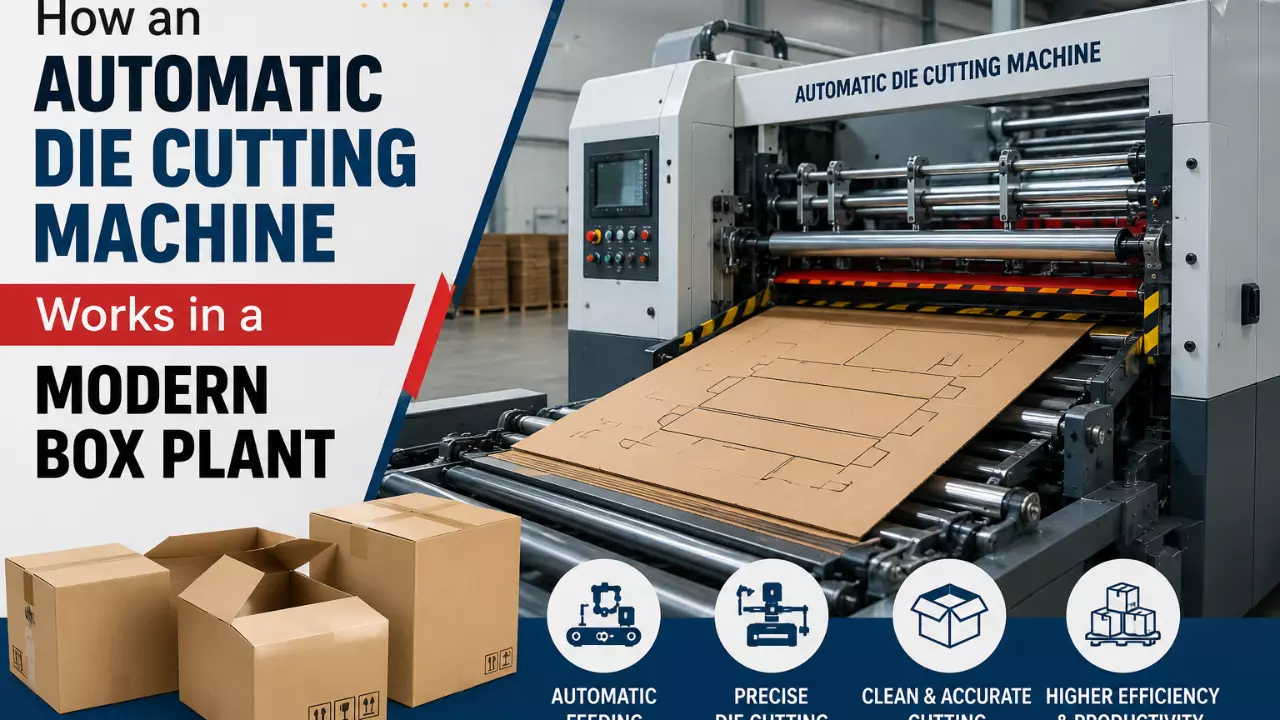
How an Automatic Die Cutting Machine Works in a Modern Box Plant
Every corrugated box starts as a flat sheet of board.
That flat sheet needs to be cut into a precise shape before it can be folded into a finished box. The cuts must be accurate. The shapes must be consistent. And the process must be fast enough to keep up with the rest of the production line.
That is exactly what an automatic die cutting machine does.
It is one of the most important machines in a modern corrugated box plant. It determines the accuracy of every box blank that goes into your folder gluer or stitching machine. And its speed and consistency directly affect the overall output of your plant.
This article covers how an automatic die cutting machine works, what the different types are, how it fits into a full box plant line, and what to look for when you invest in one.
What Is an Automatic Die Cutting Machine
The Core Function
An automatic die cutting machine cuts corrugated board into precise shapes using a steel cutting die.
The die is a set of sharp steel cutting rules arranged in the exact pattern of the box blank shape. When the die presses against the board, it cuts through the board along every cutting line simultaneously.
The result is a box blank cut to the exact shape required for folding into a finished box. This can be a standard rectangular RSC blank. Or it can be a custom shape with hand holes, ventilation cutouts, display windows, or any other feature the client requires.
The word automatic refers to the feeding, cutting, and stripping operations all being handled by the machine without manual intervention between sheets. Board sheets feed in automatically. The machine cuts them automatically. Waste is stripped automatically. Finished blanks stack automatically.
Why Die Cutting Matters for Box Quality
Die cutting precision is a fundamental quality determinant for corrugated boxes.
If the cut dimensions are slightly off, the box blank will not fold correctly in the folder gluer. The flaps will not meet cleanly. The box will not form squarely. And the finished box will not perform as the client expects.
Consistent die cutting means every blank in every production run is cut to exactly the same dimensions. This consistency is what allows your folder gluer or stitching machine to run smoothly and produce finished boxes that are identical to each other.
The Two Main Types of Automatic Die Cutting Machines
Rotary Die Cutting Machine
A rotary automatic die cutting machine uses a cylindrical die that rotates continuously as board passes through. The cutting rules are mounted on the curved surface of the cylinder.
As the cylinder rotates and the board passes through the nip between the die cylinder and the anvil cylinder, the cutting rules cut through the board.
Key characteristics of rotary die cutting:
- Very high production speed because the die is always in motion
- Best suited for standard box shapes and high-volume production runs
- Consistent cut quality across long runs with minimal variation
- Quick setup for standard shapes
- Lower waste generation per unit of output at high volumes
- Ideal for RSC boxes and other standard corrugated box configurations
Rotary die cutting is the most common configuration in high-volume corrugated box plants because it delivers the speed and consistency that large-scale box production requires.
Flat Bed Die Cutting Machine
A flat bed automatic die cutting machine uses a flat die mounted on a platen. The platen presses down onto the board with controlled force, driving the cutting rules through the board to cut the required shape.
Key characteristics of flat bed die cutting:
- Higher cutting precision than rotary for complex or intricate shapes
- Better suited for custom shapes, display boxes, and retail packaging
- Lower production speed than rotary die cutting
- Easier to change dies between different box shapes
- Handles thicker board and harder-to-cut materials more effectively
- Ideal for smaller batches and custom work where shape accuracy is critical
Comparison Table
Factor
Rotary Die Cutting
Flat Bed Die Cutting
Production Speed
Very High
Medium
Cutting Precision
Good
Very High
Best For
Standard shapes, high volume
Custom shapes, smaller batches
Die Change Time
Longer
Shorter
Board Thickness Range
Standard
Wider range
Waste Generation
Low at high volume
Higher per unit
Setup Complexity
Medium
Lower
Upfront Cost
Higher
Lower to Medium
Best Plant Size
Medium to Large
Small to Large
Typical Applications
RSC boxes, standard cartons
Display boxes, custom retail packaging
Many corrugated box plants run both types. Rotary for their high-volume standard box production. Flat bed for custom orders, display boxes, and shapes that require more cutting precision than a rotary machine delivers.
How an Automatic Die Cutting Machine Works: Step by Step
The Complete Production Process
Here is exactly what happens inside an automatic die cutting machine from board input to finished blank output:
Step 1: Sheet Feeding Corrugated board sheets are loaded into the infeed section of the machine. The automatic feeder separates individual sheets from the stack and feeds them into the machine one at a time at a controlled, consistent rate. The feeder maintains precise sheet positioning and spacing to ensure accurate cutting registration on every sheet.
Step 2: Sheet Alignment Before reaching the cutting section, each sheet passes through an alignment system that positions it precisely relative to the cutting die. Accurate alignment is critical. Even a small misalignment between the sheet and the die means cut dimensions are off on one side of the blank.
Modern automatic die cutting machines use side lay guides, front stops, and in some cases electronic sensors to achieve precise sheet alignment at high production speeds.
Step 3: Die Cutting The aligned sheet enters the cutting section. In a rotary machine the sheet passes through the rotating die cylinder and is cut as it moves. In a flat bed machine the sheet stops under the die platen which then presses down to make the cut.
The steel cutting rules penetrate the board completely along every cutting line. Crease rules in the die simultaneously create fold lines in the board where required. These crease lines make the board fold cleanly and accurately in subsequent production steps.
Step 4: Stripping After cutting, the sheet has the finished blank shape plus waste board surrounding and inside the cut areas. The stripping section removes this waste automatically.
In most machines stripping is done by a rubber ejection system or by a mechanical stripping frame that pushes waste pieces away from the blanks. Clean stripping is important because waste pieces left on the blank cause problems in the folder gluer or stitching machine downstream.
Step 5: Blank Delivery and Stacking The stripped finished blanks move to the delivery section where they are stacked neatly. A well-designed delivery section keeps blanks in order, prevents marking or damage to printed surfaces, and stacks at a height and rate that makes transfer to the next production stage easy.
Key Sections of the Machine in Detail
The Infeed and Feeding System
The infeed system is the entry point of the automatic die cutting machine. It must handle corrugated board gently without damaging the flute structure while feeding sheets accurately and consistently at production speed.
Good infeed systems handle a wide range of board sizes and thicknesses without complex manual adjustment. They maintain consistent sheet spacing to keep cutting registration accurate across long production runs.
The Cutting Unit
The cutting unit is the heart of the machine. Its quality determines cutting precision, die life, and the range of board types and thicknesses the machine can handle.
Key cutting unit features to evaluate:
- Cutting pressure control: Consistent cutting pressure across the full width of the die prevents uneven cut depth and extends die life
- Platen parallelism: In flat bed machines the platen must be perfectly parallel to the bed to ensure even pressure distribution across the die
- Speed range: The machine must operate at speeds that match your production targets while maintaining cut quality
- Die mounting system: Easy and accurate die mounting reduces setup time and ensures the die is positioned correctly every time
The Stripping System
The stripping system removes waste board from the cut sheets automatically. In most modern automatic die cutting machines this is done by rubber ejection pads or pins that push waste pieces away from the blanks as the sheet passes through the stripping station.
Effective stripping is essential. Incompletely stripped waste causes jams and quality problems in downstream machines. And manual waste removal slows production significantly.
The Delivery and Stacking System
The delivery system collects finished blanks and stacks them for transfer to the next production stage. In high-speed machines the delivery system must handle blanks at production speed without causing surface damage, misalignment, or disorganised stacking.
Jogging mechanisms in the delivery section align blank stacks neatly. This makes the stack easy to handle and transfer to the folder gluer or stitching machine without manual sorting.
How It Fits Into the Corrugated Box Plant Production Line
Its Position in the Line
The automatic die cutting machine sits in the converting section of a corrugated box plant. Here is the full production flow:
In plants producing custom or complex box shapes, the die cutting machine may receive board directly from the printing machine output. In plants producing standard RSC boxes, slotting is often done in the flexo printer slotter and die cutting handles only the final shape cuts.
Speed Matching Across the Line
The output speed of your automatic die cutting machine must match the input capacity of your folder gluer or stitching machine.
A die cutter that produces more blanks per hour than the folder gluer can process creates a bottleneck at the folder gluer. A die cutter that is slower than the folder gluer leaves the folder gluer waiting.
This speed matching is something experienced corrugated box making machine manufacturers address during plant planning.
Buying all your machines from one manufacturer with full plant planning capability eliminates most speed matching problems before they happen.
Semi-automatic die cutting suits plants producing varied custom work in smaller batches where the flexibility of manual adjustment is more valuable than raw output speed.
Fully automatic die cutting suits plants running long, consistent production runs for large clients where output speed, consistency, and low labour cost per unit are the priority.
What to Look for When Buying an Automatic Die Cutting Machine
The Key Evaluation Factors
Cutting Pressure and Uniformity Uniform cutting pressure across the full width of the die ensures consistent cut quality and longer die life. Ask for specifications on cutting pressure range and pressure control systems.
Board Thickness and Size Range Confirm the machine handles your full range of board thicknesses from your lightest 3 ply board to your heaviest 5 ply board. And confirm the sheet size range covers both your smallest and largest box blanks.
Production Speed Confirm the machine's maximum production speed matches or exceeds your daily output target at your required cut quality level.
Die Change Time In plants producing many different box designs, die change time determines how much production time is lost between jobs. Faster die change systems keep your plant productive.
Stripping Efficiency Ask about the stripping system. Incomplete stripping causes downstream problems. A reliable automatic stripping system is worth paying for.
After-Sales Support Die cutting machines require maintenance and occasional die adjustment. Your corrugated box making machine manufacturers must have trained engineers who can reach your plant quickly when needed.
Why Natraj Machines for Your Automatic Die Cutting Machine
Natraj Machines, headquartered in Palwal, Haryana, is one of India's most established corrugated box making machine manufacturers.
ISO 9001:2008 certified, the company has decades of experience manufacturing corrugated box making machinery including a comprehensive range of automatic die cutting machines for corrugated box plants of every scale.
Their die cutting machine range covers both rotary and flat bed configurations, semi-automatic and fully automatic operation, and a wide range of board sizes and thicknesses to suit diverse plant requirements.
Every machine is engineered in-house, rigorously tested before delivery, and backed by complete after-sales support including installation, commissioning, operator training, preventive maintenance, and spare parts supply.
Whether you are setting up your first corrugated box plant or upgrading an existing die cutting machine to higher speed or greater precision, Natraj Machines has the right automatic die cutting machine for your requirements.
Final Thoughts
The automatic die cutting machine is a fundamental part of every modern corrugated box plant.
It determines the accuracy of every box blank your plant produces. And its speed and reliability directly affect your overall plant output and client satisfaction.
Understanding how it works helps you choose the right type for your plant. Rotary or flat bed. Semi-automatic or fully automatic. The right board size range. The right production speed. And the right manufacturer behind the machine.
Choosing the right automatic die cutting machine from the right corrugated box making machine manufacturers means your plant produces accurate, consistent box blanks, runs at full capacity, and delivers the quality your clients expect from every production run.