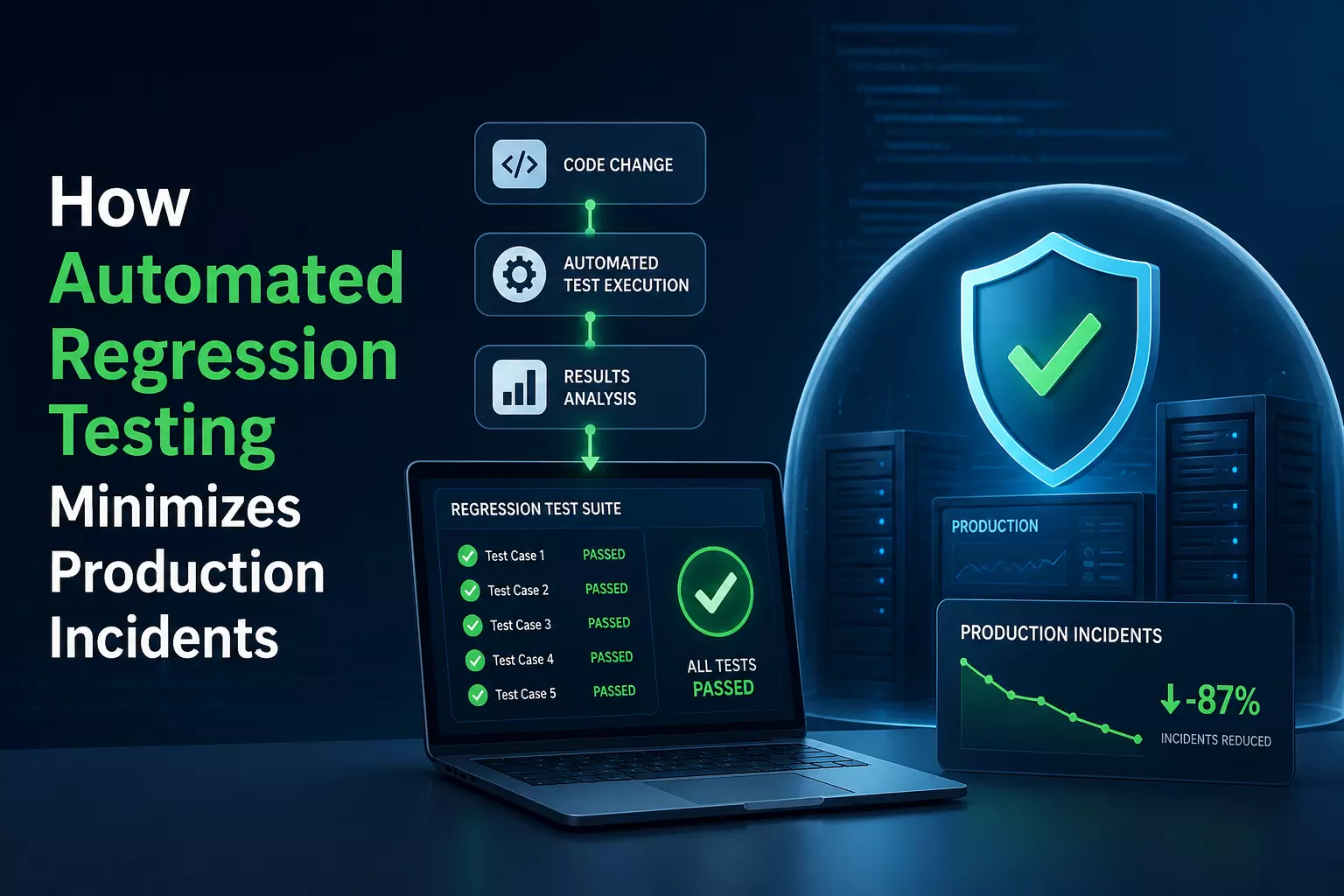
How Automated Regression Testing Minimizes Production Incidents?
Production incidents are often the result of small changes that introduce unintended side effects. In modern systems, where releases are frequent and dependencies are complex, even minor updates can break existing functionality.
This is why automated regression testing plays a critical role in maintaining system stability.
Instead of relying on manual validation, automated regression testing ensures that previously working features continue to behave as expected after every change.
Why Production Incidents Still Happen
Even with structured development processes, incidents occur due to:
- Incomplete validation of code changes
- Overlooked edge cases
- Hidden dependencies between components
- Inconsistent test coverage
- Time pressure during releases
These issues often go unnoticed until the system is already in production.
The Role of Automated Regression Testing
Automated regression testing focuses on continuously validating existing functionality as the system evolves.
It helps teams:
- Detect unintended side effects early
- Ensure consistency across releases
- Reduce the risk of breaking critical workflows
- Maintain confidence in frequent deployments
By catching issues before deployment, it prevents many incidents from reaching users.
1. Continuous Validation of Changes
One of the biggest advantages of automated regression testing is its ability to run continuously.
With integration into CI/CD pipelines:
- Every code change is validated automatically
- Issues are identified immediately
- Feedback loops remain short
This ensures that problems are detected before they accumulate.
2. Early Detection of Side Effects
Changes in one part of the system can impact other areas in unexpected ways.
Automated regression testing helps by:
- Re-running existing test cases after every change
- Validating interactions between components
- Identifying regressions that might otherwise be missed
This reduces the likelihood of hidden bugs reaching production.
3. Improved Test Coverage Over Time
As systems evolve, test suites grow.
Automated regression testing allows teams to:
- Continuously expand test coverage
- Include new scenarios as features are added
- Retain validation for older functionality
This ensures that both new and existing features are protected.
4. Faster and More Reliable Releases
Manual testing can slow down releases and introduce inconsistencies.
With automation:
- Tests run quickly and consistently
- Releases can happen more frequently
- Teams gain confidence in deployment decisions
This reduces the pressure to skip validation steps.
5. Alignment with Real System Behavior
One of the reasons incidents occur is the gap between test environments and real-world usage.
Some approaches address this by using real system interactions to build tests. For example, tools like Keploy capture actual API traffic and convert it into test cases.
This helps teams validate realistic scenarios and reduce the risk of unexpected failures in production.
6. Reduced Human Error
Manual testing is prone to inconsistency and oversight.
Automated regression testing eliminates this by:
- Running the same tests reliably every time
- Ensuring no critical scenario is skipped
- Providing consistent validation across environments
This improves overall testing accuracy.
7. Faster Debugging and Recovery
When incidents do occur, automation helps in identifying the root cause more quickly.
By maintaining a history of test results, teams can:
- Pinpoint when a failure was introduced
- Reproduce issues more easily
- Isolate the affected components
This reduces downtime and speeds up recovery.
Common Challenges to Address
While automated regression testing is powerful, it is not without challenges:
- Maintaining large test suites
- Handling dynamic and changing systems
- Managing test data effectively
- Avoiding flaky or unreliable tests
Addressing these challenges is key to maximizing its effectiveness.
Read: What is Software Testing and How Does it Work
Real-World Perspective
In real-world environments, teams that invest in automated regression testing see clear benefits:
- Fewer production incidents
- Faster release cycles
- Improved system reliability
- Reduced debugging effort
This makes it a foundational part of modern development workflows.
Practical Takeaways
To minimize production incidents using automated regression testing:
- Integrate testing into CI/CD pipelines
- Focus on high-impact and critical workflows
- Continuously update and expand test coverage
- Align tests with real-world system behavior
- Maintain test reliability and stability
These practices help ensure that issues are caught before they reach production.
Conclusion
Production incidents are often preventable when systems are validated consistently and thoroughly. Automated regression testing provides a scalable way to ensure that changes do not introduce unexpected failures.
By continuously validating existing functionality, teams can reduce risk, improve confidence, and deliver more stable software. In modern development environments, it is one of the most effective strategies for minimizing production issues.