Australia Student Visa Work Rules Every Student Should Know
Working while studying can make life in Australia more manageable for international students. It can help with living costs, provide workplace experience and give students greater financial independence. But employment also comes with responsibilities when a student holds a Subclass 500 visa.
The research source on work-hour breaches shows that exceeding the permitted limit is often accidental. Students may accept an extra shift, work for several employers or misunderstand how their fortnight is calculated. These small decisions can create a much bigger visa problem.
Understanding the rules before problems occur is far easier than trying to resolve a breach afterward.
How the Subclass 500 Work Limit Works
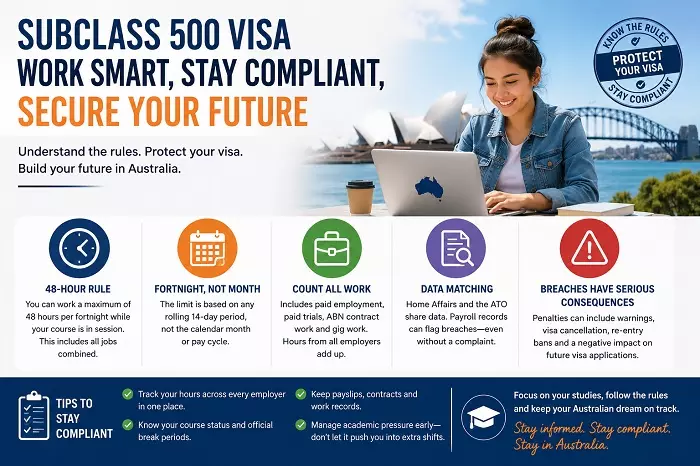
Condition 8105 generally restricts most Subclass 500 students to 48 hours of work per fortnight while their course is in session. The limit applies across all jobs, so students cannot treat each employer as having a separate allowance.
Consider a student who works 26 hours at a café and 24 hours at a supermarket. The two employers may each have reasonable schedules, but the student's combined total reaches 50 hours.
This is why students with multiple casual jobs need to track their employment collectively. The research source also points to paid trials, ABN-based contract work and gig work as forms of work that students should consider when assessing their commitments.
A basic spreadsheet can solve much of the problem. Record each shift, add the hours from every employer and check the running total before accepting another shift.
Don't Confuse a Course Break With Free Time
Course status is another area where students can make costly assumptions.
The source explains that most students can work unrestricted hours during an official scheduled course break, provided their course has not formally ended. However, having a few days without classes does not automatically mean unrestricted work is available.
For example, a student may have a short gap between assessments and assume it is a holiday. If that period is still part of the official study period, accepting several additional shifts could create an unexpected breach.
The safest approach is to check the institution's official academic calendar. When the status of a break is unclear, students should confirm it with their education provider before increasing their work hours.
Read: Everything About the Turkey Visa from Mexico
Why Accurate Records Matter
The research highlights an important change in how work-hour compliance can come to attention.
The Department of Home Affairs and the Australian Taxation Office share information, meaning employment and payroll data can reveal inconsistencies through data matching.
Students should therefore avoid assuming that a breach will remain unnoticed simply because nobody has complained.
The same applies to cash-in-hand work. Informal payment does not guarantee that employment leaves no record. Employer reporting, financial activity or a later workplace dispute may create evidence.
Keeping your own records is one of the simplest protections available. Payslips, employment contracts and timesheets can help students understand exactly how much they have worked and preserve useful documentation if questions arise.
Academic Pressure Can Increase Employment Risk
Work-hour problems can sometimes begin with academic pressure rather than a job.
When students fall behind with assignments, they may have less time for employment. Financial pressure can then encourage them to accept more shifts, creating an increasingly difficult schedule.
Dealing with academic challenges early can help break that cycle. Students who need additional guidance with coursework can explore Expertsmind's assignment help resources for subject-specific academic assistance.
The practical goal is better time management. Students need enough space for classes, assignments and revision while keeping employment within their visa conditions.
A student who spends an entire weekend trying to solve one difficult assignment may later feel pressure to accept extra shifts during the week. Getting help with a difficult academic task early can make the overall schedule easier to manage.
Protecting Your Options After Graduation
A student visa is often only one stage of an international student's plans.
Some students hope to gain professional experience after graduation or explore possible pathways toward permanent residency. That makes compliance during the student-visa period part of a much longer-term plan.
The research source notes that serious work-hour breaches can result in consequences ranging from warnings or formal notices to visa cancellation, depending on the circumstances. A cancellation can also become part of an immigration record and affect future visa decisions.
Students thinking about their longer-term options can read Expertsminds' guide to moving from a student visa to permanent residency in Australia as a starting point for understanding the broader transition.
No single pathway applies to every graduate. Immigration requirements can depend on individual circumstances and the visa available at the time. Still, maintaining compliance now gives students a stronger foundation for whatever comes next.
Make Compliance Part of Your Weekly Routine
The easiest way to avoid an accidental breach is to make work-hour tracking automatic.
Record every shift across every employer. Review the combined total rather than checking each job separately. Keep copies of employment documents and payslips, and check official course-break dates before accepting additional work.
Students should also recognise the connection between academic planning and employment. When coursework becomes difficult, solving the academic problem early can be better than trying to compensate by changing a carefully balanced work schedule.
The research points to a straightforward conclusion: students have significant control over work-hour compliance when they understand the rules and track their commitments consistently.
For Subclass 500 students, every shift should fit two plans at once: the plan for completing the degree and the plan for protecting the visa.