Assets: Meaning, Definition, Types, and Examples in Accounting
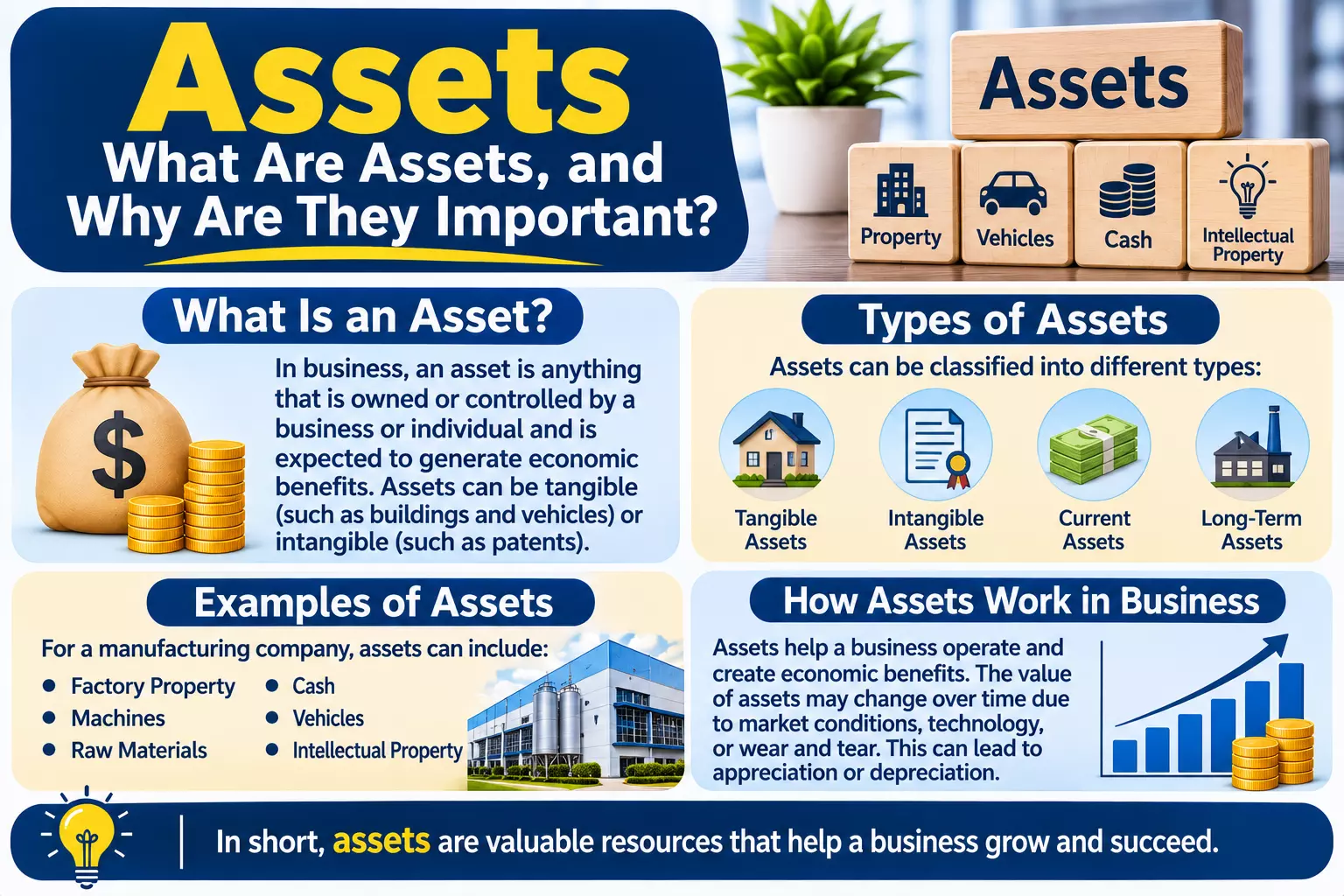
Assets in business and accounting refer to resources that a company or individual has that have future economic benefit. They are crucial in planning, business and future development.
When the business owner gets to know the meaning of assets, he or she will be able to recognize the assets that the business has, and how they help the business to be financially stable.
So, if you're asking what is asset, it's anything of value that can help you generate income, assist your operations or benefit in the future. Assets may be money, real estate, equipment, vehicles, stock, patents and investments.
These resources are used by businesses to make products and provide services, and to make money.
What Is an Asset? Definition and Types of Assets
The simplified definition of asset is that it is a resource which a business or individual owns or controls and expected to benefit from in the future. The asset definition in accounting is based on the resource's economic value and the organization's ability to control it as a result of past events.
The correct spelling is “assets” which is commonly used in accounting. Assets are items on the balance sheet and are categorized based on their use and type.
Assets are divided into a number of distinct types. Current assets are those that are readily convertible into cash or will be sold or used within a company's operating cycle or one year, whichever is shorter. These include cash, accounts receivable and inventory.
Non-current assets are assets that are used for long-term and would be needed for the continuity of business operations. They can be property, equipment, machinery and long-term investments.
Intangible assets are assets that do not have a physical form, but still have value, like trademarks, patents, copyrights and some software rights.
Comprehending the different types of assets can aid businesses in structuring their finances and assessing their assets. Another advantage of the classification is that it simplifies investment, credit and management appraisal of the financial status of the business.
Asset Format and Examples of Assets in Business
In accounting, the asset format typically is presented in a structured layout on the balance sheet. In most cases assets are classified into current assets and non-current assets and individual assets are presented in a list based on the reporting requirements of the company.
For instance, a manufacturing company may own a factory valued at $200,000, machines worth $75,000, its inventory worth $30,000 and cash of $25,000.
These resources can be utilized for daily production, employee activities and business expansion. They combine to form the company's assets, but the value of these assets may fluctuate over time.
The value of assets can increase or decrease for different reasons. The value of property can go up when there is a market demand for it, whereas the value of machinery and vehicles will usually go down due to wear and tear.
Technology can also render some equipment obsolete. Useful life or economic benefits of intangible assets can diminish, causing them to become worth less.
The accounting equation is a relationship between assets and other financial elements:
The value of assets must equal the value of liabilities plus owner's equity.
The formula is useful to keep a firm track of the finances and will display the financial relationship between a business and the resources it finances by borrowing or owning.
To sum it up, it is vital to know what an asset is, its definition, and the various types of assets for effective accounting. Accurate asset tracking enables businesses to manage their resources, create financial reports, assess performance, and make decisions. You can also rely on accurate asset records for better financial planning and business success in the long-term.