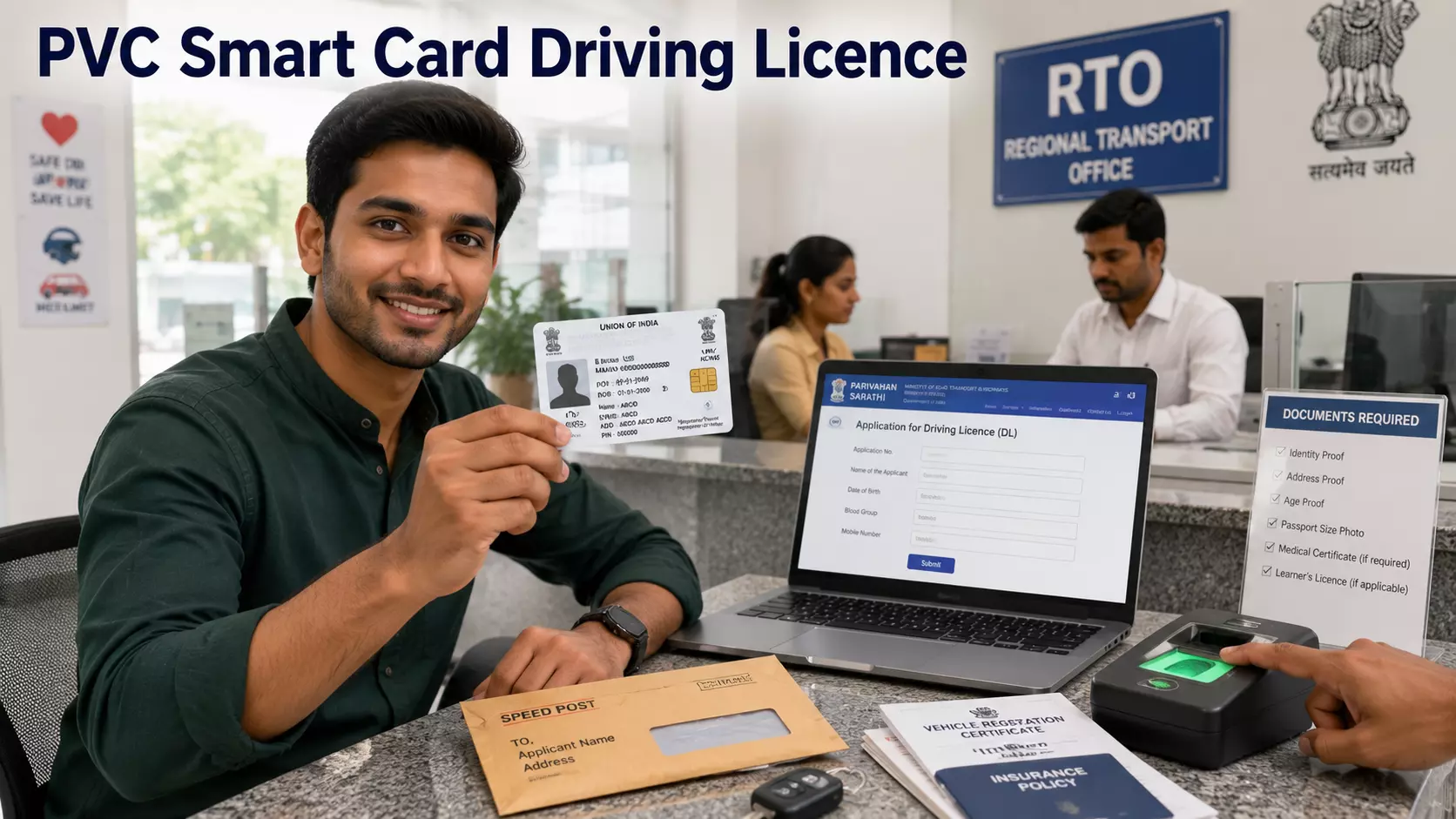
Apply for a PVC Smart Card Driving Licence: Complete Online and Offline Guide
A driving licence is one of the most important documents for every vehicle owner and driver in India. It proves that you are legally allowed to drive a specific class of vehicle, whether it is a two-wheeler, car, commercial vehicle or transport vehicle.
Earlier, many people used to carry paper or booklet-style driving licences, which could easily get damaged, torn, faded or misplaced. Today, many states issue driving licences in a more durable and convenient format known as a PVC Smart Card Driving Licence.
A PVC Smart Card Driving Licence looks similar to an ATM or debit card. It is compact, easy to carry, more durable than paper, and may include secure printed details, barcode, QR code or chip-based information depending on the state system.
It generally contains important details such as the licence holder’s name, date of birth, address, licence number, blood group, vehicle class, validity and issuing authority. Because of its small size and strong plastic body, many people prefer it over older paper licences.
If you are planning to apply for a PVC Smart Card Driving Licence, you can usually do it through the official Parivahan/Sarathi portal or by visiting your Regional Transport Office. The exact process may vary slightly from state to state because transport services are implemented through state RTO systems.
Some states issue smart card licences automatically when you apply for a new driving licence, while others may allow replacement, duplicate licence, renewal or conversion from an old licence to a smart card format.
Along with a valid driving licence, every vehicle owner should also keep vehicle documents updated, including RC, PUC and motor insurance. If you are buying a new vehicle or renewing your policy, Square Insurance can help you compare motor insurance options and choose suitable coverage for your needs.
Featured Snippet Answer: How to Apply for a PVC Smart Card Driving Licence?
To apply for a PVC Smart Card Driving Licence, visit the official Sarathi Parivahan portal, select your state, choose “Driving Licence Related Services,” and select the relevant service such as new driving licence, duplicate licence, renewal, replacement or services on DL.
Enter your driving licence details or application details, upload required documents, complete biometric or test requirements if applicable, pay the prescribed fee and submit the application.
After approval, the smart card licence is usually dispatched to your registered address or made available as per state RTO rules. The official Parivahan fee list mentions ₹200 for issue of a driving licence and ₹200 for renewal, while some states may charge an additional smart card fee.
What Is a PVC Smart Card Driving Licence?
A PVC Smart Card Driving Licence is a modern driving licence printed on a plastic card instead of paper or booklet format. PVC stands for Polyvinyl Chloride, a strong plastic material commonly used for cards such as debit cards, ID cards and access cards. Because of this material, the licence is more resistant to everyday wear and tear.
The smart card format is designed to make licence handling easier and safer. It is compact enough to fit inside a wallet, does not tear like paper and is easier to verify. In many states, the card may include machine-readable elements such as a barcode, QR code or chip that helps authorities verify licence details faster.
However, it is important to understand one thing clearly: the legal value comes from the driving licence record issued by the transport authority, not only from the plastic card. If your state issues e-DL or digital licence formats, those may also be legally valid as per state rules.
For example, Rajasthan Transport has stated that from 01.04.2024 only e-Driving Licence and e-Registration Certificate are issued, and printable PDF formats can be downloaded from the Parivahan Sewa Citizen portal; it also states that e-DL and e-RC are legally valid.
Why Should You Apply for a PVC Smart Card Driving Licence?
A PVC Smart Card Driving Licence is useful because it is durable, portable and easier to maintain. Many old paper licences become unreadable over time because of folding, moisture, heat or rough handling. A PVC card reduces this problem because it is stronger and more compact.
It also looks more professional and standardised. When traffic police or RTO officials check your licence, a clean and readable card makes verification easier. If the card includes a barcode or QR code, the details can be checked more efficiently through official systems.
For people who travel frequently, a smart card licence is easier to carry than a booklet licence. It fits in a wallet and can be kept with other essential documents. If you drive regularly, this convenience matters.
A PVC smart card is also helpful when you are renewing an old licence, applying for a duplicate licence, changing address or updating licence details. In many cases, the updated licence may be issued in smart card format depending on your state.
Who Can Apply for a PVC Smart Card Driving Licence?
You can apply for a PVC Smart Card Driving Licence if you are applying for a new driving licence and your state issues licences in smart card format. You may also apply if you already have a valid old driving licence and want to convert, replace, renew or update it, subject to state rules.
Generally, the following people may need a smart card driving licence:
- A new applicant who has passed the learner’s licence and driving test process may receive a smart card licence after approval.
- An existing licence holder with an old paper or booklet licence may apply for replacement or conversion if the service is available in the state.
- A person whose licence is damaged, torn, faded or lost may apply for a duplicate driving licence, which may be issued in smart card format.
- A licence holder who is renewing an expired licence may receive the renewed licence in smart card or digital format depending on the RTO system.
- A person changing address or updating details may also receive an updated licence card after approval.
The exact service name may differ on the Sarathi portal. In some states, you may see options like “Services on DL,” “Replacement of DL,” “Duplicate DL,” “Renewal of DL,” “Change of Address” or similar service names.
Documents Required to Apply for a PVC Smart Card Driving Licence
The documents required depend on whether you are applying for a new driving licence, duplicate licence, renewal, address change or conversion from old licence to smart card. Still, most applicants need basic identity, address and licence-related documents.
For a new driving licence, you may need proof of age, proof of address, learner’s licence, application form, passport-size photo where required, medical certificate if applicable and driving test details. The official Parivahan fee page separately lists learner’s licence, driving test and driving licence fees, which shows that a new licence process includes more than one stage.
For conversion or replacement of an old licence, you may need your existing driving licence, proof of identity, proof of address, application form and biometric verification. If the licence is damaged, you may need to submit the damaged licence. If it is lost, some states may ask for an FIR, declaration or loss report depending on local rules.
For renewal, you may need your existing driving licence, age proof, address proof, medical certificate if required and recent photograph or biometric capture. If you are above a certain age or applying for a transport category, medical forms may be required.
For address change, you need valid proof of the new address. The Parivahan FAQ says applicants can apply online for change of address in driving licence by visiting Sarathi, selecting state, going to Driving Licence services, entering DL number and date of birth, and selecting Change of Address from the services list.
How to Apply for a PVC Smart Card Driving Licence Online
The online process is usually done through the official Sarathi Parivahan portal. Since driving licence services are state-linked, you must select your state before starting the application.
First, visit the official Parivahan/Sarathi portal.
The Parivahan portal provides various services related to new and old driving licences, learner’s licences, appointment booking, duplicate driving licence, application status and online test services.
Next, select “Driving Licence Related Services” and choose your state. After selecting the state, you will see services available for that state. If you are applying for a new driving licence, choose the new driving licence service.
If you already have a licence and want a smart card, choose services like “Services on DL,” “Replacement of DL,” “Duplicate DL,” “Renewal of DL” or similar options available in your state.
Then enter your driving licence number, date of birth and other required details. The portal may fetch your existing licence details. Check all details carefully before proceeding. If any information is wrong, you may need to update it through the correct service.
After that, select the required service. For example, if your old licence is damaged, choose duplicate or replacement. If you want to update your address, choose change of address. If your licence is expiring, choose renewal. If your state offers smart card conversion, select that option.
Upload the required documents as per the portal instructions. These may include address proof, identity proof, old driving licence copy, medical certificate or other documents depending on the service.
Next, book an appointment if required. Some services may require biometric capture, photograph, signature, document verification or driving test. For a new driving licence, the driving test is usually required after learner’s licence stage.
Then pay the prescribed fee online. The official Parivahan fee list mentions ₹200 for issue of driving licence, ₹300 for driving competence test or repeat test for each class of vehicle, ₹200 for renewal of driving licence, ₹500 for addition of another class of vehicle and ₹200 for change in address or other particulars. State-specific smart card charges may apply in some places.
Finally, submit the application and save the acknowledgement number. You can use this number to track your application status. After verification and approval, the smart card licence may be dispatched by post, made available at the RTO or issued digitally depending on your state’s process.
How to Apply for a PVC Smart Card Driving Licence Offline
If you are not comfortable with the online process, you can visit your nearest RTO. The offline process is useful for people who need help with document verification, biometric capture or old licence conversion.
Visit the RTO that issued your licence or the RTO under your current jurisdiction, depending on the service. Ask for the relevant form for smart card driving licence, duplicate licence, renewal, replacement or address change. Fill in the form carefully and attach required documents.
Submit your old driving licence if required. If the licence is damaged, carry the damaged copy. If it is lost, carry the documents required by your RTO, such as a declaration or FIR if applicable.
Pay the fee at the RTO counter or through the prescribed payment mode. Some RTOs may ask you to complete biometric verification, photograph capture or signature capture. For a new driving licence, you may need to appear for a driving test.
After approval, the smart card licence is usually printed and sent to your registered address or collected as per RTO instructions. Delivery time varies by state, workload and postal service.
Fees for PVC Smart Card Driving Licence
The fee depends on the service you are applying for and the state where you apply. The official Parivahan licensing fee page mentions ₹200 for issue of a driving licence, ₹200 for renewal of driving licence, ₹300 for driving test or repeat test for each class of vehicle, ₹500 for addition of another class of vehicle and ₹200 for change in address or other particulars.
Some states charge an additional smart card fee. For example, Telangana Transport states that where a smartcard type driving licence is issued in Form 7, an additional fee of ₹200 shall be levied.
This means the total cost may vary depending on your state and service type. A new licence may include learner’s licence fee, test fee, driving licence issue fee and smart card charges where applicable. A duplicate or replacement licence may have a different fee structure. Always check the official Sarathi portal or your state transport department website before paying.
How Long Does It Take to Receive a PVC Smart Card Driving Licence?
The delivery time depends on your state RTO, application type, document verification and card printing process. In many cases, after approval, the smart card may be dispatched within a few days to a few weeks. Some private guides mention two to three weeks as a common delivery estimate, but the actual time can vary by state and workload.
If your application requires a driving test, biometric verification or document correction, it may take longer. If your address is incorrect or incomplete, delivery may fail. That is why you should carefully check your address before submitting the application.
If your state has moved to e-DL, you may be able to download the digital licence or printable PDF instead of waiting for a physical card. Rajasthan Transport, for example, states that e-DL and e-RC printable PDF formats can be downloaded from the Parivahan Sewa Citizen portal and are legally valid.
How to Check PVC Smart Card Driving Licence Application Status
You can check the status of your application through the Sarathi Parivahan portal. Visit the portal, select your state and look for application status or related service status. Enter your application number, date of birth and captcha details if required.
For existing driving licence details, Parivahan also provides a DL status service where users can enter their driving licence number and date of birth. The DL status page explains accepted DL number formats and asks users with old licence formats to convert them into the required format before entering.
If the status shows pending at RTO level, your application may still be under verification. If payment is pending, you may need to verify payment status. The Parivahan fee payment FAQ explains that users can visit Sarathi, select state, click Fee Payments, choose EPayment and verify payment status. It also notes that cancelled application fees are not refunded.
Can You Convert an Old Driving Licence into a PVC Smart Card?
Yes, in many states you can convert or replace an old driving licence into a smart card format, subject to availability of the service. The exact process depends on your state. Some states allow this through Sarathi under “Services on DL” or “Replacement of DL,” while others may require an RTO visit.
For conversion, you usually need your old licence, identity proof, address proof and biometric verification. If your old licence details are not available digitally, the RTO may need to verify old records before issuing a smart card.
Some state transport departments provide specific rules. For example, the Directorate of Transport in Andaman and Nicobar states that if any licence holder wishes to convert their valid driving licence from existing plain PVC card or booklet form to smart card, they can do so by making a payment of ₹200.
Is a PVC Smart Card Driving Licence Mandatory?
A PVC Smart Card Driving Licence may not be mandatory in the same way for every state and every licence holder. What is mandatory is having a valid driving licence for the class of vehicle you drive. The format may vary depending on state rules and current transport system.
Some states issue smart card licences. Some states may issue e-DL or digital licence formats. Some may allow old licences to remain valid until renewal or replacement. Therefore, you should check your state transport department rules.
If your old licence is valid, readable and accepted by the authority, you may not need immediate conversion. But if it is damaged, unreadable, outdated or you want a more durable format, applying for a smart card licence can be useful.
PVC Smart Card Driving Licence vs Digital Driving Licence
A PVC Smart Card Driving Licence is a physical card that you can carry in your wallet. A digital driving licence is stored electronically and can be accessed through government-approved digital platforms or downloaded as a PDF where allowed.
Both formats can be useful. A PVC card is helpful when you want a physical document. A digital licence is convenient because it can be accessed from your phone and may reduce the need to carry physical documents in some situations.
However, acceptance can depend on the platform and state rules. Always use official digital sources and avoid fake PDF or unofficial card printing services that do not update government records.
Read: Explore the Best Investment Banking Programs in Hyderabad
Avoid Unofficial PVC Card Printing Scams
Many websites may offer cheap PVC printing of driving licence copies. These may simply print your licence details on a plastic card, but that does not mean the card is officially issued by the RTO. A legally valid licence should be issued or approved through the official transport authority.
If you only print a card from a private website without applying through official channels, it may not be treated as an official smart card licence. It can also create privacy risks because you may be sharing your driving licence number, address, date of birth and other personal details with unknown platforms.
Always prefer the official Parivahan/Sarathi portal or your state transport department. If you need a physical card, check whether your RTO provides official smart card issuance or replacement.
Common Mistakes to Avoid While Applying
One common mistake is choosing the wrong service on the Sarathi portal. For example, a person who wants to replace an old licence may accidentally apply for a new licence. This can delay the process. Always select the correct service based on your need.
Another mistake is entering the wrong driving licence number or date of birth. If the portal cannot fetch your record, check the format carefully. The Parivahan DL status page explains that old driving licence numbers may need to be entered in a specific format.
Many applicants upload unclear documents. Blurry address proof, expired ID proof or mismatched details can lead to rejection or delay. Make sure your documents are readable and valid.
Some people ignore payment status after a failed transaction. If your payment is pending, use the official fee payment status option instead of paying repeatedly without checking. The Parivahan FAQ provides steps to verify payment status.
Another mistake is relying on unofficial agents or websites. Use official portals whenever possible.
Driving Licence, Vehicle Insurance and Legal Road Safety
A valid driving licence proves that you are legally authorised to drive, but it is only one part of responsible vehicle ownership. You should also keep your vehicle registration certificate, PUC certificate and insurance policy updated.
In India, third-party motor insurance is mandatory for vehicles. A driving licence may also be required during claim processing, especially when the claim involves the person driving the vehicle at the time of the accident. If the driver does not have a valid licence for the vehicle class, claim complications may arise depending on policy terms and circumstances.
Square Insurance can help vehicle owners compare motor insurance plans, understand coverage and choose suitable protection. Whether you drive a two-wheeler or car, keeping both your licence and insurance valid is important for legal and financial safety.
Tips Before Applying for a PVC Smart Card Driving Licence
Before applying, check whether your state offers physical PVC smart card issuance or e-DL. Since some states are moving toward digital formats, the process may differ.
Keep your driving licence number, date of birth, Aadhaar, address proof and old licence copy ready. If your mobile number is linked to your application or Aadhaar, OTP verification may become easier.
Use the official Sarathi portal and avoid random websites that ask for personal data. If you need help, visit the RTO or an authorised service centre.
Check the fee before payment. Official fees are usually displayed on the portal. If someone asks for a very high amount, verify before paying.
Track your application after submission. Save your acknowledgement number, payment receipt and application number.
Conclusion
Applying for a PVC Smart Card Driving Licence is a smart step if you want a durable, compact and easy-to-carry licence. It is especially useful for people with old paper licences, damaged licences, expired licences or licences that need updated details.
The process can usually be completed online through the Sarathi Parivahan portal or offline through the RTO, depending on your state and service type.
The official fee structure includes charges for licence issue, renewal, test, address change and other services, while some states may charge an additional smart card fee. Since rules and formats can vary by state, always check the official portal before applying.
A smart card driving licence makes carrying and verifying your licence easier, but it does not replace responsible driving. Keep your licence valid, follow traffic rules and maintain all vehicle documents.
Along with your driving licence, make sure your motor insurance is active and suitable for your vehicle. For comparing car or two-wheeler insurance options, Square Insurance can help you make an informed decision.
FAQs on Applying for a PVC Smart Card Driving Licence
What is a PVC Smart Card Driving Licence?
A PVC Smart Card Driving Licence is a driving licence printed on a durable plastic card. It is compact, easy to carry and may include secure printed details, barcode, QR code or chip-based information depending on the state system.
How can I apply for a PVC Smart Card Driving Licence online?
You can apply through the Sarathi Parivahan portal by selecting your state, choosing Driving Licence Related Services, selecting the relevant service, uploading documents, paying fees and completing verification or appointment requirements.
What is the fee for a PVC Smart Card Driving Licence?
The official Parivahan fee list mentions ₹200 for issue of a driving licence and ₹200 for renewal. Some states may charge an additional smart card fee. Telangana, for example, mentions an additional ₹200 for smartcard type driving licence in Form 7.
Can I convert my old driving licence into a smart card?
Yes, many states allow old driving licences to be converted or replaced with smart card format, subject to state rules and RTO verification. You may need your old licence, identity proof, address proof and biometric verification.
Is PVC Smart Card Driving Licence mandatory?
Not necessarily in every state. Having a valid driving licence is mandatory, but the format may vary. Some states issue smart cards, while others may issue e-DL or digital formats.
How long does it take to receive the smart card licence?
After approval, it may take a few days to a few weeks depending on the RTO, card printing and postal delivery. If your state provides e-DL, you may be able to download the digital version faster.
Can I apply for a smart card licence if my licence is lost?
Yes, you can apply for a duplicate driving licence. Depending on state rules, you may need a declaration, FIR or other documents along with identity and address proof.
Can I drive with a digital driving licence?
Digital driving licence formats issued through official channels may be legally valid depending on applicable rules and state implementation. Rajasthan Transport, for example, states that e-DL and e-RC are legally valid.
Should I use private PVC card printing websites?
It is safer to avoid unofficial websites for licence printing because they may not issue an official RTO-approved smart card and may misuse your personal data. Use the official Sarathi/Parivahan portal or your state transport department.
Does driving licence affect insurance claim?
Yes, a valid driving licence can be important during motor insurance claims. If the driver does not have a valid licence for the vehicle class, the claim may face complications depending on policy terms and accident circumstances.