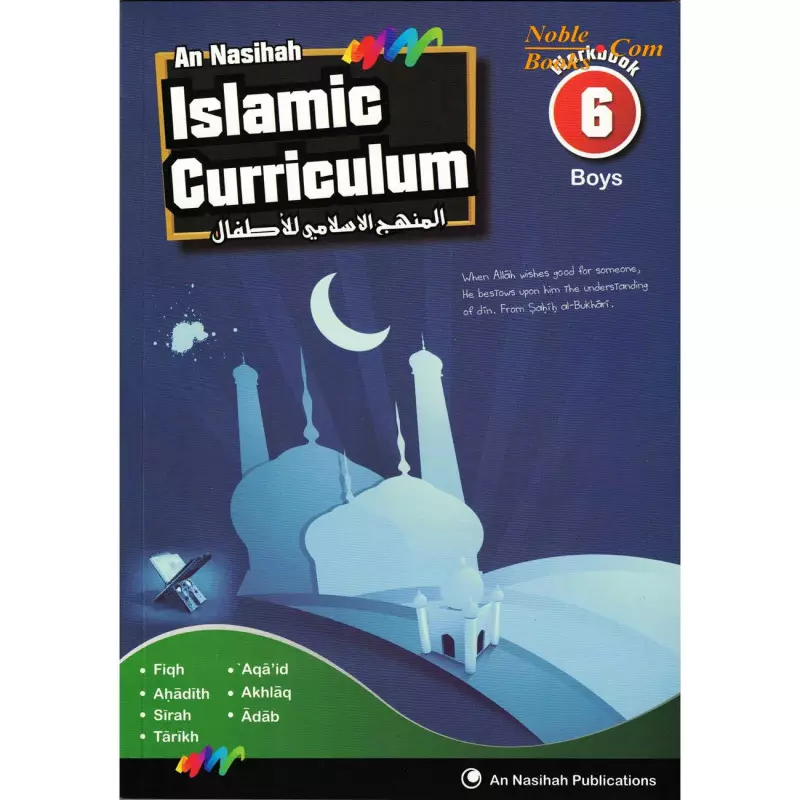
An Nasihah Islamic Curriculum Workbook 6 For Boys
The An Nasihah Islamic Curriculum: Workbook 6 for Boys is part of the highly regarded An Nasihah series a curriculum in Islamic studies designed to guide young Muslims with clarity, structure, and depth.
Written particularly for boys at an upper-primary level, this workbook assists in reinforcing key knowledge in Islamic beliefs (aqeedah), jurisprudence (fiqh), Hadith, manners, and self-development. Similar to the first levels, Workbook 6 continues with earlier learning and adds increasingly complex and mature topics suitable for this age.
This workbook is part of a complete curriculum that can be implemented in Islamic schools, part-time madrasahs, and homeschooling settings. It is a progressive, child-friendly format that enables boys to increase in knowledge as well as acquire good character and a robust Islamic identity.
A Complete Islamic Curriculum Under One Roof
Another standout feature of Workbook 6 is that it covers a broad area of subjects. The material comprises organized lessons in five important areas: fiqh, aqeedah, seerah, hadith, and adab. Every section is carefully balanced to enable students to gain both knowledge and character.
In fiqh, the workbook exposes students to issues relevant to their everyday lives, including the rules of fasting, zakah, and elements of personal hygiene and purification. These are all handled in a straightforward, step-by-step manner that’s easy for boys at this stage to grasp and implement.
The aqeedah part addresses belief in Allah, the unseen, prophethood, and pillars of Islam and imaan. It allows for a solid theological background that enables students to achieve conviction and spiritual sensitivity rather than mere memorization of facts.
In hadith, selected authentic statements of Prophet Muhammad ﷺ are brought alive with short explanations and room for reflection. The aim is to make young students relate to the Sunnah and motivate them to use the advice of the Prophet in actual situations.
Designed Specifically for Boys
The workbook is also customized for boys in tone, content, and examples. Layout and tone use situations that appeal to young men, making them identify personally with what they are being taught. It does not present abstract ideas but locates lessons in the actual life of Muslim youth school, friendships, obligations, and struggles.
Boys are now at an age where they will start posing deeper questions and forming stronger opinions. Workbook 6 addresses that intellectual transition with material that encourages thinking, reflection, and discussion. It challenges students not only to know what Islam says, but to know why it says it and how they can live it.
Seerah, Identity, and Character Building
One of the strongest aspects of this workbook is the way it links Islamic knowledge and identity formation. Using anecdotes from the seerah (life of the Prophet ﷺ) and illustrations from the lives of the companions, the workbook offers positive male role models. The stories are not presented in fairy-tale form, but as actual events which point towards values like courage, honesty, patience, and humility.
Adab (manners and ethics) lessons are incorporated into each chapter. These encompass treating parents, how to conduct oneself during parties, cleanliness, and how to solve differences. The goal is not only to produce informed students, but practicing young Muslims who are humble, courteous, and rooted in Islamic manners.
Interactive Learning Through Exercises and Activities
Workbook 6 is not a passive workbook. It is loaded with interactive exercises like fill-in-the-blanks, short answers, reflection questions, and application exercises. Each lesson concludes with questions to assess understanding while also stimulating further thinking.
Students are invited to describe what they’ve learned in their own words, relate Islamic principles to everyday situations, and discuss how the teachings relate to their everyday activity. Active approach reinforces understanding and retains the content for a longer period.
Numerous exercises also encourage discussion, and thus the book can be used in group classes and home study. Parents and teachers may utilize such questions to initiate meaningful discussions that go beyond the book.
Designed for Classroom and Home Learning
Workbook 6’s design is easy to use for both teachers and students. Lessons are neatly separated, and the tempo provides room for adjusting how it’s presented. A classroom teacher may give one lesson at a time, or a homeschool parent may go through a few pages daily.
The material follows the broader An Nasihah Islamic Curriculum textbook, but as a standalone, the workbook has sufficient information to act as a freestanding sourcebook. It is particularly ideal for weekend schools, madrasahs, and Islamic afterschools where time is limited but quality Islamic education is desirable.
Age-Appropriate, Clear, and Confidently Islamic
One of the most characteristic aspects of this curriculum is how assuredly and clearly it presents Islamic teachings. It does not water them down or avoid critical matters, but presents them in terms the children can comprehend and embrace. Whether addressing issues of worship, belief, or practice, the tone is respectful, respectful, and appropriate to the age.
The workbook assists boys in establishing a positive connection with their faith. It sets structure at a time of life when worldview and self-identity start to form. When external influences are at their strongest, this workbook sets a strong anchor in the message of Islam.
Final Thoughts
An Nasihah Islamic Curriculum: Workbook 6 for Boys is a balanced, structured Islamic learning book aimed at supporting the needs of developing boys at a critical phase of their growth. It incorporates classical Islamic knowledge with applicable lessons on character-building, brought forth in an approach that is compelling, considerate, and simple to understand.
This workbook assists in developing a young Muslim who does not merely know his religion but attempts to practice it with sincerity and comprehension. Used either in school, at home, or in community life, it provides a wholesome package of learning, contemplation, and moral development.