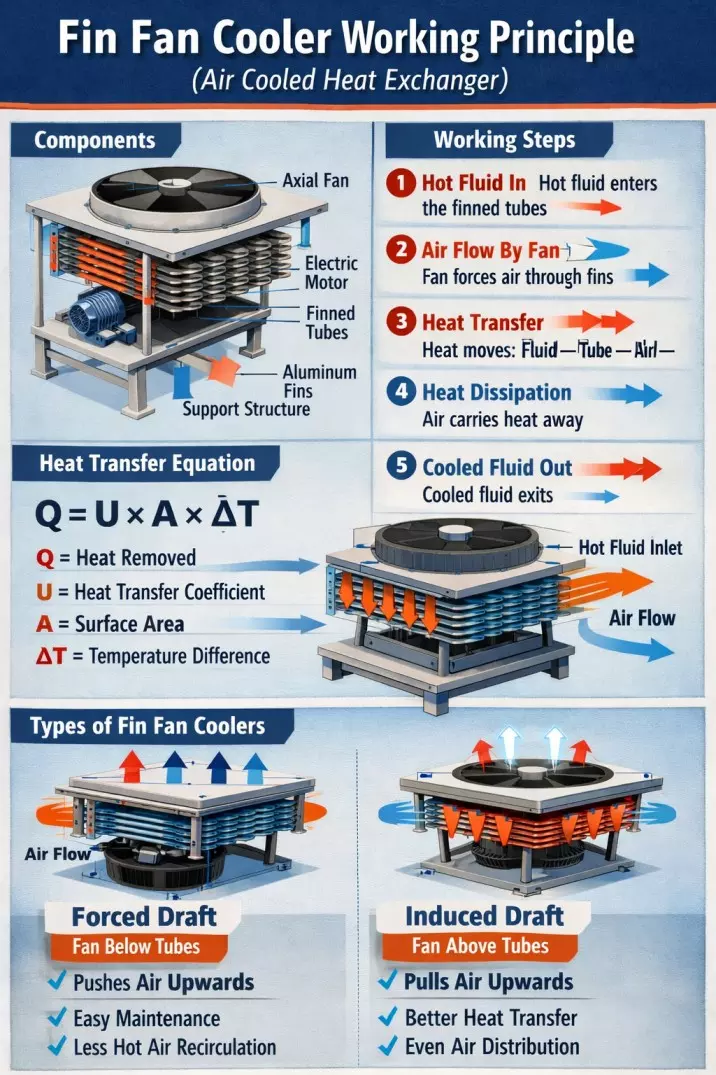
Air Blast Oil Cooler: Working Principle
An Air Blast Oil Cooler is a type of air-cooled heat exchanger used to remove heat from lubricating, hydraulic, or turbine oil in various industrial and power applications. Unlike water-cooled systems, it uses air as the cooling medium, eliminating the need for water and pumps.
1. Construction
The main components of an air blast oil cooler include:
- Cooling Fins / Tubes:
- The oil flows inside tubes that are surrounded by fins to increase the surface area for heat transfer.
- Fan or Blower:
- Forced air is blown over the tubes and fins to carry away the heat.
- Oil Inlet & Outlet:
- Oil enters the cooler through the inlet, flows through the tube bundle, and exits from the outlet at a lower temperature.
- Casing / Frame:
- Supports the tubes, fins, and fan assembly.
Read: Why Should the Construction Industry Use ERP
2. Working Principle
The air blast oil cooler works on the principle of convection:
- Hot Oil Enters the Cooler:
- Heated oil from engines, turbines, or hydraulic systems enters the cooler tubes through the oil inlet.
- Heat Transfer to Tube Walls:
- The oil flows through the tubes, and its heat is transferred to the tube walls via conduction.
- Heat Dissipation to Air:
- The fan blows ambient air over the tube fins.
- The air absorbs heat from the fins through convective heat transfer, lowering the oil temperature.
- Cooled Oil Returns:
- The cooled oil exits the cooler and returns to the system for lubrication or hydraulic operation.
3. Key Features
- Forced-Air Cooling: Fans or blowers provide high heat transfer efficiency.
- Compact Design: Can be installed where water-cooled systems are not feasible.
- Self-Contained: No water supply is needed, reducing maintenance issues.
4. Advantages
- Eliminates the need for water and related plumbing.
- Simple and reliable design.
- Reduces system complexity and operating costs.
- Suitable for high-temperature and continuous operation.
5. Applications
- Turbine and generator lubrication systems.
- Hydraulic oil cooling in presses and machinery.
- Diesel engine and marine oil cooling.
- Industrial gear oil cooling.