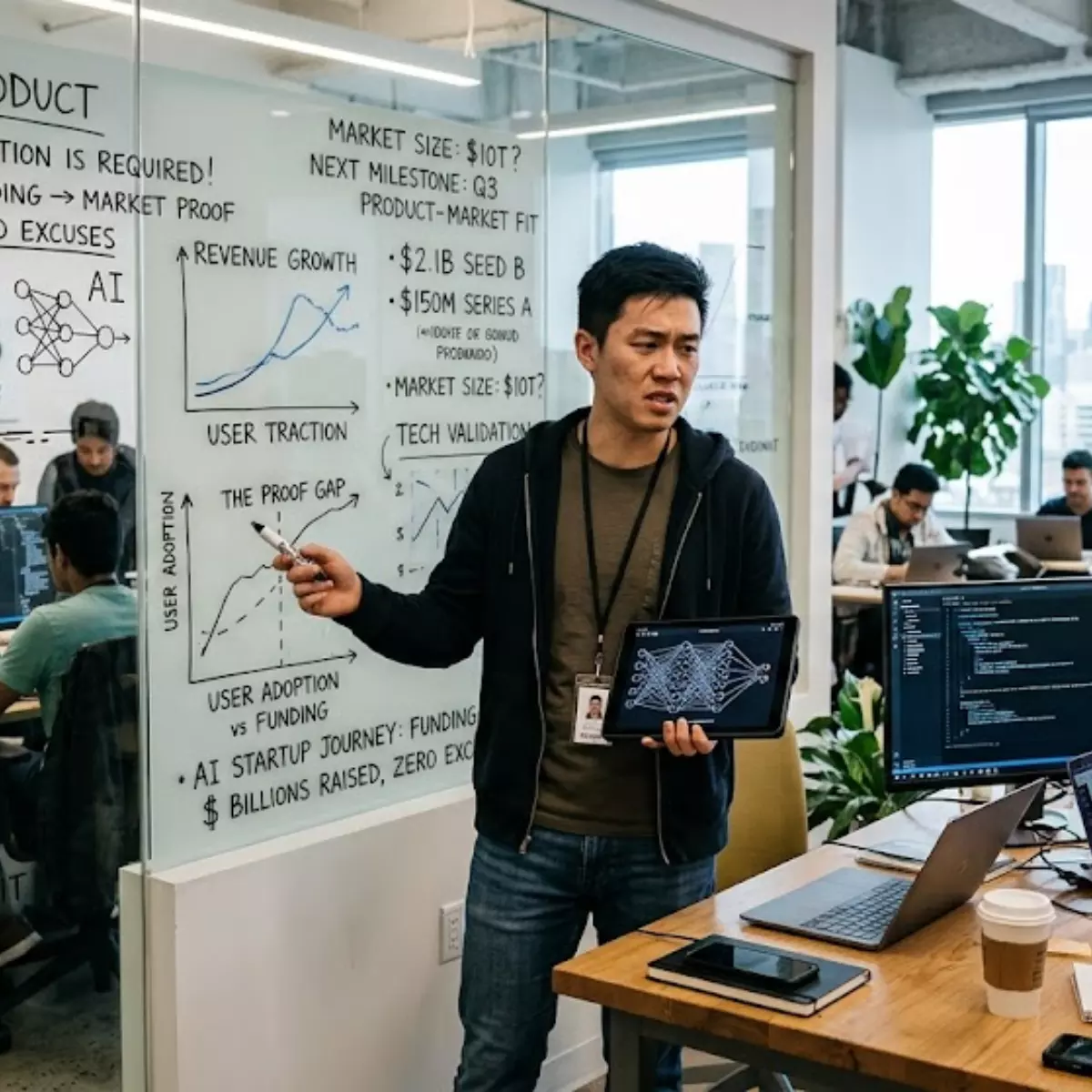
AI Startups Are Raising Billions, but Founders Still Have Something to Prove
A billion-dollar funding announcement can make starting an AI company look easier than it really is. Investors are willing to commit enormous sums to certain businesses, yet many founders still struggle to secure enough money to hire a small team, find paying customers and keep their operations running.
That difference is worth paying attention to.
Recent funding activity has included a reported $1 billion Series A for AI research startup Flapping Airplanes and a $550 million round for legal technology company Legora.
Meanwhile, companies working on battery storage and software testing are attracting investment in areas that support the wider adoption of artificial intelligence. <Cite refs={["turn979254search0"]}/>
These deals tell us that investor interest remains strong. They do not mean every business with an AI feature is likely to attract funding.
For founders, the harder part is proving that their product deserves a place in a crowded market. For investors, it is working out which companies can turn today's enthusiasm into revenue that lasts.
The funding headlines do not tell the whole story
It is tempting to compare a young startup with a company that has just announced a huge investment. But the amount raised is only one part of the picture.
A research laboratory developing new AI capabilities has different costs, risks and potential customers from a small software company building tools for accountants or retailers.
One may need substantial funding before a product is commercially ready. The other might be able to test demand with a handful of customers and a much smaller budget.
Neither approach is automatically better. The important question is whether the amount being raised makes sense for the business.
Founders should be able to explain what the money will accomplish. Will it fund product development, bring in experienced employees, support customer acquisition or help the company enter a new market? Investors need a clear answer, not simply a forecast showing that the business will become much larger.
This is particularly relevant for early-stage companies. A founder who can demonstrate that ten customers are paying for a useful product may have a more convincing starting point than someone with thousands of free users and no clear plan for generating income.
Build something customers would miss
One problem with the current AI rush is that products can look remarkably similar. Several companies may offer tools that write emails, summarise documents or answer questions.
If customers can switch between them without much difficulty, winning their attention may not be enough to build a lasting business.
A founder needs to understand what makes the product difficult to replace.
Perhaps it handles a complicated task that general-purpose software performs poorly. Perhaps it fits into a customer's existing systems, saves employees several hours a week or reduces mistakes that cost the business money. These advantages are worth investigating because they connect the technology to an actual business need.
Consider a startup developing software for small logistics companies. Rather than offering another general AI assistant, it could help staff identify delivery delays, organise shipping documents and respond to customer enquiries using information already held by the business.
The value would not come from the AI label alone. It would come from making daily work easier.
That is the kind of distinction founders should establish before approaching investors.
What happens when a larger competitor copies the idea?
A useful exercise is to imagine that a well-funded competitor launches a similar feature next month.
Would customers stay because the product is more reliable? Does the startup understand a particular industry better? Has it built integrations that would be expensive to replace? Does it have a strong route to reaching customers?
If the honest answer is that the company has no advantage beyond being early, its position may be weaker than the founder realises.
This does not mean every startup needs patented technology or a proprietary AI model. Strong customer relationships, specialist knowledge, distribution and consistent execution can matter just as much.
Investors should also be careful about assuming that rapid technical progress automatically creates commercial success. A product can be impressive and still struggle with pricing, customer retention or the cost of delivering its service.
Read: Top 10 AI Software Companies in 2026
The financial details matter more than the presentation
A good pitch deck can explain a business clearly, but it cannot replace sound numbers.
Founders should know how much it costs to acquire a customer, how much revenue that customer generates and how long it takes to recover the acquisition cost.
They should also understand the expenses associated with running the product, including computing, customer support and ongoing development.
These figures become particularly important when a startup grows. A service that appears profitable with a small group of customers may become less attractive if each new account requires extensive manual work.
Anyone planning to raise capital for startup Singapore expansion should prepare forecasts that reflect these realities.
Investors will want to understand how much money is required, what milestones it will finance and how long the company can operate before needing additional funding.
It is better to present a realistic forecast and explain the risks than to promise growth that depends on every assumption working perfectly.
Singapore's opportunity is not limited to building another AI model
For startups in Singapore and the wider region, there may be opportunities in applying AI to existing industries rather than competing directly with the largest research laboratories.
Businesses need practical solutions for logistics, financial administration, manufacturing, customer service and other operational problems.
Some of these markets are less glamorous than frontier AI research, but a focused product can still become commercially valuable if customers are willing to pay for it.
A venture capital firm Singapore founders approach should be able to examine the business behind the technology: the target market, the sales process, the competitive position and the funding required to reach sustainable growth.
Regional expansion also requires care. A product that works well in Singapore may need changes to meet the languages, regulations and operating practices of neighbouring countries. Expanding too early can consume cash without producing enough additional revenue.
Founders looking for a VC firm Southeast Asia should therefore consider the practical support an investor can provide, including market introductions, hiring advice and help preparing for subsequent funding rounds.
The right relationship can be more useful than choosing an investor simply because its name is well known.
Advice from Evolve Venture Capital
Our recommendation to founders is simple: do not build your fundraising strategy around the largest deals in the news. Build it around the progress your own company can demonstrate.
Before approaching investors, identify the next milestone that would materially improve the business.
It might be reaching consistent paid usage, improving gross margins or securing repeat contracts from enterprise customers. Calculate the funding required to reach that point and allow for delays.
Investors should take the same measured approach when assessing a new opportunity. A large market and promising technology deserve attention, but neither guarantees a profitable outcome.
For those considering early stage investment opportunities, the strongest starting point is a clear understanding of the product, the people building it and the evidence supporting future demand.
AI will continue to create new possibilities. The companies that stand out over time will be those that solve problems customers care about, manage their money carefully and give investors a credible reason to believe in their next stage of growth.