AI Security Posture Management: What Security Teams Need to Know
A security team can lock down servers, review cloud permissions, and monitor network traffic, yet still have blind spots once AI enters the environment.
A single AI application can involve a model, API, vector database, data source, user permissions, prompts, and several third-party services.
That makes AI security posture management a practical concern for teams running AI in production. The goal is to know what AI assets exist, how they're configured, who can access them, what data they handle, and where the security gaps are.
What is AI security posture management?
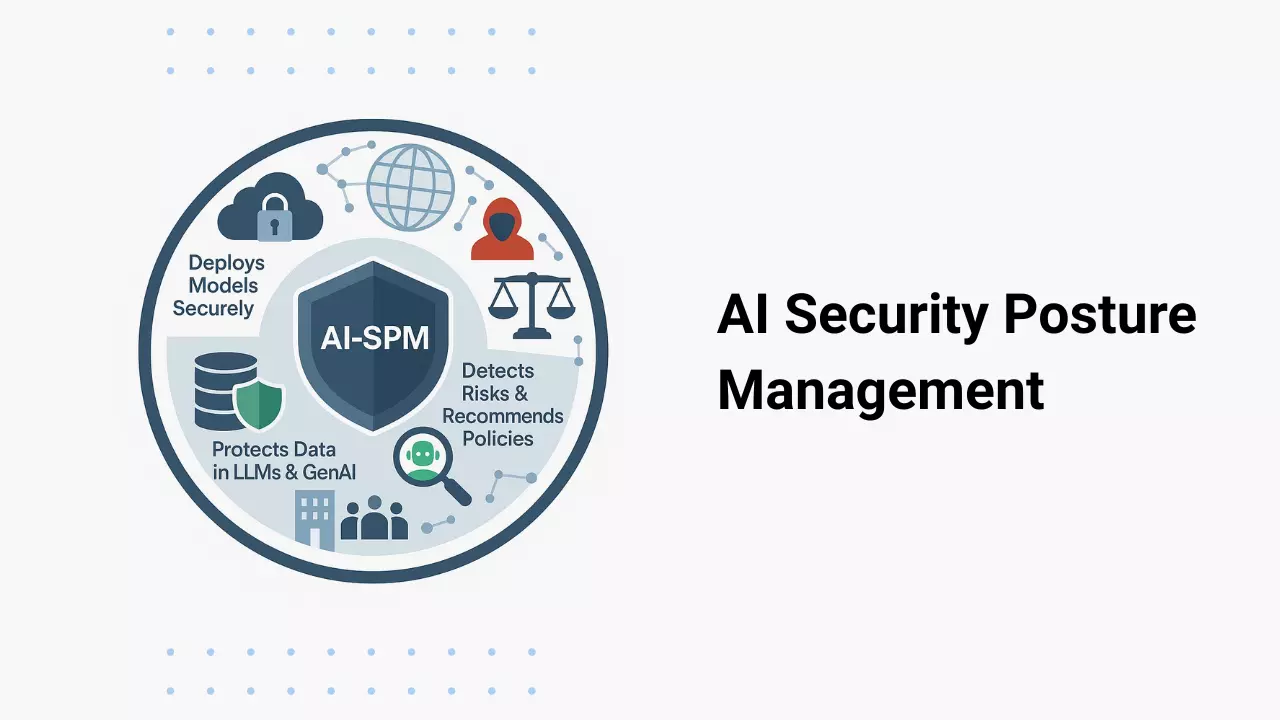
AI Security Posture Management, or AI-SPM, is the process of finding, assessing, and monitoring security risks across AI systems. The scope goes beyond the model itself.
An AI environment can include large language models, machine learning models, training datasets, vector databases, model registries, APIs, development pipelines, AI agents, and third-party AI services.
Each component can introduce a different security concern. For example, an exposed API creates an access problem.
A poorly protected dataset creates a data security problem. Excessive permissions create an identity problem. A compromised training dataset can affect what a model produces. AI-SPM brings these areas into the same security view.
Why AI needs its own security approach
Traditional security controls still matter. Firewalls, endpoint protection, identity controls, vulnerability management, and cloud security remain part of the security stack.
AI introduces additional assets and behaviors that security teams need to track. An enterprise AI setup might use OpenAI APIs, Azure OpenAI, Claude, Gemini, Hugging Face models, self-hosted models, RAG systems, vector databases, AI agents, CI/CD pipelines, Kubernetes clusters, cloud storage, and identity providers.
The security team then has some very practical questions to answer:
- Which AI models are deployed?
- Who can access them?
- Which systems can call the APIs?
- What data reaches the models?
- Are any AI services publicly exposed?
- Are employees using unsanctioned AI tools?
- Where are sensitive prompts or datasets stored?
Without a current inventory, those questions are difficult to answer.
What risks does AI-SPM help manage?
AI security has its own set of problems. Some are familiar security issues in a different setting, while others come directly from how AI systems process prompts, data, and models.
Prompt injection
Prompt injection happens when an attacker crafts input that causes an AI system to ignore or work around its intended instructions.
A simple example is a chatbot connected to internal documents. An attacker may try to manipulate the system into revealing information that the application should keep private.
AI-SPM can help security teams monitor AI assets and related activity so suspicious behavior gets the attention it needs.
Training data poisoning
AI systems depend heavily on the data used to train or improve them. If an attacker manages to introduce malicious or misleading data, the resulting model behavior can change.
The consequences depend on how the model is used. A poisoned dataset could affect fraud detection, financial predictions, healthcare applications, or other systems that rely on model outputs. Data security therefore has to begin before a model reaches production.
Read: Why CTOs, Team Leads, and Administrators Rely on All Pass
Model theft
Models can contain significant intellectual property. Attackers may try to extract model weights, copy a model through repeated API requests, or reverse engineer an exposed service.
Monitoring access to model endpoints and related infrastructure can help identify unusual activity. The API deserves attention here. A well-trained model behind a poorly protected endpoint can still create a serious security problem.
Sensitive data exposure
AI applications frequently connect to business information. That might include customer records, source code, internal documents, credentials, or personal information.
If access controls and data handling rules are weak, sensitive information can end up in prompts, logs, datasets, or model-related services. AI-SPM can help teams keep track of where these assets exist and identify risky configurations or data flows.
Shadow AI
Employees don't always wait for IT approval before trying a new AI tool. Someone might upload a company document to a public AI service, connect an unauthorized plugin, or use a personal AI assistant for work.
The security problem isn't the existence of the tool. It's the lack of visibility around what data is being sent, who is using it, and whether the service meets the organization's security requirements.
Model drift
AI systems can change behavior as data patterns change. Security teams may need to watch for unexpected outputs, accuracy changes, and unusual performance. These signals can point to issues that aren't visible through a standard infrastructure security check.
What should an AI-SPM platform monitor?
A useful AI-SPM program needs visibility across several areas.
AI asset discovery
Start by finding the AI assets that exist across the organization. That includes models, APIs, model endpoints, vector databases, AI services, and training pipelines. The inventory should also account for third-party AI services and AI agents. This gives security teams a starting point for everything that follows.
Risk and configuration checks
AI-SPM can examine AI environments for issues such as public exposure, excessive permissions, weak authentication, insecure APIs, encryption gaps, and configuration errors.
The point is to connect a finding with the asset behind it. A public AI endpoint used for an internal application deserves a different response from an unused development model sitting inside a restricted environment.
Identity and access monitoring
AI applications can involve users, service accounts, API tokens, and role assignments. Reviewing these permissions helps security teams keep access limited to what each user or service actually requires.
This becomes especially important when AI agents can interact with other applications or business systems.
Data protection
Security teams should know what information AI systems can access and where that information is stored. AI-SPM can help identify exposed datasets, sensitive prompts, weak storage controls, and other data security issues.
Encryption, masking, tokenization, and access controls remain useful controls here.
Compliance monitoring
AI projects can touch several existing security and privacy requirements. Depending on the organization and its data, teams may need to consider frameworks and regulations such as GDPR, HIPAA, SOC 2, ISO 27001, the NIST AI Risk Management Framework, and the EU AI Act. The exact requirements depend on the organization, industry, location, and type of AI system being used.
How to build a practical AI security program
You don't have to start with a massive AI security project. Begin by answering a few basic questions.
- Create an AI inventory. Find the models, APIs, AI vendors, datasets, agents, plugins, and related services being used across the business.
- Review access. Check users, service accounts, API tokens, and permissions. Remove access that no longer has a business reason behind it.
- Protect sensitive information. Decide what data can enter an AI system and what must stay outside it. Apply encryption, masking, and access controls where appropriate.
- Secure AI APIs. Authentication, rate limiting, API gateways, logging, and monitoring can reduce the risk around exposed endpoints.
- Watch model behavior. Unexpected outputs, data leakage, unusual access patterns, and performance changes deserve investigation.
- Review the environment regularly. AI systems change as teams add new models, connect new data sources, and introduce new AI services. A security review from 6 months ago may no longer describe the environment accurately.
AI-SPM and Zero Trust
Zero Trust is based on continuous verification of users, systems, and access.
That idea fits AI environments well because an AI application can sit between users, models, APIs, databases, and other business systems.
An AI-SPM program can monitor users, workloads, models, APIs, data, and permissions as part of the broader security process.
For example, a service account that normally accesses one model may suddenly start calling several unrelated endpoints. That change deserves investigation, particularly if the account also has access to sensitive data.
Where AI-SPM fits with existing security tools
AI-SPM doesn't replace the rest of the security stack. A company may already use CSPM for cloud configurations, IAM tools for identities, SIEM for security events, SOAR for response workflows, and CNAPP capabilities for cloud workloads.
AI-SPM adds visibility around AI-specific assets and risks. The useful part is the connection between these systems. An exposed AI endpoint, an unusual identity event, and a sensitive data flow can tell a much clearer story when security teams can see them together.
How Kosmic Eye approaches AI security
Kosmic Eye's AI-SPM approach covers AI assets alongside cloud security posture management. Its platform is designed to provide visibility into AI workloads, identify configuration issues, monitor identities and access, track security risks, and support compliance reporting.
It also connects AI security with broader security operations, including SIEM and SOAR integrations. That gives security teams a way to look at AI systems within the wider environment rather than treating every AI application as a separate project.
What should security teams do next?
Start with visibility. Find the AI systems already running inside the organization. Map the models to their APIs, data sources, users, service accounts, and supporting infrastructure.
Then look for the obvious gaps: public exposure, excessive permissions, unprotected data, weak API controls, unauthorized AI services, and unclear ownership.
Once those basics are covered, the security team can build more detailed controls around monitoring, compliance, incident response, and model behavior. AI security gets much easier to manage when the team knows what it actually has.
Final thoughts
AI-SPM gives security teams a way to keep track of an environment that can change quickly. Models get replaced. New APIs appear.
Employees try new AI services. Data sources change. AI agents gain access to more systems. The security process has to keep up with those changes.
A practical AI-SPM program starts with asset discovery, then moves through access control, data protection, configuration checks, monitoring, and regular risk reviews. That's enough to give a security team a clear place to start without turning AI security into another disconnected project.