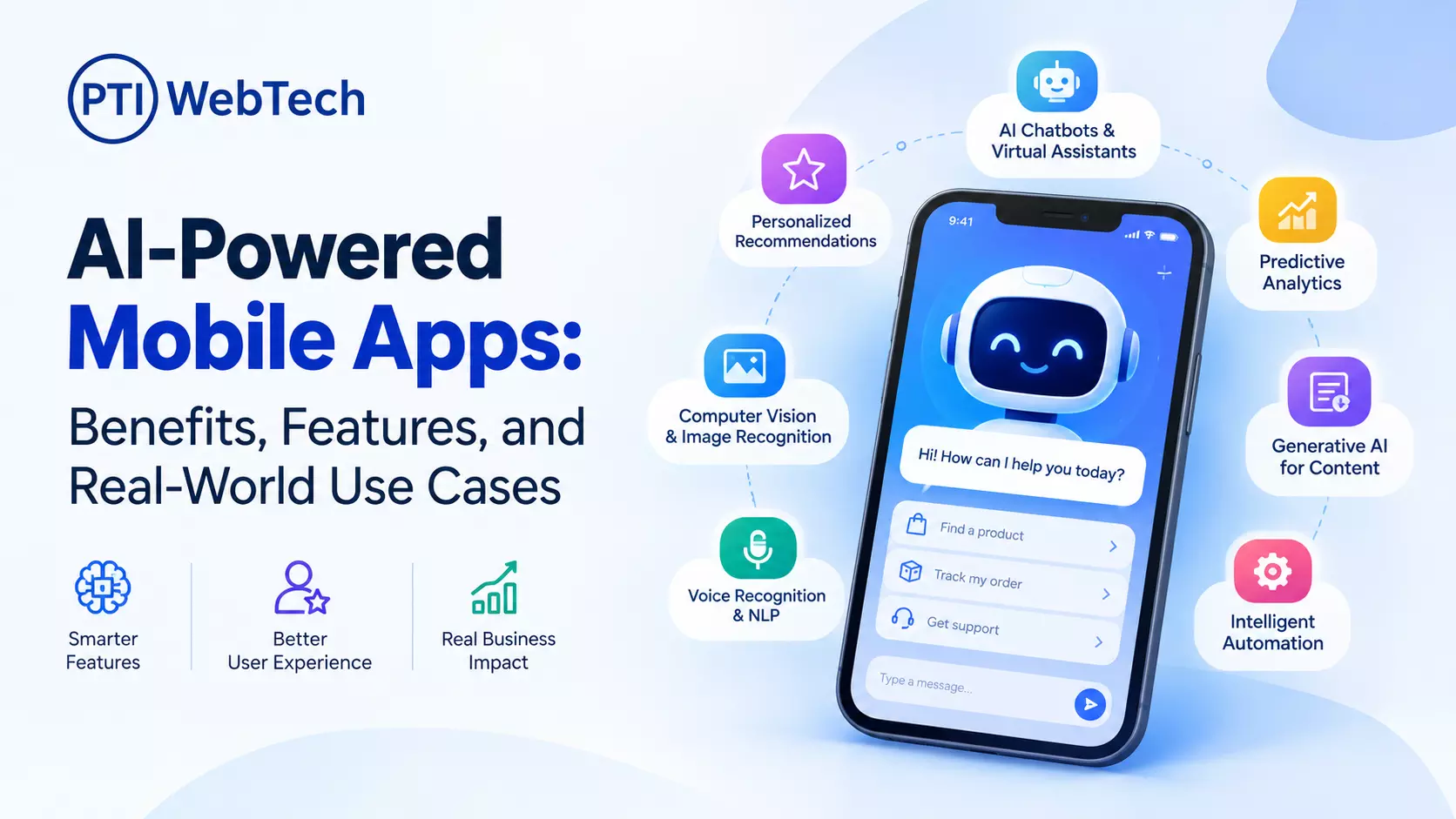
AI-Powered Mobile Apps: Benefits, Features, and Real-World Use Cases
Mobile applications have become an essential part of how businesses connect with customers, deliver services, and manage daily operations.
With the advancement of artificial intelligence (AI), mobile apps are becoming smarter, more personalized, and more efficient.
From AI-powered chatbots and personalized product recommendations to predictive analytics and voice assistants, AI is changing how mobile applications work.
AI-powered mobile apps use technologies such as machine learning (ML), natural language processing (NLP), computer vision, and generative AI to understand user behavior, automate tasks, and deliver more relevant experiences.
For businesses looking to improve customer engagement and streamline operations, integrating AI into mobile applications can create new opportunities for innovation and growth.
At PTI WebTech, we help businesses explore modern AI and software development solutions to build intelligent digital experiences tailored to their needs.
What Are AI-Powered Mobile Apps?
AI-powered mobile apps are applications that use artificial intelligence to analyze data, recognize patterns, understand user requests, and perform tasks with greater intelligence.
Unlike traditional mobile apps that primarily follow predefined rules, AI-enabled applications can use data and AI models to provide personalized recommendations, generate content, answer questions, and support decision-making.
For example, an eCommerce app can recommend products based on a customer's browsing history, while a healthcare app can use AI to provide personalized wellness insights based on user-provided information.
AI capabilities can be integrated into Android apps, iOS apps, and cross-platform applications using AI APIs, machine learning models, cloud services, or on-device AI technologies.
Key Features of AI-Powered Mobile Apps
AI can enhance mobile applications in several ways, depending on the business goals, target audience, and available data.
1. AI Chatbots and Virtual Assistants
AI chatbots allow users to interact with mobile applications through natural conversations. They can answer frequently asked questions, provide product information, guide users through processes, and assist with customer support.
With generative AI and large language models (LLMs), chatbots can understand more complex requests and generate contextually relevant responses.
When connected to authorized business systems, they can also retrieve information or help users complete specific tasks.
Business benefit: Faster customer support, improved user engagement, and reduced pressure on support teams.
2. Personalized Recommendations
AI-powered recommendation engines analyze relevant user data, such as browsing behavior, preferences, and previous interactions, to suggest products, services, videos, or content.
For example, a shopping app can recommend products based on a customer's interests, while a streaming application can suggest content aligned with viewing preferences.
Business benefit: More relevant user experiences, increased product discovery, and potential improvements in conversions and retention.
3. Predictive Analytics
Machine learning models can analyze historical and real-time data to identify patterns and estimate future outcomes. Mobile apps can use these insights to support inventory planning, customer engagement, demand forecasting, and user retention strategies.
For example, a subscription app may identify usage patterns associated with customer cancellations and help a business plan timely retention campaigns.
Business benefit: Better-informed decisions and more proactive business strategies.
4. Voice Recognition and Natural Language Processing
Voice-enabled features allow users to search, navigate, dictate text, or interact with an application using spoken commands. Natural language processing helps applications interpret text and language in a more meaningful way.
These features can be especially useful for hands-free interactions, accessibility, and applications where typing is inconvenient.
Business benefit: More convenient interactions and improved accessibility for different user groups.
5. Computer Vision and Image Recognition
Computer vision enables mobile applications to analyze images and video. Depending on the use case, it can support object recognition, document scanning, visual product search, image classification, and quality inspection.
For example, a retail app might allow customers to search for a product by uploading a photo instead of entering a text query.
Business benefit: Faster visual search, simplified workflows, and new interactive features.
6. Generative AI for Content Creation
Generative AI can help users create text, summaries, product descriptions, images, and other content directly within a mobile application.
A business productivity app, for instance, could summarize meeting notes, while a marketing app could assist with drafting social media captions.
Business benefit: Reduced manual effort, faster content creation, and improved productivity.
7. Intelligent Automation and AI Agents
AI-powered automation can handle repetitive tasks such as categorizing requests, summarizing information, organizing data, and initiating predefined workflows.
AI agents can go a step further by interpreting a goal, selecting appropriate actions, and interacting with connected tools within defined permissions. Their capabilities depend on the systems they can access and the safeguards implemented by developers.
Business benefit: More efficient workflows, fewer repetitive tasks, and improved operational efficiency.
Benefits of AI-Powered Mobile Apps for Businesses
Integrating AI into a mobile application can deliver several advantages when the technology is selected and implemented according to actual business needs.
Improved User Experience
AI helps applications adapt to individual user preferences and behavior. Personalized interfaces, relevant recommendations, intelligent search, and conversational assistance can make apps easier and more useful to navigate.
Better Customer Engagement
Businesses can use AI to provide timely recommendations, personalized notifications, and responsive customer support. Relevant interactions can encourage users to return to an application, although results depend on implementation and user preferences.
Increased Operational Efficiency
AI can automate repetitive tasks, assist employees with information retrieval, and reduce the manual effort required for routine processes. This allows teams to focus more on complex tasks and customer requirements.
Data-Driven Decision-Making
AI models can identify patterns in large datasets that may be difficult to detect manually. Businesses can use these insights to understand user behavior, evaluate product performance, and make more informed decisions.
Potential for Higher Conversions and Retention
Personalized product suggestions, faster support, and simpler user journeys can help reduce friction during the customer experience. When implemented effectively, these improvements may contribute to higher conversions and customer retention.
Competitive Differentiation
AI-enabled features can help businesses introduce new services, improve existing functionality, and deliver experiences that distinguish their mobile applications from competitors.
However, AI integration should be based on measurable business objectives. Not every app needs advanced AI; sometimes, conventional automation or simpler software features are more cost-effective.
Read: AI Mobile App & Software Development Company in USA
Real-World Use Cases of AI in Mobile Applications
AI is being applied across multiple industries to solve practical business and customer problems.
1. eCommerce and Retail Apps
AI is helping online retailers deliver more personalized shopping experiences and improve product discovery.
Common use cases include:
- Personalized product recommendations.
- AI-powered shopping assistants and chatbots.
- Visual product search.
- Personalized offers and promotions.
- Demand forecasting and inventory insights.
- Automated product descriptions and content assistance.
Example: A fashion shopping app can recommend clothing based on a customer's selected preferences and previous interactions. An AI shopping assistant can also help users find products based on size, style, budget, or intended use.
2. Healthcare and Wellness Apps
Healthcare and wellness applications can use AI to support administrative tasks, wellness tracking, and access to relevant information.
Common use cases include:
- Symptom information and health education.
- Appointment scheduling assistance.
- Personalized fitness and wellness recommendations.
- Medical document organization and summarization.
- Analysis of user-provided activity data.
Example: A wellness application can analyze activity patterns from connected devices and suggest adjustments to daily fitness goals. Such recommendations should be appropriate to the user's circumstances and should not replace professional medical advice or diagnosis.
3. Banking and Fintech Apps
AI can help financial applications identify unusual transaction patterns, improve customer support, and provide relevant financial insights.
Common use cases include:
- Fraud detection and suspicious activity alerts.
- Automated customer support.
- Transaction categorization.
- Spending analysis and budgeting assistance.
- Risk assessment and anomaly detection.
Example: A personal finance app can categorize expenses and highlight changes in monthly spending. Financial decisions and high-impact actions should use suitable verification, security controls, and human oversight where necessary.
4. Education and E-Learning Apps
AI can support more flexible learning experiences by adapting educational content to student needs and helping learners access information.
Common use cases include:
- Personalized learning recommendations.
- AI tutoring and question-answering.
- Automated practice questions.
- Language learning assistance.
- Learning progress summaries.
- Feedback on selected exercises.
Example: An e-learning app can recommend additional practice questions based on a learner's performance. Educational content should be reviewed for accuracy and suitability, especially when it is generated automatically.
5. Travel and Hospitality Apps
AI can help travelers discover destinations, organize itineraries, and access travel information more conveniently.
Common use cases include:
- Personalized travel recommendations.
- Conversational trip-planning assistants.
- Itinerary suggestions.
- Multilingual customer support.
- Travel search and recommendation systems.
Example: A travel application can suggest an itinerary based on a user's budget, travel dates, and interests. Before users rely on recommendations, the app should verify current prices, availability, and booking details through appropriate data sources.
6. Logistics and Transportation Apps
AI can help logistics and transportation businesses analyze operational data and improve planning.
Common use cases include:
- Route optimization.
- Delivery time estimation.
- Predictive vehicle maintenance.
- Fleet performance analysis.
- Demand forecasting.
- Automated support for delivery-related queries.
Example: A delivery management app can use traffic, location, and delivery data to recommend efficient routes. Actual results depend on data quality, real-time conditions, and the accuracy of the underlying models.
How to Integrate AI into a Mobile App
Adding AI to a mobile application requires more than connecting an AI model. Businesses should first identify the problem they want to solve and then select an appropriate technical approach.
Step 1: Identify Business Goals
Determine what AI should improve. Common goals include reducing customer support workload, improving product discovery, automating repetitive processes, or offering personalized recommendations.
Define measurable success criteria before development begins.
Step 2: Choose the Right AI Technology
Select the technology based on the intended functionality:
- Machine learning: Predictions, classification, and pattern recognition.
- Natural language processing: Text analysis and conversational interfaces.
- Generative AI and LLMs: Content generation, summarization, and conversational assistance.
- Computer vision: Image recognition and visual analysis.
- AI agents: Multi-step workflows involving connected tools and defined actions.
The best option depends on complexity, accuracy requirements, cost, and available data.
Step 3: Select an Integration Approach
AI can be integrated through third-party APIs, cloud-hosted models, custom machine learning models, or on-device AI.
Cloud-based processing can support more demanding models, while on-device AI may offer lower latency and improved offline functionality for supported tasks. A hybrid architecture can combine both approaches.
Step 4: Prepare and Protect Data
AI systems depend on appropriate data to produce useful results. Businesses should review data quality, permissions, privacy requirements, and security controls before implementation.
Sensitive information should be protected through suitable access controls, encryption, retention policies, and other relevant safeguards.
Step 5: Develop and Integrate the Features
Integrate the selected AI capabilities with the app's interface, backend systems, APIs, and existing business processes. The implementation should also account for response times, error handling, model limitations, and user experience.
Step 6: Test Performance and Accuracy
Test the application across relevant devices, operating systems, network conditions, and user scenarios. Evaluate AI responses for accuracy, reliability, bias, and unexpected outputs.
For generative AI features, include safeguards against misleading responses and unauthorized actions.
Step 7: Monitor and Improve
After deployment, monitor usage, performance, costs, user feedback, and business outcomes. Update prompts, models, workflows, and app features when testing identifies opportunities for improvement.
AI-powered applications require ongoing maintenance because user needs, data, and underlying AI technologies can change over time.
Challenges of AI-Powered Mobile App Development
Although AI offers significant opportunities, businesses should consider several challenges before implementation.
- Development costs: AI APIs, model development, infrastructure, and testing can increase the initial investment.
- Data privacy and security: Personal or sensitive data requires appropriate protection and compliance measures.
- Accuracy and reliability: AI models can produce incorrect predictions or responses and require suitable testing and monitoring.
- Integration complexity: Connecting AI with existing applications, databases, and business systems may require additional development.
- Performance and latency: Large models and network-dependent features can affect response times and user experience.
- Ongoing maintenance: AI models, APIs, and business requirements may change, creating continuing maintenance needs.
Businesses can address these challenges by starting with a focused use case, selecting the right architecture, establishing clear performance metrics, and implementing appropriate security and quality controls.
How Much Does It Cost to Develop an AI-Powered Mobile App?
The cost of developing an AI-powered mobile app depends on its features, complexity, design, platform, integrations, and ongoing infrastructure requirements.
A basic app with an AI chatbot using an existing API generally requires less development effort than an enterprise application with custom machine learning models, real-time data processing, complex integrations, or autonomous AI workflows.
Important cost factors include:
- Android, iOS, or cross-platform development.
- UI/UX design and application architecture.
- AI model or API selection.
- Backend development and third-party integrations.
- Data preparation and security requirements.
- Testing, deployment, and ongoing maintenance.
- AI usage fees and cloud infrastructure.
The most practical approach is to define the core requirements first and develop a minimum viable product (MVP) to validate the idea before investing in more advanced AI features.
Why Choose PTI WebTech for AI and Mobile App Development?
Businesses need a development partner that understands both application development and the practical requirements of AI integration.
PTI WebTech provides software development and digital technology services, including AI and machine learning development, mobile app development, AI chatbot solutions, and automation services.
By aligning technology choices with business objectives, organizations can explore AI capabilities that fit their operational needs and customer expectations.
When planning an AI-powered mobile application, the development process should focus on:
- Understanding business requirements and target users.
- Selecting appropriate AI technologies and integration methods.
- Building secure and scalable application architecture.
- Integrating AI features with existing business systems.
- Testing usability, performance, and AI output quality.
- Supporting ongoing improvements as requirements evolve.
Whether a business is planning a new AI-powered application or enhancing an existing mobile app, a clear roadmap can help prioritize useful features and manage development costs.
Explore PTI WebTech's AI & ML Development Services to learn more about AI-driven solutions for your business.
The Future of AI-Powered Mobile Applications
AI is expected to play an increasingly important role in mobile app development as generative AI, on-device models, multimodal systems, and AI agents continue to evolve.
Future applications may offer more natural conversations, better contextual recommendations, intelligent workflow automation, and faster processing directly on supported devices. Businesses will also need to pay greater attention to transparency, privacy, accessibility, and responsible AI implementation.
The opportunity is not simply to add AI to every application. It is to identify where intelligent capabilities can solve real problems, improve the user experience, and deliver measurable value.
Final Thoughts
AI-powered mobile apps are changing how businesses engage with customers, automate processes, and deliver digital services.
From personalized shopping experiences and intelligent customer support to predictive analytics and AI-assisted workflows, these applications offer practical opportunities across industries.
Successful AI integration begins with a clear business objective, the right technology, reliable data, and a strong focus on security and user experience. With thoughtful planning and ongoing optimization, businesses can develop mobile applications that are more useful, responsive, and adaptable.
PTI WebTech helps businesses explore AI, machine learning, and mobile app development solutions to support their digital initiatives.
If you are planning to introduce AI capabilities into your mobile application, start by identifying the features that will create the most value for your users and your business.