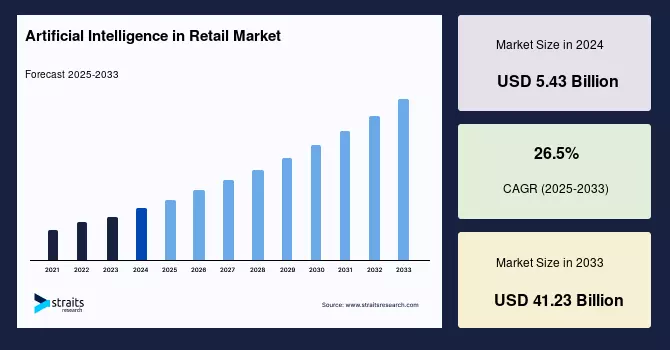
AI in Retail Market Set to Explode from USD 5.4B to USD 41.2B by 2033
Discover how AI is transforming retail—from personalization to predictive merchandising—with the global AI in retail market projected to grow from USD 5.4 billion in 2024 to USD 41.2 billion by 2033 at a 26.5% CAGR.
Introduction
Artificial Intelligence (AI) is revolutionizing the retail landscape by infusing data-driven intelligence into every step—from predicting what a customer might buy next to optimizing supply chains—and redefining what it means to be competitive.
With the rise of e-commerce, mobile engagement, and omnichannel experiences, retailers are embracing AI to personalize interactions, forecast demand, and stay agile. The AI in retail market is on the fast track to expansion, driven by innovation, consumer expectations, and operational efficiency.
Market at a Glance
- 2024 Market Size: USD 5.43 billion
- 2025 Forecast: USD 7.12 billion
- 2033 Projection: USD 41.23 billion
- CAGR (2025–2033): 26.5%
The expected multi-fold growth over the decade underscores AI’s essential role in the future of retail.
Growth Catalysts
Personalization & Predictive Merchandising
AI-driven systems enable real-time, tailored recommendations, individualized pricing, and dynamic promotional strategies. Retailers like Zara are leveraging GenAI engines to analyze live feedback and sales trends, adjusting inventory and pricing on the fly—enhancing both efficiency and consumer satisfaction.
Supply Chain Efficiency & Demand Forecasting
Advanced machine learning models help retailers predict product demand with high accuracy, reducing both overstock and stockouts. This empowers companies to optimize inventory, logistics, and delivery performance—synchronizing supply with consumer needs.
Omnichannel Integration & Enhanced Online Shopping
Retailers are unifying their physical and digital operations using AI—combining mobility, app data, and in-store behaviors to deliver seamless shopping experiences. Online platforms deploy real-time personalization, while front-end chatbots, recommendation engines, and customer profiling tools ensure consistency across touchpoints.
SME Adoption & Accessibility
Cloud-based AI services and off-the-shelf SaaS solutions are making advanced analytics accessible to smaller retailers. While 60% of large retailers already deploy AI, those lagging are poised to benefit from more accessible and budget-friendly tools that democratize AI.
REQUEST SAMPLE: https://straitsresearch.com/report/artificial-intelligence-in-retail-market/request-sample
Hurdles & Considerations
Implementation Cost & Infrastructure Gap
Despite the benefits, many small retailers face cost and capability challenges. Limited budgets, technical skills, and required infrastructure slow AI adoption, reinforcing the importance of scalable, low-code solutions.
Talent and Knowledge Barriers
Roughly 15% of smaller retailers are still unfamiliar with AI capabilities. Education and training will be vital to accelerating adoption and leveraging AI effectively.
Market Opportunities
Visual Search & Immersive Discovery
AI-powered visual search is reshaping how consumers shop—allowing image-based discovery, where users can search using a photo to find products instantly. Tools like Pinterest Lens are pioneering this approach, especially in fashion and home décor.
Real-Time Analytics & Operational Automation
Cloud-driven AI platforms are enabling real-time pricing, promotion modeling, and customer insights. Retailers integrating CRM, POS, and online data gain a 360° inventory of consumer behavior—fueling smarter, faster decision-making.
Regional Highlights
- North America: Leading the market with strong AI infrastructure, investment, and innovation—driven by giants like Amazon, Walmart, and Shopify.
- Asia-Pacific: Most dynamic growth region—powered by e-commerce adoption, digital retail strategies, and deep investments from companies like Alibaba and Rakuten.
- Europe: Rapidly adopting AI in retail with government support, startup activity, and increased customer personalization.
- Global Country Snapshots:
- China: Powerhouse of AI retail—leveraging logistics, real-time pricing, and IoT-led omnichannel systems.
- South Korea & Japan: Leaders in in-store robotics and real-time analytics systems.
- Germany & France: Forging ahead in supply chain AI and demand forecasting.
- UK: Driving personalization via AI-powered loyalty tools and dynamic marketing.
- Canada: Innovating with AI-driven descriptions, search, and recommendation systems for e-commerce stores.
Segment Insights
CategoryDominant SegmentRationaleOfferingsSolutionsChatbots, recommendation engines, and pricing platforms are central to AI adoption.TypeOnline RetailE-commerce leads with expansive need for personalization and inventory analytics.
TechnologyMachine & Deep LearningCore tools powering prediction, recommendation, and customer insights.Deployment ModeCloudOffers scalability and accessibility—ideal for both large and small retailers.ApplicationPredictive MerchandisingMaximizes sales through intelligent placement and demand forecasting.
Conclusion
By 2033, the AI in Retail Market is forecasted to swell to USD 41.23 billion, growing at a strong 26.5% CAGR from USD 5.43 billion in 2024. Intelligence is becoming inseparable from retail—from indoors to channels online, from personalization to operational optimization. Retailers embracing AI will gain precision, performance, and competitive advantage—while those lagging risk moving into irrelevance.