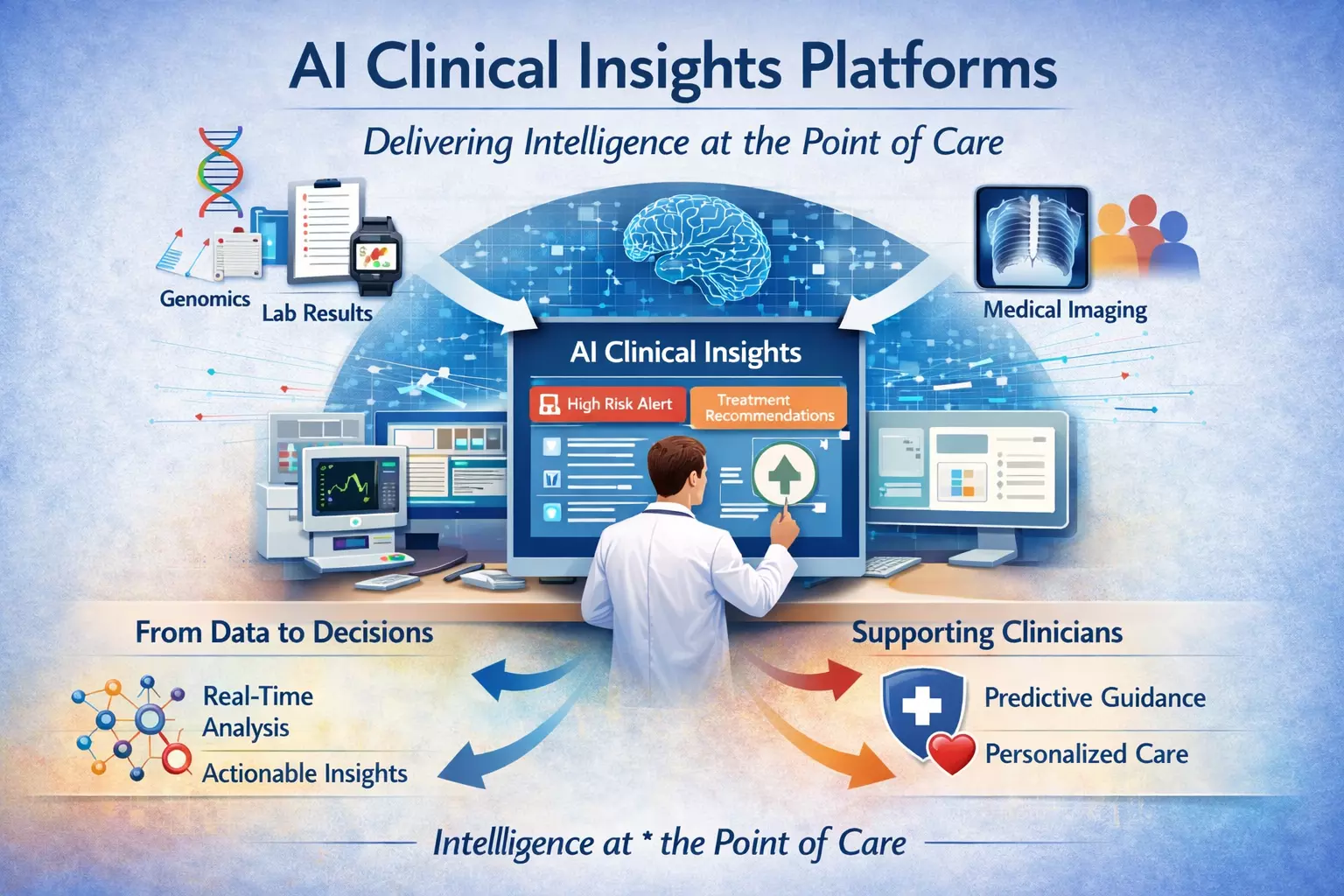
AI Clinical Insights Platforms: Delivering Intelligence at the Point of Care
Healthcare today generates more data than ever before, scientific notes, lab outcomes, imaging, genomics, wearable data and actual-time affected person inputs.
Yet clinicians are often forced to make crucial decisions underneath intense time strain, navigating fragmented systems and incomplete statistics.
This is where AI Clinical Insights Platforms are starting to redefine what selection assist seems like in modern-day care environments, not as disruptive equipment, however as intelligent partners embedded at once into clinical workflows.
The Gap Between Data and Decisions
For many years, healthcare groups have invested closely in digital infrastructure. Electronic health statistics (EHRs), health information exchanges, and analytics dashboards promised higher consequences via higher facts.
However, access to data does no longer robotically translate into perception. Clinicians nevertheless face cognitive overload, toggling among monitors, reconciling conflicting facts, and counting on memory to connect complex medical dots.
Traditional clinical decision support systems attempted to assist through regulations, reminders, and indicators. While beneficial in slender eventualities, those structures frequently lacked context.
Over time, alert fatigue sets in, lowering trust and adoption. What clinicians wished was now not extra notifications—however clearer, more applicable intelligence brought at exactly the proper second.s now not extra notifications—however clearer, more applicable intelligence brought at exactly the proper second.
What Makes AI-Driven Insights Different
AI-powered clinical insight platforms shift the focus from static regulations to dynamic knowledge.
By studying huge volumes of established and unstructured data, those systems can become aware of patterns which are difficult for people to hit upon in real time.
They synthesize affected person records, present day presentation, population-degree proof, and rising studies into actionable guidance.
Rather than interrupting workflows, effective AI systems work quietly in the background. They surface prioritized insights—chance stratification, care gaps, predictive tendencies, or therapy concerns—directly within the tools clinicians already use.
The result is selection support that feels less like an alarm and more like a 2d set of professional eyes.
Intelligence at the Point of Care
The true value of AI-driven insights lies in their timing. Intelligence added too early will become noise; too past due, and it will become inappropriate. Point-of-care shipping ensures that insights appear while scientific selections are virtually being made—during diagnosis, remedy planning, or care transitions.
For instance, AI can assist pick out patients susceptible to deterioration before signs expand, endorse evidence-primarily based interventions tailored to person profiles, or highlight neglected elements consisting of social determinants of health.
Importantly, those insights support—now not replace—clinical judgment. The clinician stays in control, the use of AI as a relied on assistant instead of an expert.
Supporting Personalized and Value-Based Care
As healthcare moves toward personalized and value-based models, the need for nuanced decision-making grows. One-size-fits-all guidelines are often insufficient for patients with complex, chronic, or multi-system conditions.
AI-driven insights enable more personalized care by accounting for variability across patients while maintaining alignment with clinical evidence.
At the system level, these platforms also help organizations improve outcomes, reduce unnecessary variation, and support quality metrics.
By aligning clinical decisions with both patient needs and organizational goals, AI-driven insights become a bridge between bedside care and broader healthcare strategy.
Read: AI Clinical Documentation: Transforming Healthcare Efficiency
Building Trust and Adoption
Technology adoption in healthcare depends on trust. Clinicians want transparency, and relevance. The most successful AI platforms are designed with clinicians, not just for them. They provide clear motive for pointers, adapt to remarks, and evolve as evidence changes.
Equally vital is integration. When insights are seamlessly embedded into existing workflows, clinicians are more likely to engage. When they add friction, even the most sophisticated tools risk being disregarded.
Final Thoughts
Healthcare does no longer suffer from a lack of data—it suffers from a loss of usable intelligence. AI Clinical Insights Platforms represent a significant evolution in decision support, moving past indicators closer to contextual, well timed, and clinician-focused steerage.
By turning in intelligence at the factor of care, those systems assist clinicians navigate complexity with self belief, enabling higher decisions for sufferers and extra resilient healthcare structures normal.