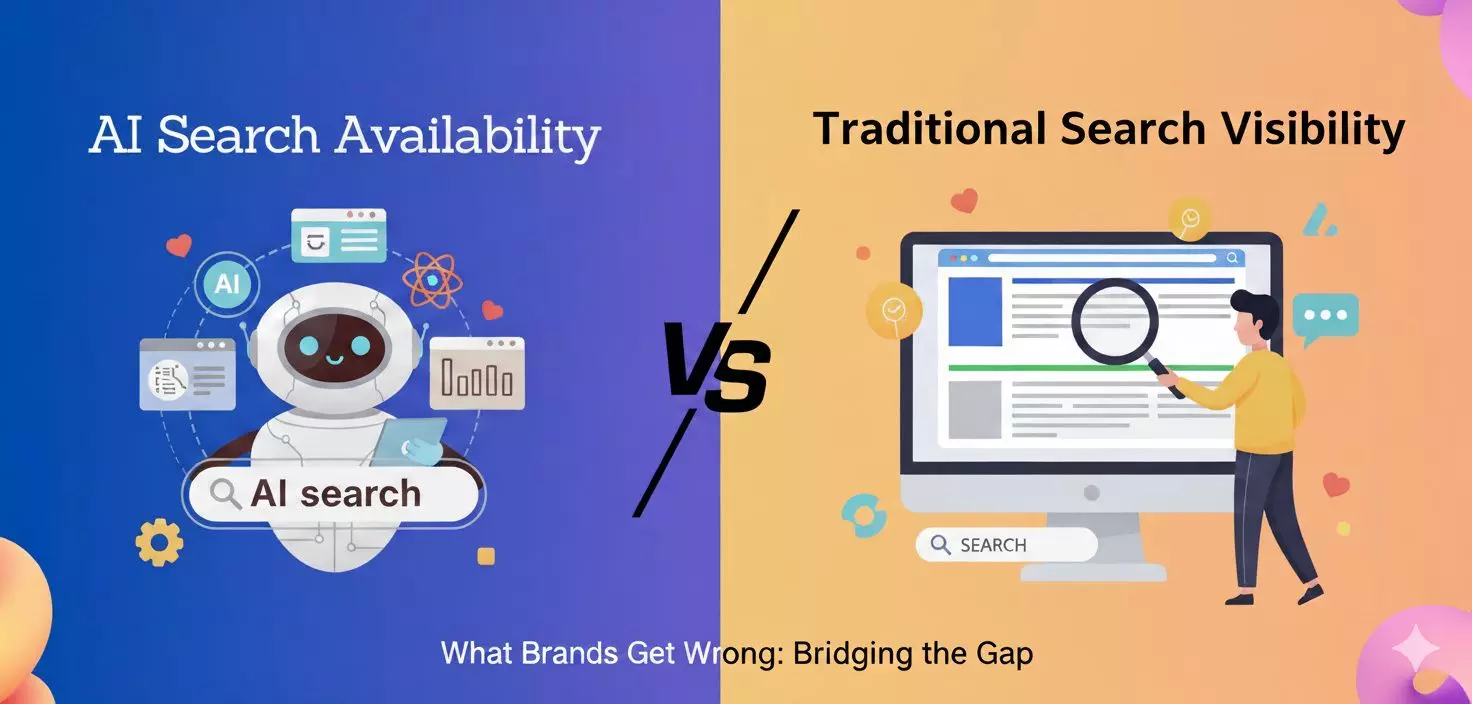
What Brands Get Wrong about AI Availability vs. Traditional Search Visibility
In today’s digital landscape, ranking on page one of Google isn’t the only goal. Generative AI platforms like ChatGPT, Perplexity and Google’s AI Overviews have added a new battleground: AI availability. This means being recognised and recommended by AI systems during customer search queries.
Digital Romans defines AI availability as “the likelihood that artificial intelligence will recommend your products, services, or business to people in a buying situation”. In other words, AI is now a powerful “influencer”. If your brand is invisible to AI, it may be invisible to a growing number of consumers. Yet many companies make critical mistakes by treating AI search the same way they do traditional SEO.
AI Search vs. Traditional Search: Key Differences
Traditional search (Google/Bing) still drives most website traffic, but AI-driven search behaves differently. AI tools don’t just match keywords to pages – they summarise and synthesise content into direct answers. For example, ChatGPT or Google’s AI Overviews often give a concise response rather than a list of links.
That means AI prioritises context, clarity and authority, not just keyword density. Some AI engines (like Perplexity) even cite sources, while others may not unless browsing is enabled. In practice, this means simply ranking high in Google Search does not guarantee an AI will surface your content. As one expert bluntly puts it, “If you’re invisible to AI, you’re invisible to the market.”.
AI systems also behave as “decision mediators” rather than shortcuts for human searchers. Consumers increasingly use both Google and AI assistants together. According to Semrush data, companies that ignore Google sacrifice volume, while ignoring AI search sacrifices conversion efficiency. In short, brands must serve both channels: traditional SEO to attract broad awareness and AI optimisation to capture high-intent queries.
Common Mistakes Brands Make
Brands often stumble by misunderstanding AI availability versus classic search visibility. Common errors include:
- Assuming SEO = AI success. Many teams believe that high Google rankings automatically translate into AI presence. In reality, users switch between Google and AI chat in the same research sessions, so you need strategies for both. Treating SEO and AI optimisation as separate “silos” is a mistake – they should reinforce each other.
- Ignoring brand-controlled content. Some marketers think AI answers come mostly from forums or social media. A recent analysis of 6.8M AI citations found 86% of AI answers drew from brand-owned sources (websites, listings). In practice, keeping your official site and profiles accurate, structured and up-to-date has a huge impact – yes, that’s just good SEO. Neglecting your own content means ceding visibility to others.
- Focusing only on keywords. Traditional SEO often revolves around keyword matching, but LLMs look at category entry points (full user queries) and “mutual information” about your brand. Brands forget that AI needs context: who you are, what you do, and how you’re different. In the AI era, words become the currency: what matters is that you supply clear, distinctive information – not just SEO copy.
- Overlooking content structure. AI models prefer well-formatted pages that they can parse easily. If your content is a long, unstructured article, AI may skip it. For example, including definitions up front, using descriptive headings, bullet lists, or an FAQ/”TL;DR” section can make your brand’s answers liftable by AI. Neglecting these formatting tweaks is a missed opportunity to be featured in AI-generated answers.
- Not tracking AI visibility. Many analytics tools only report search engine traffic. Without dedicated AI metrics, brands can’t tell if AI searchers are finding them. Industry experts advise implementing unified tracking for both SEO and AI responses. If you don’t measure AI presence (e.g. mentions in AI chat answers), you won’t know where you’re falling short.
- Underestimating authority signals. Like search engines, AI favours trusted, authoritative sources. Brands that ignore building expertise (via content quality, expert authorship, backlinks and reviews) risk being ignored by AI. Having a strong reputation and publication history makes AI more likely to cite you.
Overall, the biggest blind spot is treating generative search as a fad or believing one approach fits all. Modern search is multi-modal. SEO fundamentals still apply, but AI availability requires extra layers.
Read: Top 5 Free DA PA Checker Tools for SEO Success
Bridging the Gap: AI + SEO Strategies
Future-proof brands are integrating their SEO and AI strategies. In practice, this means:
- Continue SEO best practices. High-quality, crawlable content and good site UX are still vital. AI bots crawl similar sources, so maintain meta tags, schema markup and clear site structure (headings, bullet points) as you always have.
- Create answer-rich content. Write pages that directly address common questions. For instance, include concise answer boxes, definitions or a summary section early on. This not only serves readers but also makes your content easy for AI to extract and cite. Structure long-form content with subheads and a logical flow so LLMs can follow your narrative.
- Supply contextual brand info. Ensure your unique selling points and context appear everywhere online – on your website, blog, press releases, social profiles, review sites, etc. The more “mutual information” AI models have about you, the more likely you’ll surface in answers. In practical terms, engage in PR, guest posting or partnerships that get your brand mentioned on reputable sites – these references feed the AI’s knowledge graph.
- Leverage structured data and FAQs. Use schema markup (FAQ, How-To, Product, etc.) so AI can easily identify question-answer pairs on your pages. Even if ChatGPT doesn’t read schema directly, Google’s AI Overviews do. Structured content signals quality and helps your brand stand out.
- Unify analytics. Track both search and AI visibility. Use enterprise SEO tools or platforms that monitor brand mentions in AI outputs. For example, see if your site or content is being pulled into ChatGPT answers or Google’s AI Mode. Auditing your top pages for AI citations reveals gaps – maybe your competitor’s how-to page is being quoted where yours isn’t.
- Blend discovery with conversion. Remember: search engines drive volume, AI drives high-intent traffic. As one report notes, AI referrals convert at up to 4.4× the rate of average organic traffic. By optimising for AI recommendations, brands capture more qualified leads, while traditional SEO keeps awareness high. Both matter for growth.
By following a dual-optimisation approach (often called Generative Engine Optimisation, or GEO), brands ensure they’re visible “wherever customers search”. The strategies are complementary: thorough, authoritative content that boosts Google rank will also improve AI visibility – provided it’s framed for both humans and machines.
Take Action: Future-Proof Your Visibility
AI is not replacing search; it’s augmenting it. Brands that cling to old metrics alone risk falling behind. In Andrew Holland’s words, “the false choice between traditional SEO and AI search is a fundamental misunderstanding” of how customers discover information. Today’s market is multi-channel, and the winners will be those with robust SEO and strong AI presence.
If your team is still figuring out AI availability, start by auditing your current content: is it easy for an AI to find and understand? Update pages with clear answers, maintain your site’s technical health, and build brand signals everywhere online. Monitor both Google SERPs and AI chat outputs. Over time, your brand will become a familiar name to recommendation algorithms.
Ready to stay ahead? Contact our digital marketing team for a consultation on an AI-savvy SEO strategy. Or subscribe to our newsletter for tips on optimising content for both traditional search and AI-powered answers. In the new era of search, visibility means mastering both worlds – and it’s never too early to adapt.