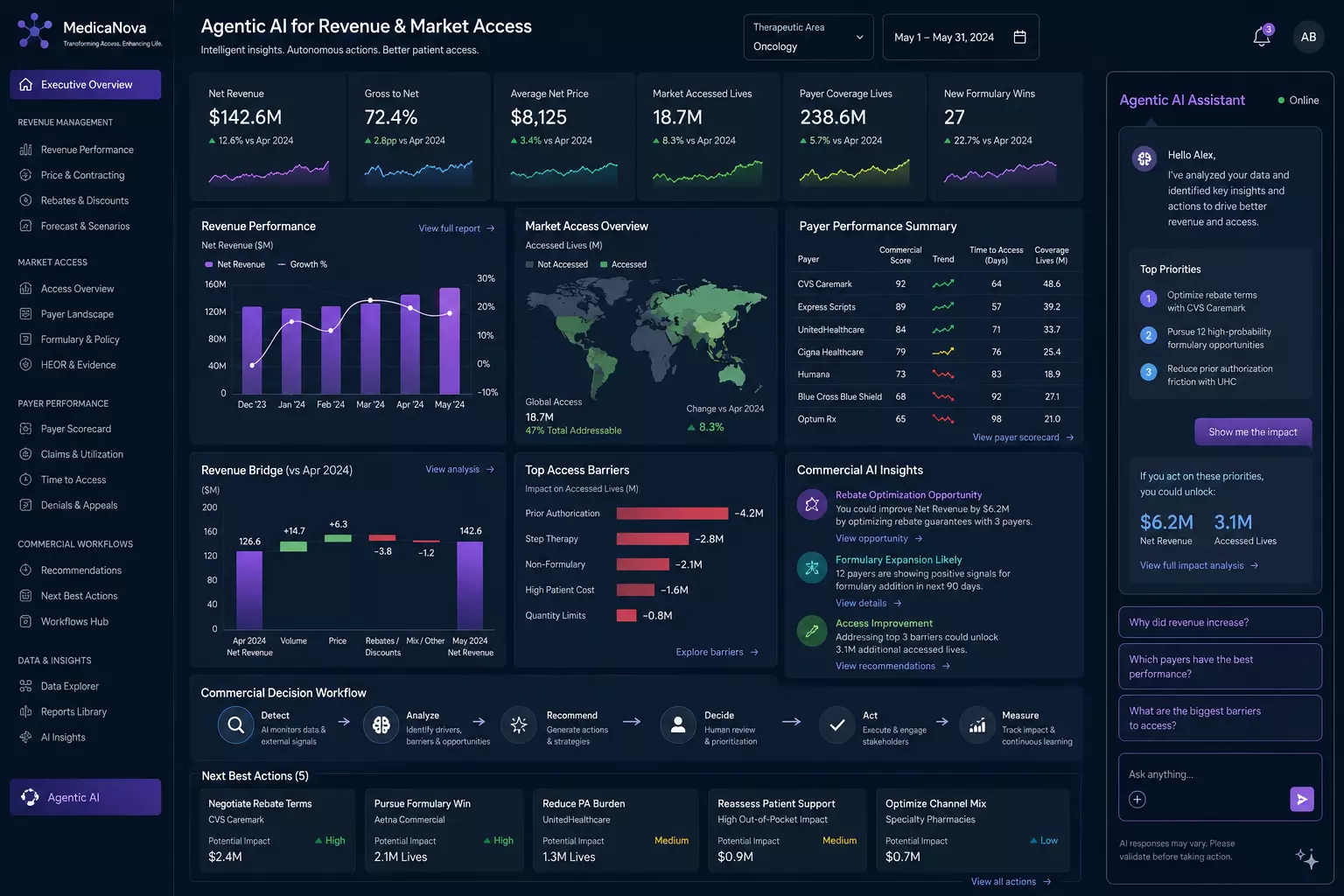
Agentic AI in Life Sciences: The Future of Revenue Management
The pharmaceutical and biotechnology industries have spent decades accumulating more data than they have ever been able to act on efficiently.
Clinical trial outputs, prescribing behavior records, payer contract performance, patient journey analytics, and real-world evidence databases sit in systems that rarely communicate at the speed commercial operations actually require.
The gap between what organizations know and when they can act on it is one of the most persistent and costly structural inefficiencies in pharmaceutical commercial operations.
Artificial intelligence has begun to change this — but the shift that matters most right now is not AI that assists. It is AI that acts.
Agentic AI in life sciences refers to systems capable of autonomous multi-step decision-making and task execution without requiring constant human direction at each stage.
Unlike conventional AI tools that surface a recommendation and return control to a human decision-maker, agentic systems monitor inputs continuously, identify the appropriate response, and initiate action across connected platforms — compressing timelines that previously required full planning cycles into near-real-time operational loops that match the actual pace of market change.
What Distinguishes Agentic Systems From Conventional AI
The distinction is not cosmetic. Most pharmaceutical organizations have deployed AI that functions as an advanced analytical layer —
useful for generating better insights, but still dependent on human bandwidth to translate those insights into commercial action.
That dependency creates a structural ceiling: execution speed is bounded by how quickly teams can receive, process, and act on outputs. A recommendation that is not acted on within the window its market context is still accurate becomes a historical artifact, not an operational advantage. Agentic systems are architecturally designed to operate above that ceiling.
In practice, this means a system that can detect early HCP adoption signals in a new geography, cross-reference them against payer access data and competitive activity,
update targeting priorities accordingly, and push deployment instructions into field execution systems — all without requiring a weekly commercial review meeting to initiate the sequence.
The applications extend across regulatory affairs workflow management, pharmacovigilance signal routing, clinical site selection, and patient recruitment optimization. The common thread across every application is organizational latency being systematically removed from processes that have always been constrained by it.
Where Revenue Operations Feels the Impact Most
Commercial decision-making in biopharma is not forgiving of slow intelligence cycles.
Pricing strategy, contracting logic, channel investment allocation, and market access management sit at the intersection of high-stakes institutional complexity and rapidly shifting market conditions.
Decisions made on data that is two weeks old in a market moving daily are not suboptimal in a minor, recoverable way — they are operationally misaligned with the environment they were designed to address.
This is where AI in revenue management is producing results that traditional analytical approaches cannot structurally match.
Systems applied to revenue operations analyze payer behavior patterns, detect contract performance drift before it becomes an entrenched trend,
model competitive pricing scenarios in real time, and recommend access strategy adjustments with enough precision and speed to be actionable within the planning cycle that generated the underlying data.
The human oversight function shifts from initiating analysis to reviewing and approving recommendations — a compressed but considerably more informed role.
The Infrastructure Gap That Most Organizations Are Still Closing
The capability exists. The limiting factor for most pharmaceutical organizations is not the AI itself — it is the data architecture that sits beneath it.
Agentic systems require clean, complete, and continuously updated inputs from commercial, medical, and market access functions simultaneously.
Most organizations still operate with significant data fragmentation across these functions, which means the cross-functional intelligence that would make agentic workflows most powerful does not arrive in a usable form at the moment decisions need to be made.
The governance design problem runs parallel to the technical one. Deploying agentic AI in a pharmaceutical commercial environment safely requires well-defined rules about what systems are authorized to initiate independently, what decisions require human review before execution, and how edge cases escalate within the organization.
Companies that skip this governance design work discover quickly that an agentic system without clear operational boundaries does not produce autonomous efficiency — it produces autonomous errors at commercial scale.
Read: Enhancing Customer Experience with Real-Time Automation
Building the Model That Compounds Over Time
The organizations investing now in the data infrastructure and organizational governance required to support agentic AI in life sciences are not pursuing a technology upgrade.
They are building a commercial operating model whose performance compounds with each cycle — one where every market engagement generates more refined intelligence, and every intelligence cycle enables faster and more precise execution than the iteration before it.
AI in revenue management, integrated within this agentic commercial layer, does not simply improve individual pricing or access decisions at the margin.
It changes the organizational speed at which market learning becomes operational action.
In pharmaceutical commercial operations, that speed — the ability to detect a signal, understand its implications, and respond before competitors have even assembled the data to formulate a response — is the most durable competitive advantage available to organizations willing to build the infrastructure required to sustain it.