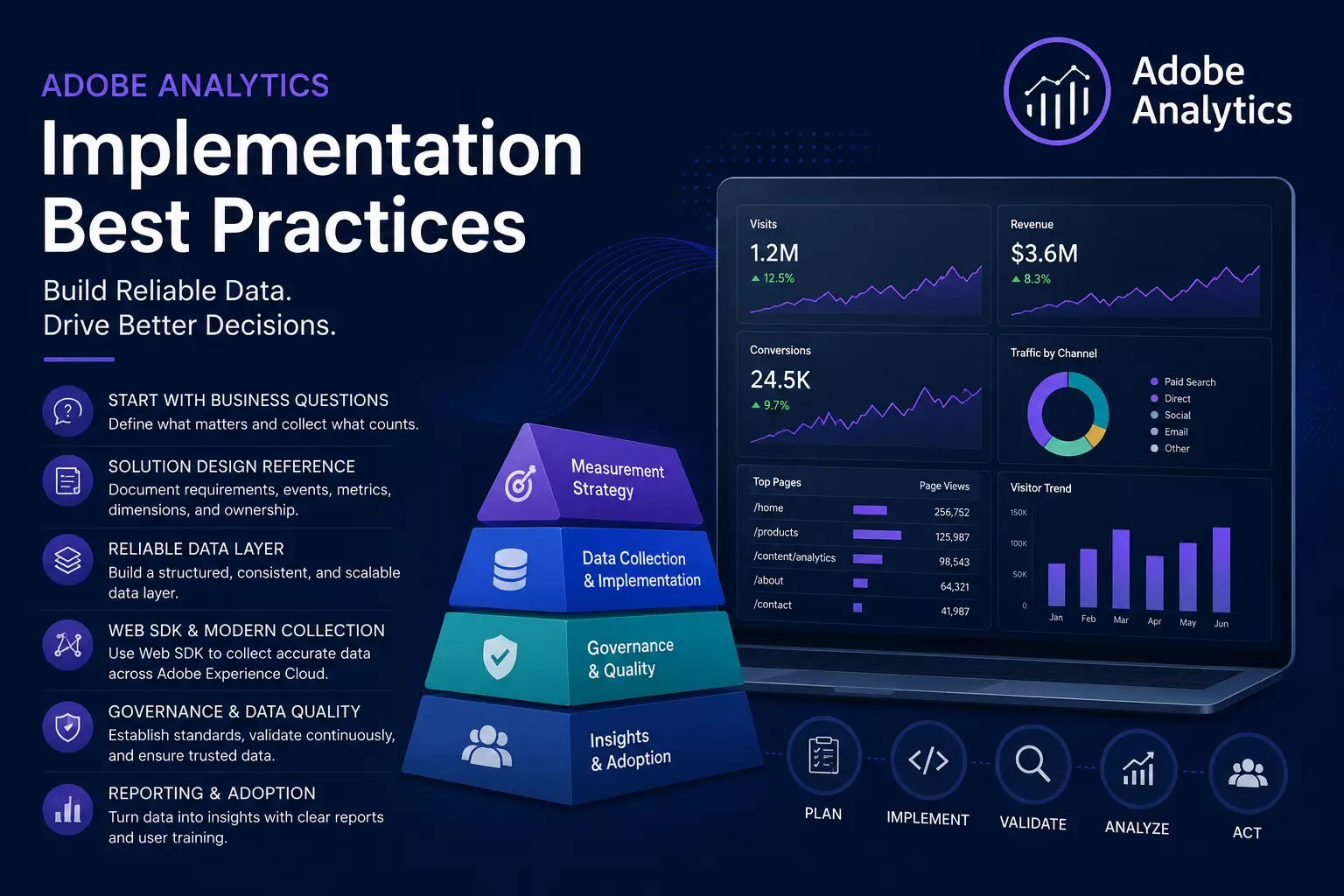
Adobe Analytics Implementation Best Practices for US Businesses
Adobe Analytics can provide detailed digital measurement, but the platform is only as reliable as the implementation behind it.
When tracking is inconsistent, naming conventions drift, data layers are incomplete, or governance is weak, teams may have dashboards but still lack trustworthy answers.
A strong Adobe Analytics implementation starts with measurement design. Business questions should be translated into a solution design reference, data layer requirements, event definitions, dimensions, metrics, processing rules, and reporting needs. The implementation should then be validated continuously.
DWAO's current implementation guidance specifically recommends creating a solution design reference before touching tags, building a structured data layer, collecting through the Web SDK, planning report suites for the organization's future state, and treating governance as an implementation deliverable.
Start With Business Questions
Analytics implementation should begin with questions, not variables. Marketing leaders may want campaign attribution.
Product teams may need feature adoption. Ecommerce teams may want conversion and merchandising insights. Executives may need customer journey and revenue views.
Once questions are documented, the implementation team can determine which events, dimensions, metrics, identities, and data sources are required. This approach prevents teams from collecting large volumes of data that no one uses.
Create a Solution Design Reference
The solution design reference acts as the contract between business requirements and technical implementation. It should define business objectives, tracking requirements, naming conventions, events, dimensions, classifications, calculated metrics, data sources, and ownership.
A well-maintained document also makes onboarding and future changes easier. When a developer or analytics engineer changes, the organization does not have to reconstruct the implementation from scattered tags and dashboards.
Build a Reliable Data Layer
A structured data layer separates business information from the page's presentation code. This makes analytics collection more resilient because data definitions are less dependent on individual UI elements.
The data layer should be designed around consistent objects and values. Product IDs, page types, logged-in status, customer identifiers, campaign information, and conversion events should have clear definitions. Governance should specify who owns each field and how changes are approved.
Web SDK and Modern Data Collection
Adobe's Web SDK can provide a modern collection approach for Adobe Experience Cloud implementations. The technical architecture should be designed carefully around identity, consent, event data, schemas, and downstream destinations.
The key point is that implementing a newer collection technology does not automatically create better analytics. The data model and business definitions still need to be correct. Technology should support a clear measurement strategy rather than replace it.
Governance Is Part of Implementation
Governance should define naming standards, ownership, access, documentation, testing, release procedures, and data-quality expectations. Without governance, analytics implementations tend to accumulate duplicate metrics, inconsistent values, unused variables, and conflicting dashboards.
Governance also matters when multiple regions or business units share an Adobe Analytics environment. A common framework can preserve comparability while still allowing local requirements.
Read: Web Development Company Best Practices for Modern
Validate Continuously
Validation should happen during development, QA, UAT, and after release. Teams should compare expected events with actual network calls, confirm values in reporting, test edge cases, and monitor for unexpected changes.
A release should not be considered successful simply because a page loads. Analytics needs its own acceptance criteria. DWAO's implementation guidance emphasizes continuous validation rather than a one-time check.
Reporting and Adoption
The final goal is not data collection. It is decision-making. Dashboards should be designed around the decisions stakeholders need to make. A report that contains hundreds of metrics may look comprehensive but can be less useful than a focused scorecard with clear definitions.
Training should explain not only where to find a report but how the metrics were calculated, what they do and do not mean, and which decisions they can support.
Choosing an Adobe Analytics Partner
Look for a partner that can demonstrate both technical implementation and analytics strategy. Ask to see how they handle solution design, data-layer architecture, Web SDK, QA, governance, migration, reporting, and documentation. Ask who owns the implementation after launch and how changes will be controlled.
A strong partner should be able to explain technical decisions to analysts, marketers, product managers, and engineers without creating separate definitions for each audience.
Conclusion
Adobe Analytics becomes valuable when businesses can trust the data and use it consistently.
A disciplined implementation combines business requirements, solution design, structured data collection, governance, validation, reporting, and training. The best implementation is not the one that collects the most data; it is the one that reliably answers the most important business questions.
Adobe Analytics Data Quality Framework
A mature Adobe Analytics program should define data-quality checks as ongoing controls. Teams can monitor unexpected drops in events, sudden changes in dimensions, missing values, duplicate tracking, broken campaign parameters, and discrepancies between analytics and trusted business systems.
A data-quality framework should assign ownership for each issue and define escalation. This turns analytics from a collection of dashboards into a governed measurement capability. It also reduces the risk that leadership decisions are made using silently broken data.
FAQs
What is Adobe Analytics implementation?
It is the process of designing and configuring Adobe Analytics measurement, data collection, variables, events, reporting, integrations, testing, and governance.
Why is a data layer important?
A structured data layer makes tracking more consistent and less dependent on page presentation or individual UI elements.
What is a solution design reference?
It is a documented mapping between business measurement requirements and the technical analytics implementation.
How often should Adobe Analytics be validated?
Validation should occur continuously during development, QA, UAT, releases, and after major site or implementation changes.