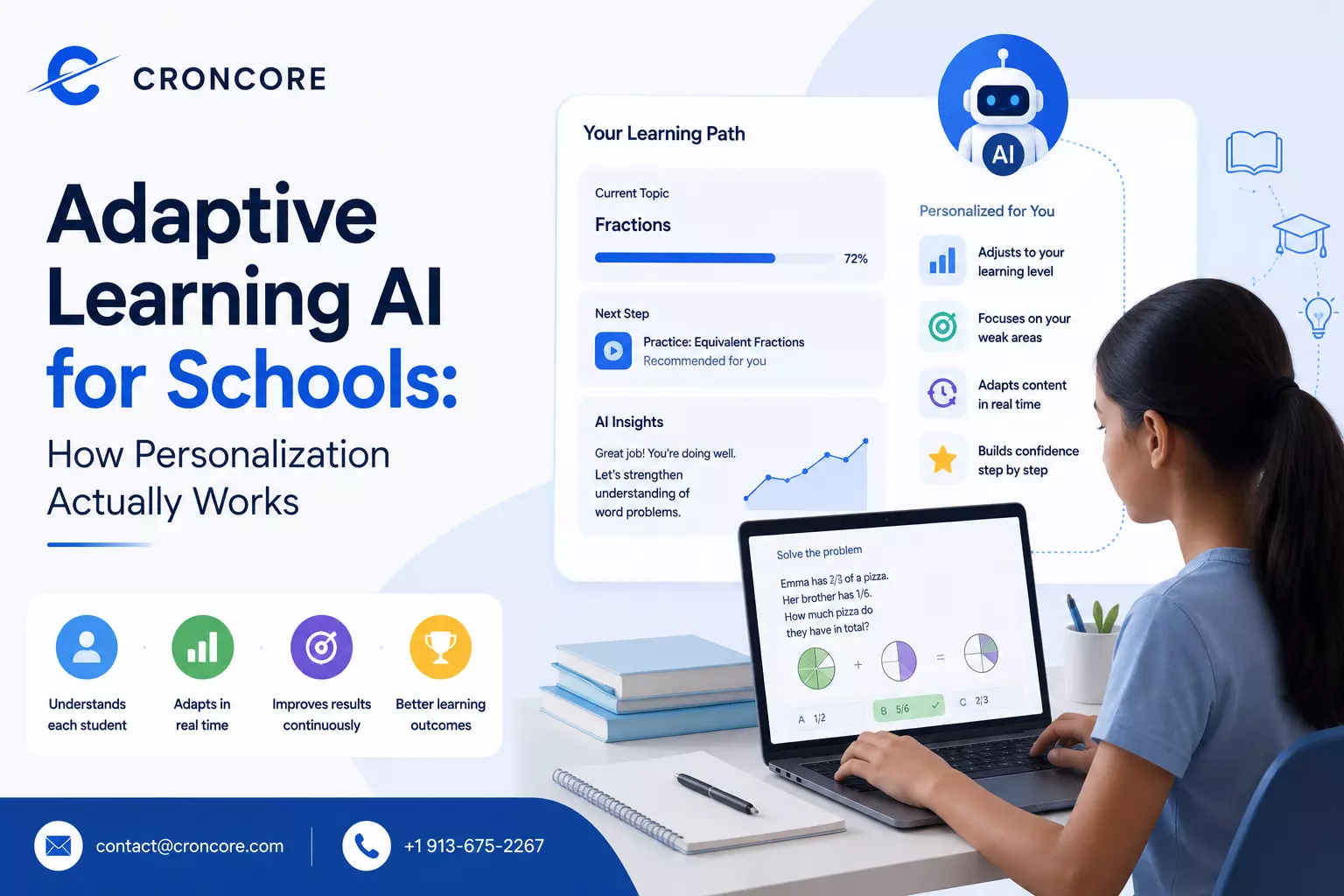
Adaptive Learning AI for Schools: How Personalization Actually Works
"Personalized learning" has been a buzzword in education for long enough that it barely means anything on its own anymore. Most platforms that claim to personalize the experience really just let students pick a topic or adjust a difficulty slider manually.
Real adaptive learning AI for schools works differently, it continuously adjusts based on how a student is actually performing, without requiring the student or teacher to manage that process by hand.
What "Adaptive" Actually Means
An adaptive system tracks how a student answers over time, not just whether a single response was right or wrong. It looks at hesitation, common mistake patterns, which concepts a student has clearly mastered, and which ones keep tripping them up.
Based on that, it adjusts pacing, difficulty, and even how a concept gets explained, sometimes offering a simpler explanation, sometimes a different approach entirely, rather than repeating the same material louder.
Why Static Content Plus a Chat Window Is Not Adaptive
A lot of platforms bolt an AI chat feature onto a fixed curriculum and call it personalized. That is not the same thing. If the underlying lesson sequence never changes regardless of how a student is doing, the AI is answering questions in isolation, not actually adapting the learning path.
Genuine adaptive learning AI for schools has to sit underneath the curriculum, shaping what comes next, not just responding to what a student happens to ask.
Read: How AI-Driven LMS Administration Services Improve Student
Data Has to Be Structured and Ongoing
Adaptive systems depend on having a structured record of student performance across sessions, not a single conversation with no memory of what happened last week.
This is part of what separates a real AI tutoring platform from a general chatbot with an education skin, the ability to build on prior sessions instead of treating every interaction as the student's first.
Teachers Still Need to Be in the Loop
Adaptive does not mean autonomous. A well-designed system gives teachers visibility into how a student is progressing, where they are consistently struggling, and what the AI has adjusted in response. Platforms that operate as a black box, with no reporting back to the teacher, tend to see lower trust and slower adoption in actual classrooms, even when the underlying personalization is technically strong.
Compliance Still Applies
Because adaptive learning depends on continuously collecting and analyzing student performance data, it raises the same questions any EdTech AI product has to answer around student privacy.
Any system doing this work needs to be FERPA and COPPA compliant AI by design, since the ongoing data collection that makes adaptivity possible is exactly the kind of information these regulations are meant to protect.
What Schools Often Get Wrong When Evaluating These Tools
The most common mistake is judging a platform's personalization based on a short demo, where almost any system can look responsive over a handful of questions.
Real adaptivity only becomes visible over weeks of actual use, once there is enough performance history for the system to meaningfully adjust.
Asking a vendor how the platform behaves after a month of use, not just in a first session, is a better way to evaluate whether the adaptivity is real or just a well-designed demo.
The Bottom Line
Adaptive learning AI for schools is only as good as the data it builds on and the degree to which it actually reshapes the learning path, not just the responses to individual questions.
A platform built around ongoing student performance, with teacher visibility and compliance built in from the start, is what separates genuine personalization from a chatbot dressed up as one.