A4 vs C4 Envelope: Size Difference and Uses for Indian Businesses
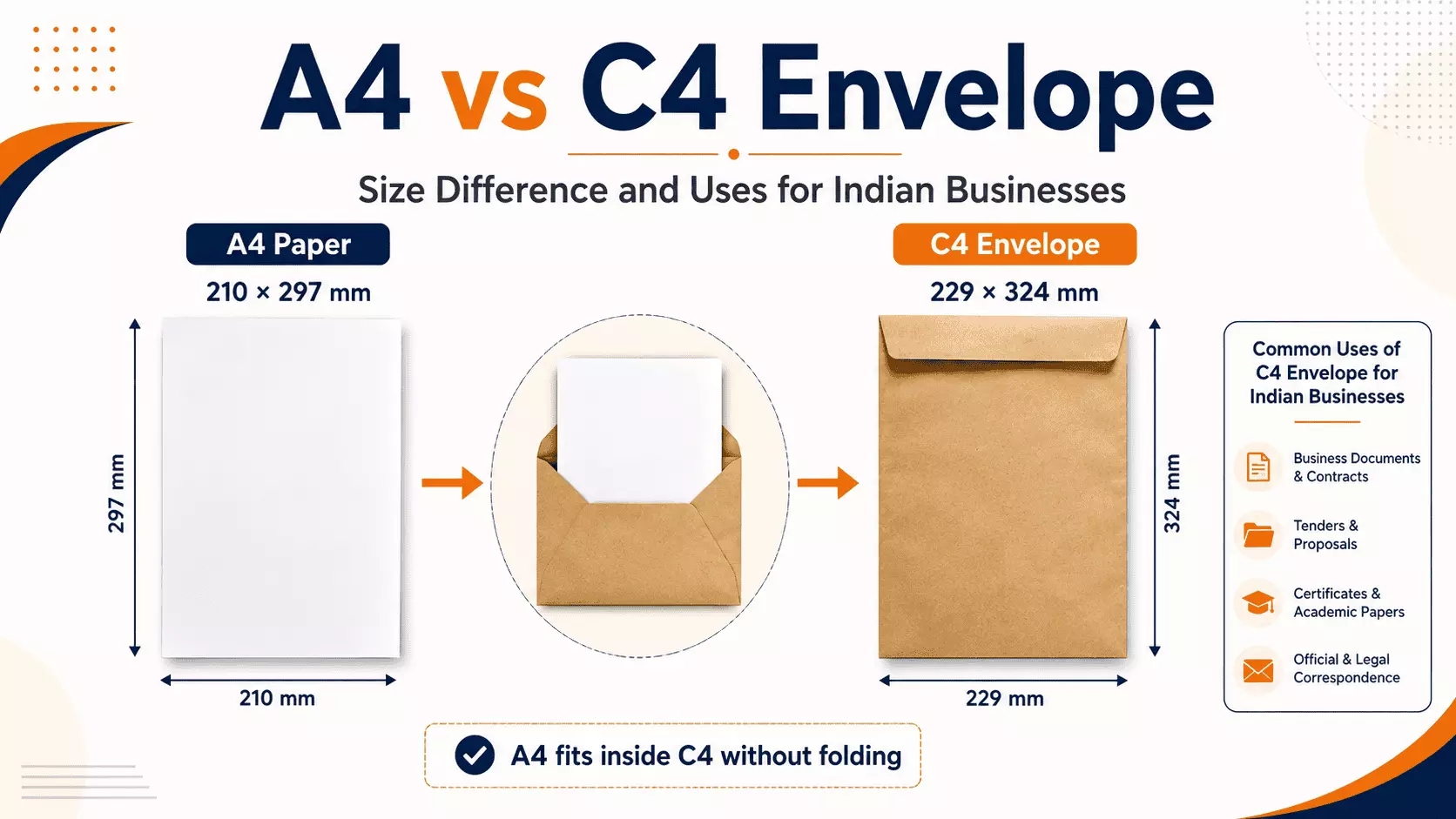
Many businesses use the terms “A4 envelope” and “C4 envelope” as if they mean the same thing. However, they refer to two different formats. A4 is a paper size, while C4 is an envelope size designed to hold an A4 sheet without folding.
Understanding this difference can help businesses avoid ordering the wrong envelope, damaging important documents or spending money on reprinting and replacement packaging
An A4 sheet measures 210 × 297 mm, while a C4 envelope measures 229 × 324 mm. The C4 envelope is slightly larger, allowing an A4 document to fit inside flat without folding.
What Is A4 Paper Size?
A4 is one of the most commonly used paper sizes in India. It measures:
- 210 × 297 mm
- 21 × 29.7 cm
- 8.27 × 11.69 inches
A4 paper is commonly used for:
- Business letters
- Invoices
- Certificates
- Contracts
- Reports
- Proposals
- Legal documents
- Application forms
A4 describes the size of the paper, not the envelope. The term “A4 envelope” is commonly used in the market, but buyers should always check the actual envelope dimensions before placing an order.
What Is a C4 Envelope?
A C4 envelope measures:
- 229 × 324 mm
- 22.9 × 32.4 cm
- 9.02 × 12.76 inches
It is larger than an A4 sheet, making it suitable for documents that should remain flat. Businesses commonly use C4 envelopes for certificates, contracts, tenders, reports, brochures and other important papers.
Because the document does not need to be folded, it arrives in a cleaner and more professional condition.
A4 Paper vs C4 Envelope Size
Format
Size in mm
Size in cm
Size in inches
Main use
A4 Paper
210 × 297
21 × 29.7
8.27 × 11.69
Letters, invoices and reports
C4 Envelope
229 × 324
22.9 × 32.4
9.02 × 12.76
Holds A4 paper without folding
C5 Envelope
162 × 229
16.2 × 22.9
6.38 × 9.02
Holds A4 paper folded once
DL Envelope
110 × 220
11 × 22
4.33 × 8.66
Holds A4 paper folded into thirds
This comparison shows why businesses should select envelopes according to how the document will be presented.
Read:Best Locations for Acreage Homes Built in Adelaide
Why Does This Naming Confusion Cost Businesses Money?
Ordering the wrong envelope may appear to be a small mistake, but it can create several problems.
Documents may need to be folded
Certificates, contracts and presentation documents often look less professional when folded. Creases may also affect signatures, stamps and printed designs.
Envelopes may be too small
Some suppliers use “A4 envelope” as a general term without confirming the measurements. A smaller envelope may not fit the document properly.
Orders may need to be replaced
Bulk envelope orders can be expensive. If the selected size is incorrect, the business may need to reorder the entire quantity.
Printing artwork may not fit
A logo or address design prepared for a C4 envelope may not fit correctly on a smaller format. This can lead to artwork changes, printing delays and additional costs.
Which Envelope Size Should You Choose?
Choose a C4 envelope when:
- The A4 document must remain flat
- You are sending certificates or contracts
- The document includes photographs or presentation pages
- Professional appearance is important
- Folding may damage the document
Choose a C5 envelope when:
- Folding the A4 sheet once is acceptable
- You need a more compact mailing format
- The contents include standard letters or notices
Choose a DL envelope when:
- The A4 sheet can be folded into thirds
- You are sending invoices, statements or regular business letters
- You need a common office-mailing format
A Simple Business Example
Suppose a company needs to send 500 certificates to employees or event participants. If it orders a smaller envelope, every certificate may need to be folded. This reduces the quality of presentation and may create a poor first impression.
A C4 envelope allows each certificate to remain flat. It may also be customised with the company logo, address and brand colours for a more professional appearance.
Businesses that regularly send unfolded A4 documents can consider using custom C4 envelopes with their company branding and contact details.
Common Envelope Ordering Mistakes
Before ordering envelopes, avoid these common mistakes:
- Selecting an envelope using only the name
- Not checking dimensions in millimetres
- Confusing paper size with envelope size
- Forgetting to check whether documents must be folded
- Creating artwork before confirming the envelope dimensions
- Ordering a large quantity without reviewing a sample or proof
Always confirm the size, material, printing area, quantity and closure type before finalising an order.
Frequently Asked Questions
Is A4 an envelope size?
No. A4 is a paper size measuring 210 × 297 mm.
Which envelope fits A4 paper without folding?
A C4 envelope measuring 229 × 324 mm holds an A4 sheet flat.
Is a C4 envelope larger than A4 paper?
Yes. A C4 envelope is slightly larger so an A4 sheet can fit inside comfortably.
What is the difference between C4 and C5 envelopes?
A C4 envelope holds A4 paper flat, while a C5 envelope holds A4 paper folded once.
Which envelope is suitable for certificates?
A C4 envelope is suitable when certificates need to remain flat and unfolded.
What size envelope is used for invoices?
DL envelopes are commonly used when an A4 invoice is folded into thirds. C4 envelopes can be used when the invoice must remain flat.
Final Thoughts
The difference is simple: A4 is the document size, and C4 is the envelope size that holds it without folding.
Before placing an envelope order, check the exact measurements instead of relying only on names such as “A4 envelope.” Choosing the correct format protects important documents, improves presentation and helps businesses avoid unnecessary printing and replacement costs.