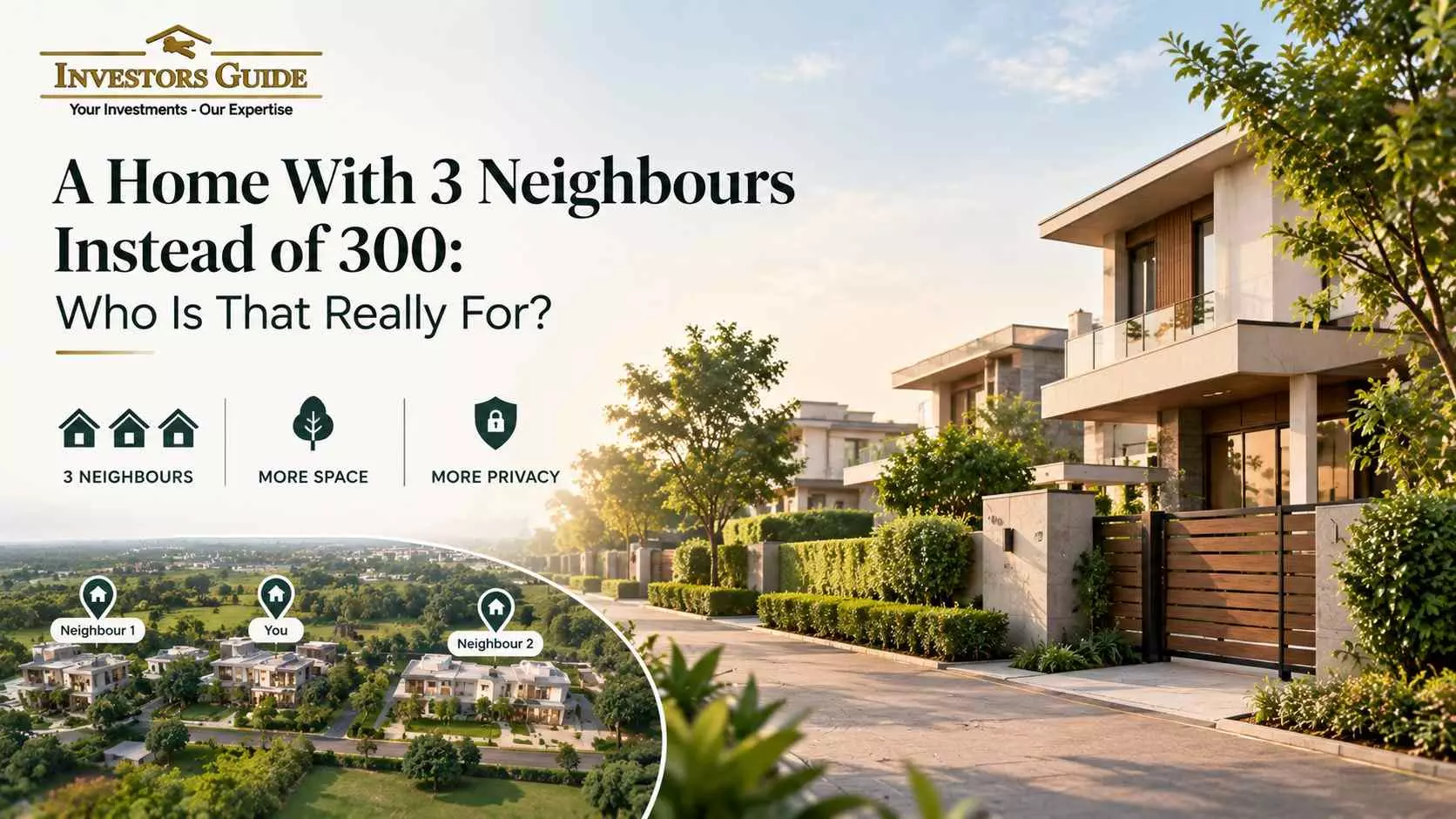
A Home With 3 Neighbours Instead of 300: Who Is That Really For?
A building with about three other households instead of a tower shared by hundreds suits people who value privacy, a quiet entrance, a sense of knowing who lives around them and a smaller, simpler community.
It suits less well those who want large shared amenities, a lively social scene, the lowest possible price per square foot or easy short-term rentability. “Three neighbours” is also a claim to test, because it depends on how many homes share each building.
In Sector 63A, Gurugram, Laburnum Victory Floors is a low-rise project buyers often consider for this reason.
Where the “Three Neighbours” Number Comes From
Low-rise floor projects are usually built as small buildings of a stilt (parking) level plus four floors of homes. If each floor has one home, a building has four households, which means three neighbours besides you. If each floor has two, a building has eight households, and you have seven neighbours.
So the number depends entirely on the layout. For Laburnum Victory Floors, public listings describe stilt plus four floors with private access for each unit, in Sector 63A on Golf Course Extension Road, on a land parcel of about 2.5 acres.
But listings disagree on the project’s size. One describes about 236 units across 22 buildings, another about 250 units, and a third describes 62 buildings.
The arithmetic shows why this matters:
- About 250 homes across 62 buildings works out to roughly 4 homes per building, which would mean about three neighbours.
- About 236 homes across 22 buildings works out to roughly 11 homes per building, which would mean about ten neighbours.
Both can’t be right. These are my own calculations from conflicting marketing numbers, so ask the developer for the actual count per building and check the sanctioned plans.
Who a Few-Neighbours Home Really Suits
Families who value privacy
If you dislike crowded lobbies and prefer to know who is on the stairs, a small building helps. The same few faces make a place feel familiar and calmer.
Households with children
Small buildings and low-rise layouts can feel easier for children, who can be closer to the ground, closer to parents and closer to neighbours they know by name. Check safety features such as gating, parking layout and traffic inside the project.
Older family members
Fewer steps between home and street level, shorter waits and fewer strangers can matter more with age. Check whether the building has a lift, since not all low-rise buildings do.
People who value a “home” feel over a “complex” feel
Some buyers prefer a street, a gate and a building of a few families to a tower with a clubhouse. If that describes you, low-rise living fits.
Buyers who prefer simpler management
Fewer households mean fewer people to coordinate decisions, and often smaller monthly charges, since there are fewer shared facilities. This varies by project.
Owners who plan to stay long
Long-term residents gain most from knowing their neighbours and from a calm environment, and they are less affected by thinner rental or resale markets.
Who It May Not Suit
People who want big shared amenities
Low-rise floor projects usually have fewer or smaller shared facilities than a high-rise with a clubhouse, pool and gym. If you’ll use those daily, a tower may serve you better.
Those who want a busy social community
With few households per building, there are fewer casual encounters. If you want a lively scene, you may find it quiet.
Buyers focused on the lowest price per square foot
Compare total cost, including parking, taxes and charges. Price per square foot alone can mislead, since low-rise and high-rise products differ in what’s included.
Investors who need easy rentability
Larger family homes can have a narrower tenant pool and moderate rental yields, and resale can take time. Check how comparable homes actually rent and sell.
Anyone who dislikes sharing walls, stairs or parking
Small buildings mean close contact. A difficult neighbour has a large effect when there are only a few households.
Buyers who want everything on site
Check how far daily needs are, since smaller projects rarely include shops or services.
Read: Tile and Grout Cleaner 101: Revive Your Floors Today
What You Trade for Fewer Neighbours
- Amenities for privacy. Smaller communities can’t usually support big shared facilities.
- Community scale for community depth. You know a few households well instead of many slightly.
- Anonymity for familiarity. Neighbours notice your comings and goings.
- Convenience for control. Fewer shared systems can simplify things, but quality still depends on construction and upkeep.
How to Verify the Claim
- Get the building plan. Count the homes per floor and per building for the exact tower you’re considering.
- Ask about the whole project. How many buildings and how many homes in total, and how do they share the gate, roads and parking?
- Check the entrance. Is access private to each home, shared or a mix?
- Look at shared walls and stairs. Which walls touch neighbours, and what sound insulation is specified?
- Ask about the lift. Is there one, and who uses it?
- Confirm what you own. Ask in writing whether you receive land share, parking and any roof or terrace rights.
- Check the status. Listings disagree on whether the project is ready to move or still being completed, so confirm in writing.
- Visit twice. Go at different times and speak to residents.
- Verify the registration on the Haryana RERA portal and have a lawyer review the agreement.
Common Mistakes to Avoid
- Taking the three-neighbours claim on trust without the building plan
- Trusting marketing numbers that disagree across websites
- Confusing homes per building with homes in the whole project
- Choosing privacy without checking sound insulation and layout
- Forgetting that fewer neighbours also means fewer shared amenities
- Skipping checks on ownership structure, parking and approvals
Fair Caveats
Small-building living suits some households very well and others not at all. Experiences depend on the people next door, the quality of construction and how the project is managed.
Project details here come from public listings that conflict, and I couldn’t confirm ownership structure, unit counts or status from official records. This article is general information, not investment or legal advice.
Count the Neighbours Before You Commit
Ask for the building plan, count the households who share your stairs and gate, and visit at different hours. If a small-building, low-rise home appeals, take a closer look at Laburnum Victory Floors and ask for written confirmation of homes per building, what you own and the current status.
FAQs
Who is low-rise floor living best for?
Households that value privacy, a calm entrance and knowing their neighbours, and who don’t need large shared amenities. It suits those wanting a busy social scene or the lowest price per square foot less well.
How many neighbours will I have in a stilt plus four building?
It depends on homes per floor. One home per floor means three neighbours, and two per floor means seven. Check the plan for your building.
How many units does Laburnum Victory Floors have?
Listings give different figures, such as 236 and 250 units, and different building counts. Confirm with the developer and the RERA record.
Are low-rise floors cheaper to maintain than towers?
Often, since there are fewer shared facilities, but it varies by project. Ask for maintenance charges in writing and compare total costs.
How do I check a project’s claims about neighbours?
Get the building plans, count homes per floor and building, visit at different times, speak to residents and verify on the Haryana RERA portal.