80G Registration Explained: How NGOs Can Unlock Tax Benefits for Donors
Donors give more freely when their contribution comes with a tax benefit attached. That single fact is why 80G registration matters so much to NGOs, trusts, and charitable institutions in India.
Without it, a donor writing a cheque to your organisation gets nothing back from the tax department. With it, they can claim a deduction on that donation, and that difference often decides whether a first-time donor becomes a repeat one.
This guide covers what 80 registration actually means, how it works alongside 12A, what the eligibility and document requirements look like, and where organisations commonly go wrong in the process.
What Is 80G Registration
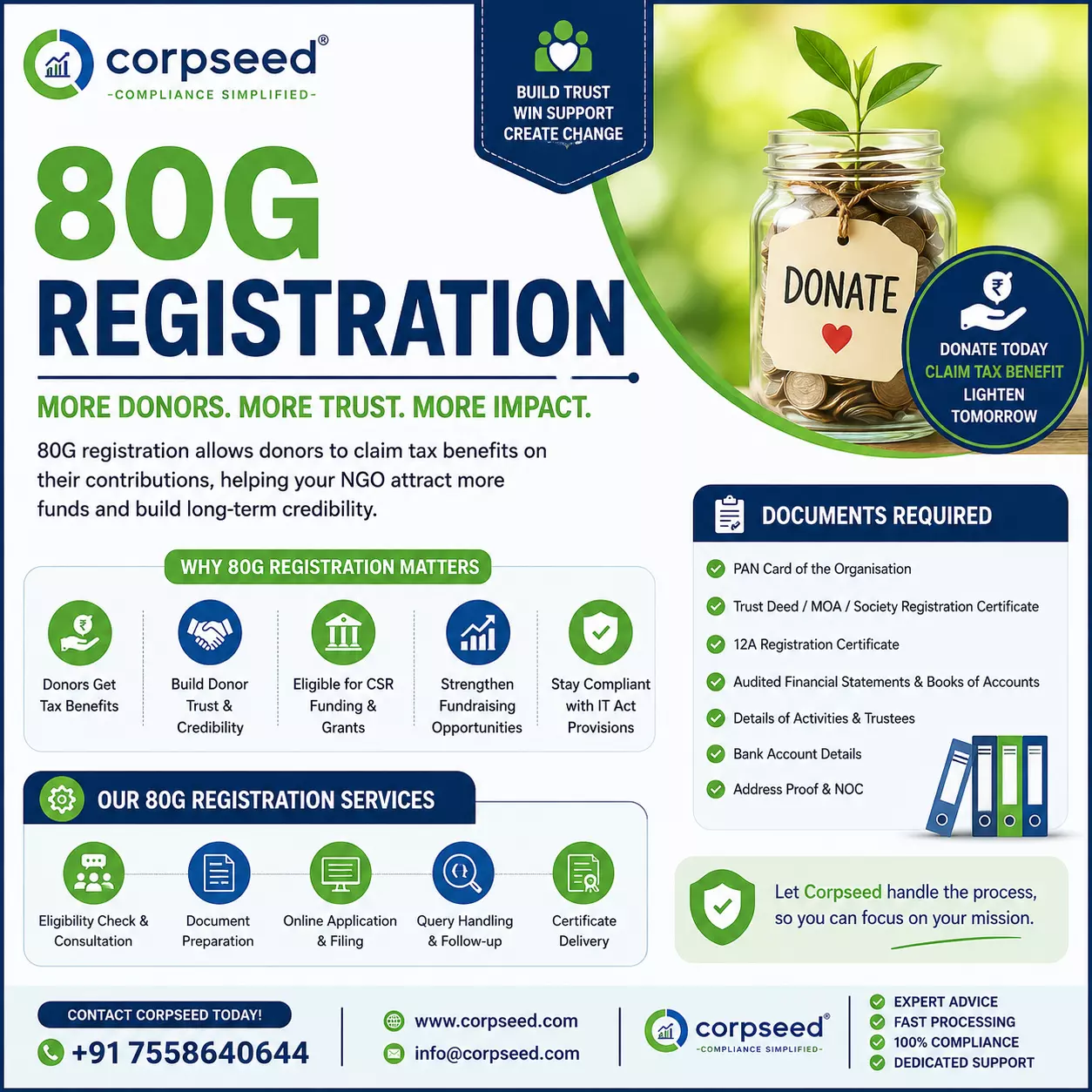
80G registration is an approval granted under Section 80G of the Income Tax Act, 1961, that allows donors to claim a tax deduction on the amount they contribute to a registered NGO, trust, or charitable institution.
The certificate itself is issued to the organisation, but the benefit flows to the person or entity making the donation.
Hence, for the NGO, the registration under Section 80G is important not due to its tax position, but rather due to donor confidence. When the NGO is registered as a charity, the Income Tax Department reviews its structure and mission, and thus donations made to it become legitimate contributions.
12A and 80G Registration: How They Work Together
Most organisations pursue 12A and 80G registration as a pair, and for good reason. Section 12A grants the NGO itself exemption from income tax on the funds it receives, provided that income is applied toward charitable or religious purposes.
Section 80G, on the other hand, benefits the donor by letting them deduct part of their contribution from their own taxable income.
Think of it this way: 12A protects the organisation's income from taxation, while 80G makes giving to that organisation more attractive to the public.
An NGO can technically hold one without the other, but most funders and larger donors specifically look for both certificates before committing to a contribution, since 12A alone says nothing about their own tax benefit.
Who Is Eligible for 80G Registration
Not every organisation qualifies automatically. To be eligible for 80G registration, your organisation generally needs to meet these conditions:
- It must be registered as a trust, society, or Section 8 company with a clearly defined charitable or religious purpose
- Its income or assets must be used exclusively for charitable objectives, not for the personal benefit of trustees, members, or their families
- It must maintain regular, audited books of accounts
- It must not spend on activities of a religious nature that benefit a specific religious community or caste, beyond the permitted limit
- It should generally hold 12A registration already, or apply for both together, since 80G approval usually depends on the organisation's charitable status being confirmed first
How to Apply for 80G Registration Online
The process runs through the Income Tax Department's e-filing portal, and it follows a fairly consistent path:
- Log in to the Income Tax e-filing portal using the organisation's registered credentials.
- Navigate to the registration section and select the application for approval under Section 80G, filing Form 10A for a fresh application or Form 10AB for renewal or conversion to permanent status.
- Fill in organisational details, including PAN, registration type, and objects of the trust or society.
- Upload the required documents, covering your constitution, financials, and activity records.
- Submit the application and note the acknowledgement number for tracking.
- Respond to any query the department raises during scrutiny, within the given timeframe.
- Receive your certificate once the department is satisfied that your organisation meets the eligibility conditions.
New organisations typically receive a provisional certificate first, valid for a limited period, which later needs to be converted to a regular certificate once the NGO has a track record of activity.
Tax Benefits Under 80G Registration
The primary advantage is very clear: donors are allowed to deduct 50% or, sometimes, even 100% of the donation amount from their taxable income, depending on the category of the receiving organization.
It should be noted that this deduction can only be applied to donations done via cheque, demand draft or online transfer. Donations in cash above a set limit, as well as in-kind donations of such things as services or goods, don’t count.
For the NGO, the indirect benefit is often more significant than the direct one.
Being registered makes the organization eligible for CSR funding from businesses, funding from foundations that require proof of tax exemption, and increased credibility while soliciting funds from donors with substantial donations.
Common Mistakes That Delay 80G Registration
- Applying for 80G before securing 12A registration, when the organisation's charitable status hasn't yet been formally recognised
- Submitting financial statements that aren't properly audited or don't match the activity report submitted
- Listing objects in the trust deed that are too broad or don't clearly establish a charitable purpose
- Missing the renewal deadline for a provisional certificate, which can lapse the registration entirely
- Inconsistent details between the PAN, registration certificate, and application form
Get Help With 12A and 80G Registration
Between eligibility checks, document preparation, and tracking the application through the Income Tax Department's review, getting 80G registration right on the first attempt takes both time and familiarity with how the process actually works.
If you would rather have specialists handle it for you, Corpseed's 80G and 12A certificate registration service manages the entire process, from documentation to a dedicated account manager tracking your application until the certificate reaches you.
Frequently Asked Questions
What is 80G registration?
It is an approval under Section 80G of the Income Tax Act that lets donors claim a tax deduction on donations made to a registered NGO, trust, or charitable institution.
What is the difference between 12A and 80G registration?
12A exempts the NGO's own income from tax, while 80G lets the donor claim a deduction on the amount they contribute most organisations apply for both together.
Is 80G registration mandatory for NGOs?
It isn't mandatory to operate as an NGO, but without it, donors get no tax benefit for contributing, which makes fundraising significantly harder.
How long is an 80G certificate valid?
New organisations typically get a provisional certificate valid for a limited period, after which they need to apply for a regular certificate with a longer validity, subject to periodic renewal.
Can a newly formed NGO apply for 80G registration?
Yes. New organisations can apply for provisional 80G registration even without an extensive activity history, and later convert it to a regular certificate once they have a track record.
Do all donations qualify for a deduction under 80G registration?
No. Only donations made by cheque, draft, or digital transfer to an eligible registered organisation qualify cash donations beyond a set limit and in-kind contributions do not.
What is the 12A and 80G registration process online?
The 12A and 80G registration process online goes through the submission and verification of an application and documents via the Income Tax e-filing website. Eligible NGOs, trusts and societies can apply for the verification by the department and respond to queries from the Income Tax Department.
What is the 12A and 80G registration process?
The 12A and 80G registration process allows eligible charitable organisations to gain tax benefits and enable tax deductions for donors. It follows an eligibility test, submission of documents and applications, and verification by the Income Tax Department.
How to download 80G certificate online?
80G certificate can be downloaded online by accessing the Income Tax e-filing portal, and logging into the account of the organisation, and accessing the approval section for the 80G certificate.
What is 80G under the Income Tax Act?
80G of the Income Tax Act allows eligible donors to claim tax deductions on donations to registered organisations as per their category.
What is an 80G certificate?
An 80G certificate is issued to an eligible organization that has applied for and received approval for registration under section 80G. This certificate can enable the organization to claim tax deductions for donations under section 80G of the tax law.
What is 12A and 80G registration?
12A and 80G registration have different implications; 12A primarily deals with the charitable organization’s exemption from income-tax, and 80G registration allows donors to claim tax deductions for donations made to the organization.
How to check 80G registration status?
An organization can check its 80G registration status by logging into the income tax e-filing portal and entering its login credentials and application details. The portal should display the information concerning the application or approval.
How can I download my 80G certificate online?
You can find the relevant information about your organization’s 80G registration and download the certificate here . You will need to log in and search for the approved registration information to download the 80G certificate.