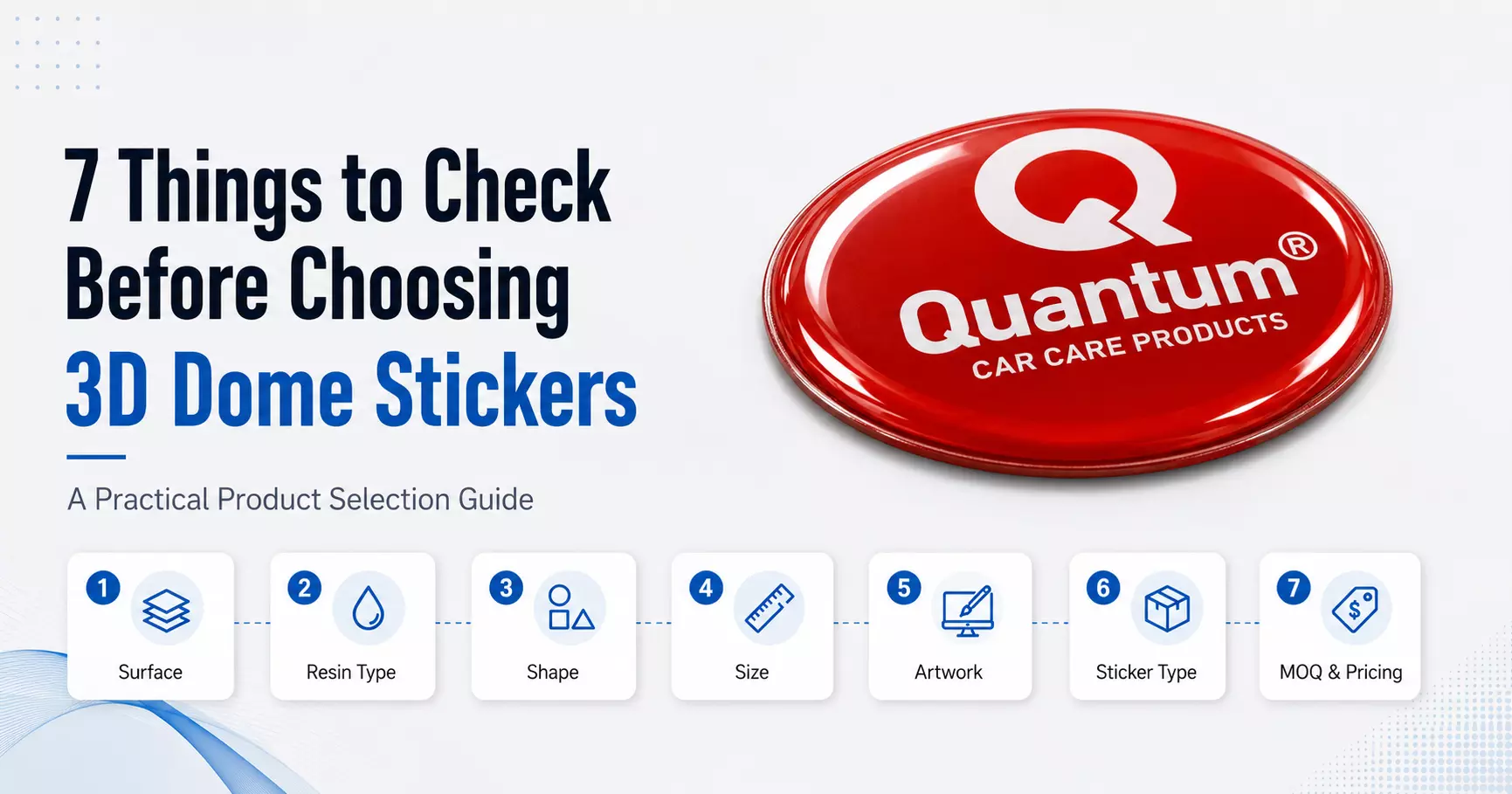
7 Things to Check Before Choosing 3D Dome Stickers
3D dome stickers are raised adhesive labels created by applying a clear resin layer over printed artwork. The resin gives logos, text and graphics a smooth, glossy and dimensional appearance, making dome stickers different from conventional flat labels.
They are commonly used on electronics, machinery, equipment, appliances, packaging and branded products.
However, choosing the right dome sticker involves more than selecting an attractive design. The application surface, resin, size, shape, artwork and order quantity should all be considered before production.
Before ordering 3D dome stickers, check the application surface, resin type, sticker size, shape, artwork quality, order quantity and intended environment. These factors help determine whether the finished label is suitable for the product and its intended use.
1. Check the Application Surface
Start by identifying exactly where the sticker will be applied.
Self-adhesive dome stickers generally work best on surfaces that are:
- Clean
- Dry
- Smooth
- Free from dust and oil
Depending on the adhesive specification, common application surfaces may include suitable plastic, metal, glass, painted panels and coated materials.
Surface texture matters because an adhesive designed for a smooth product surface may not perform the same way on rough, porous or highly uneven material.
Practical Tip
Before ordering a large quantity, test or confirm the sticker specification when the application involves an unusual surface, tight curve or demanding environment.
2. Choose the Appropriate Resin Type
The raised 3D appearance comes from the clear resin layer applied over the printed artwork.
Two materials commonly used for dome labels are epoxy resin and polyurethane (PU).
Epoxy Resin
Epoxy can create a clear, smooth, glossy and relatively firm dome over the printed design.
Polyurethane Resin
Polyurethane is another resin option used for some dome labels. Its physical characteristics differ from epoxy, so selection should depend on the intended application.
Factor
Epoxy Resin
Polyurethane (PU)
Appearance
Clear, glossy dome
Clear, glossy dome
Surface
Raised
Raised
Flexibility
Generally firmer
Generally more flexible
Selection
Application dependent
Application dependent
Best Practice
Confirm specifications
Confirm specifications
Avoid assuming that every resin dome has identical performance. If the sticker will be used around moisture, sunlight, chemicals or other demanding conditions, confirm the resin and adhesive specifications before production.
3. Select a Shape That Fits the Logo
The sticker shape should complement the artwork as well as the available product surface.
Common dome sticker shapes include:
- Rectangle
- Rounded rectangle
- Square
- Round
- Oval
- Other custom shapes where available
For example, a horizontal business logo may fit naturally inside a rectangular sticker, while a circular symbol may work better with a round shape.
The best shape is not necessarily the most decorative one. It should maintain the proportions and readability of the original design.
4. Measure the Sticker Area Carefully
Correct sizing is important for both appearance and usability.
A dome sticker that is too large may overlap product edges, controls or curves. A sticker that is too small may make the logo, text or graphic difficult to read.
Before finalising dimensions:
- Measure the available application area.
- Check the proportions of the logo.
- Leave sufficient space around nearby product features.
- Check whether the application area is flat or curved.
- Review text at the actual finished size.
Before finalising a specification, businesses can compare available options for custom dome stickers, including common shapes, sizes, materials and quantity configurations.
Example
If a logo contains long horizontal text, a rectangular format may preserve readability better than forcing the same artwork into a small round label.
5. Prepare Print-Ready Artwork
The quality of the original artwork can directly affect the printed result.
Vector artwork is generally suitable for logos because it can be resized without losing sharpness. High-resolution raster artwork may also work when prepared at the correct dimensions.
Before submitting artwork, check:
- Logo clarity
- Text readability
- Colour contrast
- Artwork proportions
- Safe spacing around important elements
- Final print dimensions
- Supported file format
Small text should be reviewed carefully because a design that looks clear on a large monitor may become difficult to read when reduced to the final sticker size.
Artwork Tip
View the design at approximately its real production size before approval. This can reveal text, spacing or proportion problems that are difficult to notice when artwork is heavily enlarged.
6. Decide Whether You Need a Dome Sticker or Regular Sticker
A raised resin label is not necessary for every application.
Comparing dome stickers with conventional stickers can help determine which format is appropriate.
Feature
3D Dome Stickers
Regular Stickers
Surface
Raised and dimensional
Flat
Clear Resin Layer
Yes
Usually no
Appearance
Glossy 3D effect
Depends on material
Texture
Smooth and raised
Generally flat
Typical Use
Product logos and branded labels
General labelling and promotion
Custom Shapes
Available
Available
Printing
Custom printing available
Custom printing available
Which Should You Choose?
Choose a 3D dome sticker when a raised, dimensional appearance is an important part of the product presentation.
Choose a regular sticker when a simple flat label is sufficient for information, general branding or promotional use.
Neither option is automatically better. The right choice depends on the application, visual requirement and budget.
7. Check MOQ, Quantity and Pricing
Custom dome sticker pricing can vary according to several factors.
These may include:
- Sticker size
- Shape
- Quantity
- Base material
- Resin specification
- Printing requirements
- Artwork preparation
Minimum order quantities may also apply.
Before placing an order, calculate how many pieces are actually required and whether the same design will be used across future production batches.
For business orders in India, it is also useful to check:
- Minimum order quantity
- Quantity increments
- Bulk pricing
- Custom-size availability
- Production requirements
- Artwork approval process
- Delivery requirements
A lower unit price is useful only when the specification is suitable for the intended product.
Common Applications of 3D Dome Stickers
3D dome stickers can be used across different commercial and product applications.
Electronics
Small raised labels can be used for logos and product identification on suitable electronic products and accessories.
Machinery and Equipment
Domed labels may be used for branding or identification on clean, smooth equipment surfaces.
Appliances
Compact custom labels can be used on selected household, office and commercial appliances.
Packaging
A raised label may be used as a visual branding element on suitable packaging applications.
Corporate and Promotional Products
Branded gifts and merchandise can also use 3D logo labels where a dimensional appearance is required.
Common Mistakes to Avoid
Some common mistakes can be avoided before production begins.
Choosing Size Without Measuring
Do not estimate the available product area visually. Measure it accurately before selecting the sticker dimensions.
Using Low-Quality Artwork
Blurred or compressed artwork can affect small logo details and text.
Ignoring the Application Surface
A suitable adhesive on one material may not be suitable for every surface.
Assuming All Resin Types Are Identical
Resin systems can have different physical characteristics. Confirm the appropriate specification for the intended environment.
Ordering Based Only on Price
Price matters, but the wrong material, dimensions or adhesive can make a low-cost order unsuitable for the actual application.
Quick Checklist Before Ordering
Use this checklist before finalising a dome sticker:
- Is the application surface suitable?
- What resin type is required?
- Does the shape match the logo?
- Are the dimensions correct?
- Is the artwork print-ready?
- Is the text readable at actual size?
- What quantity is required?
- Is there a minimum order quantity?
- Will the sticker face any special environmental conditions?
- Have the final specifications been confirmed?
Frequently Asked Questions
1. What should I check before ordering 3D dome stickers?
Check the application surface, resin type, shape, size, artwork quality, adhesive requirements, quantity and intended environment before confirming production.
2. What surfaces are suitable for dome stickers?
Dome stickers generally work best on clean, dry and smooth surfaces. Suitability for a specific material should be confirmed according to the adhesive specification.
3. What is the difference between epoxy and PU dome stickers?
Epoxy and polyurethane are different resin materials that can be used to form a raised dome. Their physical properties vary, so selection should depend on the application requirements.
4. How do I choose the correct dome sticker size?
Measure the available product area, check the logo proportions and make sure text remains readable at the final production size.
5. Are dome stickers better than regular stickers?
Dome stickers are suitable when a raised 3D appearance is required. Regular stickers may be more appropriate when a flat, general-purpose label is sufficient.
Conclusion
Choosing a 3D dome sticker should be based on more than appearance alone. The surface, resin, shape, dimensions, artwork, adhesive and order quantity all influence whether a finished label is suitable for its intended application.
The most practical approach is to start with the product itself: measure the available area, understand the surface, prepare suitable artwork and then select the sticker specification accordingly.
A clear specification before production can help avoid common sizing, artwork and material-selection problems while ensuring that the final dome label is appropriate for the product on which it will be used.