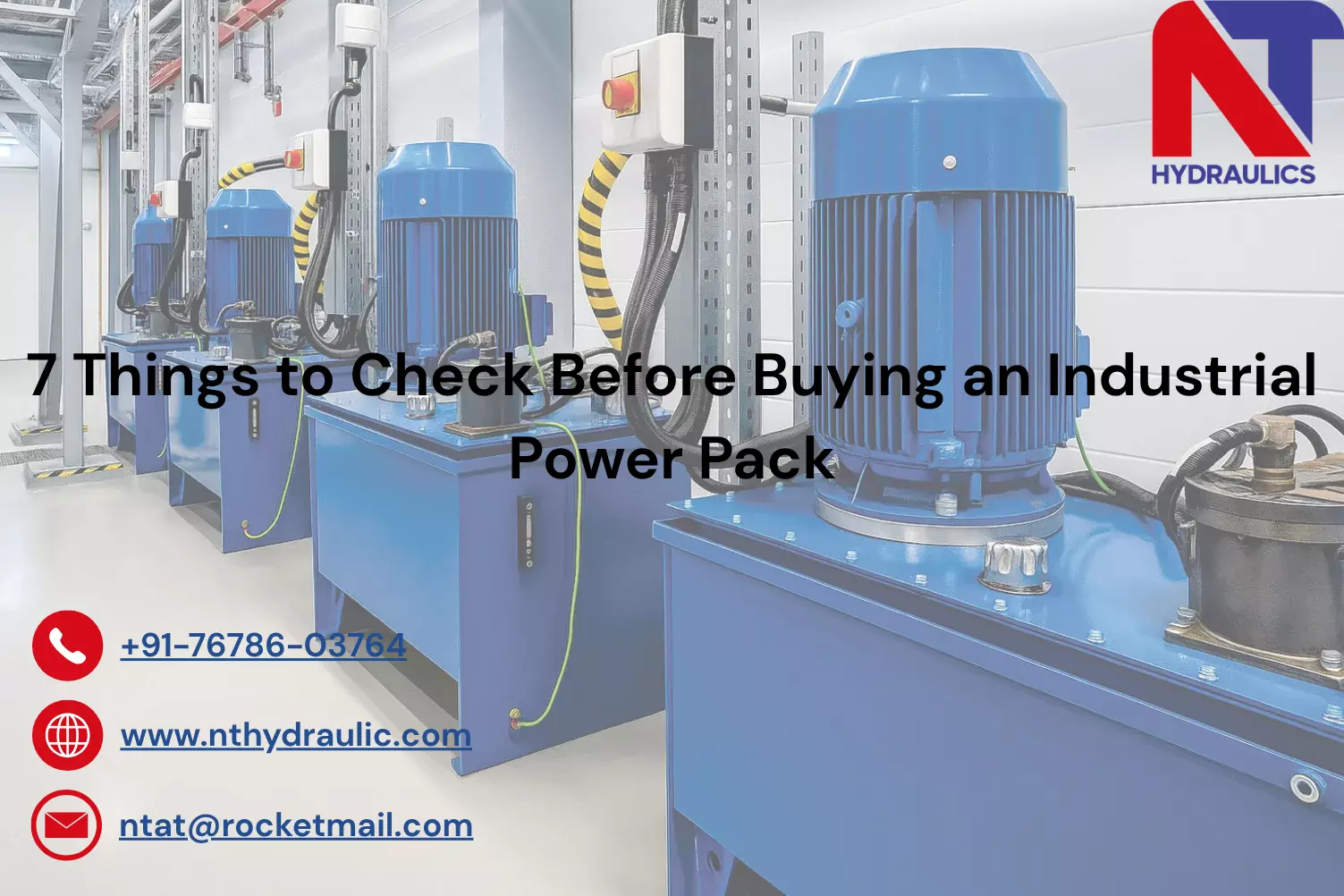
7 Things to Check Before Buying an Industrial Power Pack
A press operator in Faridabad once told us his line went down for six days because the power pack he'd bought had a pump rated for a duty cycle nobody checked. That's the story behind most bad purchases in this category.
A Power Pack looks simple from the outside — motor, pump, tank, some valves — and that simplicity is exactly why buyers skip the questions that matter. Most procurement teams compare price sheets from three Power Pack Manufacturers and pick the middle number. That's not evaluation. That's guessing with extra steps.
This isn't a list of specs to memorize. It's the checklist we wish more buyers used before signing a PO.
Specification: What's Actually Inside the Unit You're Buying
Tank Capacity + Pump Type + Duty Cycle These all work in conjunction.
The hydraulic power pack takes an external source of energy, which can be mechanical or electrical. The pump will convert this into fluid power, and the power pack comprises a tank (which stores the fluid), control valves and an electrically or mechanically driven pump.
Which is the problem.
Here's what buyers routinely overlook: pump type (gear, vane, or piston) determines noise, pressure ceiling, and service life far more than tank size does.
A gear pump handling 3000W at 24VDC with a 12-minute duty cycle behaves nothing like the same pump rated for a 2-minute cycle — and a spec sheet that doesn't state duty cycle at all should be treated as incomplete, not standard.
Motor Voltage and Pressure Range
Most industrial buyers in India need either single-phase 220V or three-phase 440V motors, depending on whether the unit runs continuously or intermittently. Match voltage and pressure range to your actual machine load. Not the load you had two product lines ago.
Objective: 5 Questions That Actually Separate Suppliers
1. What's your average lead time, in writing? A bad answer: "It depends." A real supplier gives a range tied to order size and stands by it.
2. Do you test every unit before dispatch, or only samples? Sample-only testing on a bulk order is a gamble you're taking, not the supplier.
3. What happens if a unit fails within 90 days? A supplier who says "we'll handle defects case by case" doesn't have a policy. That's a negotiation you'll lose after the shipment lands.
4. Can you share GST and export documentation upfront? Hesitation here, on a B2B order, is a red flag every time.
5. Who do I call when the unit is installed and something's off? If the answer routes back to a general inquiry number instead of a named engineer, plan on delays.
Benefits: Why the Right Power Pack Protects Your Margin, Not Just Your Machine
- Fewer unplanned shutdowns. A correctly specified pump-motor pairing cuts unscheduled downtime, which is the single biggest hidden cost in factory operations.
- Lower long-term maintenance spend. Units built with proper filtration and cooling need fewer oil changes and fewer emergency service calls.
- Predictable bulk pricing. Working with an established Power Pack Wholesaler gets you tiered pricing instead of one-off quotes that change every quarter.
- Faster reordering. A Power Pack Dealer who keeps standard configurations in stock cuts your replacement time from weeks to days.
- Export-ready documentation. If you're a brand owner selling machinery onward, your supplier's paperwork becomes your paperwork. Sloppy records upstream become your liability downstream.
- Reduced negotiation fatigue. A transparent defect policy means you're not renegotiating terms every time something goes wrong.
Read: Top Manufacturer of White Metal Bearing and Babbitt
Availability: Sourcing From the NCR Industrial Belt
Location matters more in this category than most buyers assume. Ghaziabad and the wider Delhi-NCR belt sit close to major component suppliers for valves, seals, and motors, which shortens the replacement-parts chain considerably.
That's a real advantage. It also means freight to western and southern India needs to be planned around, not assumed away — something buyers outside the region often discover only after placing their first order.
Wholesalers, procurement managers, and brand owners searching for Power Pack Suppliers in India or a Power Pack Manufacturers in India partner should ask where a supplier's actual manufacturing floor sits, not just where their sales office is registered.
About Us
We're N.T Associates, based in Ghaziabad, Uttar Pradesh. We manufacture and supply hydraulic power packs, cylinders, gear and vane pumps, directional control valves, and manifold blocks — and we also do in-house CNC precision machining, which means we're not assembling someone else's parts and calling it engineering.
One thing we've learned the hard way: buyers often ask for the highest pressure rating available, assuming more is always better.
It usually isn't. We've talked more than one client down from an oversized unit that would have cost them more in electricity and maintenance than the machine it was powering. That conversation doesn't happen with every supplier. It happens with one that actually wants your equipment to last.
Get a Quote From Our Team
Send us your required pressure range, tank capacity, and voltage — even a rough machine spec sheet works — and we'll respond within 24 to 48 hours with a configuration and price. Minimum order quantity for standard units is 1 piece; bulk pricing applies from 10 units onward. Wholesalers and dealers can request our current price list directly.
Conclusion
Buying a Power Pack isn't a five-minute price comparison, whatever the sales calls suggest. The buyers who will not allow you to stay at least in the top 3 positions are the ones who ask about the duty cycles, defect policies and documentation from the moment they receive the invoice. Get them answered at the top of the funnel.
FAQs
1. What is a Power Pack used for?
It powers hydraulic actuators — cylinders, motors — by converting electrical energy into pressurized fluid flow. You'll find them running presses, lifts, conveyors, and mobile equipment.
2. How do I choose between Power Pack Suppliers in India?
Check testing practices, defect policy, and whether they manufacture in-house or resell imported units. Price should be the fourth question, not the first.
3. What's the difference between a Power Pack Manufacturer and a Power Pack Dealer?
A manufacturer builds the unit; a dealer or wholesaler typically stocks and resells standard configurations. Custom pressure or voltage requirements usually need to go straight to a manufacturer.
4. Can a Power Pack Wholesaler handle custom specifications?
Some can, through the manufacturer they source from — but honestly, custom builds move faster when you're talking directly to the people running the CNC machines.
5. What documentation should a Power Pack Dealer in India provide?
GST registration, a test certificate per unit, and ideally an export invoice history if you're sourcing for onward sale. If a dealer can't produce these on request, that's worth noting.
6. How long does delivery typically take from Power Pack Manufacturers in India?
Standard configurations usually ship within 1–2 weeks; custom builds can run 3–4 weeks depending on pump type and current order volume. Anyone promising same-week delivery on a custom unit is probably rounding up.
7. Do Power Pack Suppliers offer after-sales support?
They should, but not all do in practice. Ask specifically what happens after the warranty period — that answer tells you more than the warranty terms themselves.