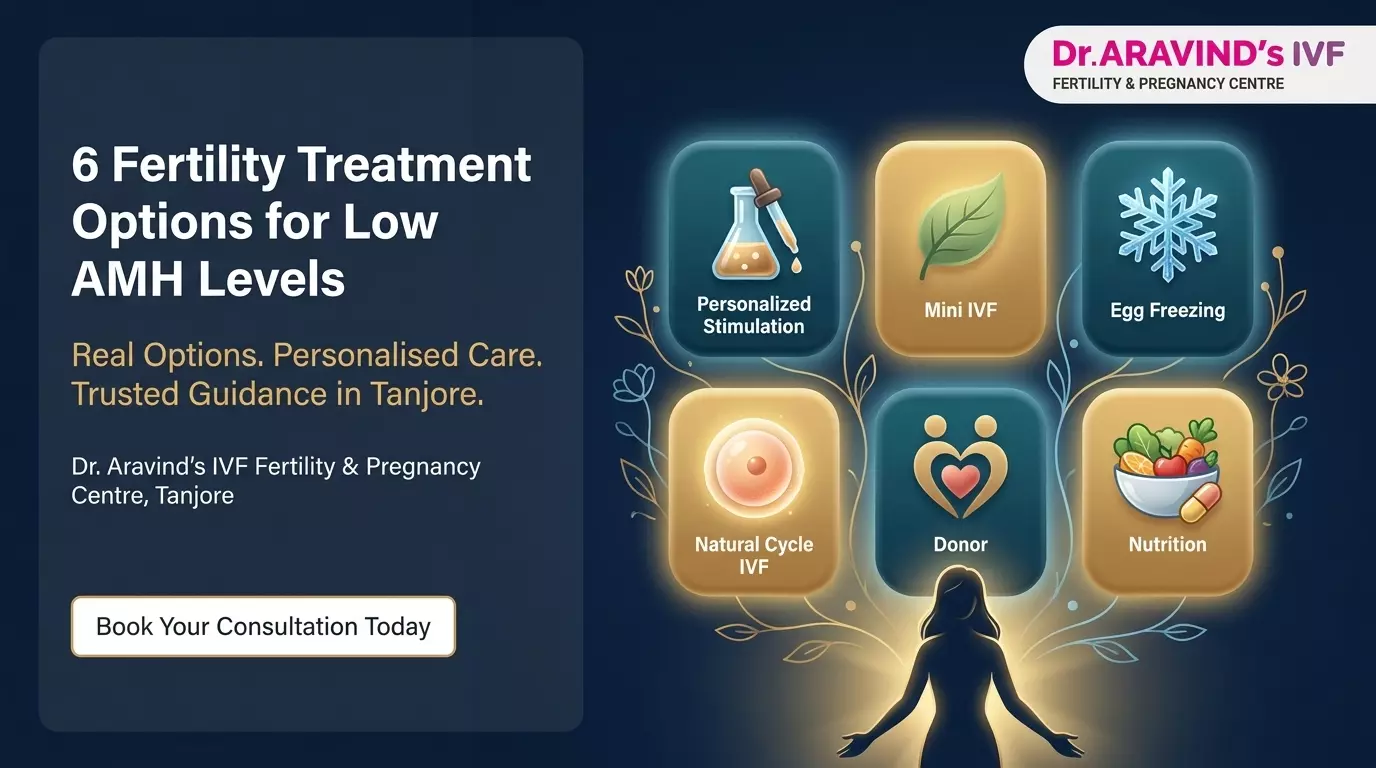
6 Fertility Treatment Options for Low AMH Levels
A low AMH result changes the conversation — but it does not end it.
It means the approach needs to be more precise, more personalised, and more carefully matched to where you are right now. The good news is that treatment options for low AMH levels have expanded significantly over the past decade.
At the right fertility centre in Tanjore, a low AMH diagnosis opens a clinical discussion — not a door that closes. Before exploring your options, it helps to understand what your specific numbers mean. Read more about what is a good AMH level to get pregnant so you can approach this conversation with clarity.
Option 1: Personalised IVF Stimulation
Standard IVF protocols are not designed for low ovarian reserve.
Women with low AMH levels respond differently to stimulation medications. Too high a dose produces poor response. Too low a dose retrieves too few eggs.
A personalized protocol adjusts stimulation based on your specific AMH, antral follicle count, and previous response history. At a trusted IVF centre in Tanjore, this level of individualisation is the difference between a cycle that works and one that does not.
What this involves:
- Lower starting doses of stimulation medication
- More frequent monitoring during the stimulation phase
- Dose adjustments based on how your ovaries respond in real time
Option 2: Mini IVF
Mini IVF uses significantly lower medication doses than standard IVF.
It is designed for women whose ovaries are sensitive — those who are likely to produce only a small number of eggs regardless of stimulation intensity. The goal shifts from collecting many eggs to collecting the best eggs available. Mini IVF is gentler on the body, less expensive per cycle, and often produces higher quality embryos in women with low ovarian reserve.
Best suited for:
- Women with critically low AMH
- Those who responded poorly to standard IVF stimulation previously
- Women prioritising egg quality over egg quantity
Option 3: Egg Freezing
If you are not ready to conceive right now — egg freezing is worth serious consideration.
AMH declines over time. Freezing your eggs while they are available preserves your options for later. This is particularly relevant for women in their late 20s or early 30s who have received an early low AMH diagnosis. Frozen eggs can be used in a future IVF cycle when the time is right — without the pressure of further reserve decline affecting the outcome.
Read: Where Miracles Begin: Delhi's Most Recommended IVF
Option 4: Natural Cycle IVF
Natural cycle IVF works with the one egg your body produces naturally each month.
No stimulation medication is used. The single naturally selected egg is retrieved and fertilised in the lab. This approach suits women with very low AMH who produce few or no eggs in response to stimulation. Success rates per cycle are lower — but there is no risk of poor stimulation response and the process is significantly gentler on the body.
Option 5: Donor Egg IVF
When ovarian reserve is severely diminished, donor egg IVF offers the highest success rates available.
A healthy donor egg is fertilised with your partner's sperm and transferred to your uterus. Your ability to carry a pregnancy is not affected by low AMH — only egg production is.
Many women who were told natural conception was no longer possible have gone on to successful pregnancies through this route. Understanding the full picture of low AMH levels and pregnancy helps you approach this option with clarity rather than fear.
Option 6: Lifestyle and Nutritional Optimisation
This is not an alternative to clinical treatment — it is a layer that improves every other option.
Key priorities for women with low AMH levels:
- CoQ10 — supports cellular energy production inside egg cells
- Vitamin D — deficiency is common and directly affects follicle development
- Antioxidant-rich diet — berries, leafy greens, walnuts, and fatty fish protect egg DNA
- Stress management — chronic cortisol suppresses the hormones that support ovarian function
- Quality sleep — hormonal balance depends on consistent seven to eight hours nightly
Three months of consistent nutritional support produces measurable benefit in the eggs available for treatment.
How to Choose the Right Option in Tanjore
No single option fits every woman with low AMH.
Your age, the severity of your AMH decline, your antral follicle count, your partner's sperm health, and your personal priorities all shape which treatment gives you the best realistic chance.
A fertility specialist in Tanjore evaluates your complete clinical picture before recommending any pathway — because the right option for you may be very different from what worked for someone else with the same AMH number.
Low AMH levels are a starting point — not a sentence. At Dr. Aravind's IVF Fertility & Pregnancy Centre in Tanjore, the fertility centre in Tanjore that families across Tamil Nadu trust, every woman receives a thorough evaluation and a personalised treatment plan built around her actual diagnosis. Your path forward exists — and it starts with one honest conversation.
Frequently Asked Questions
Q1: Which fertility treatment is best for very low AMH?
Donor egg IVF offers the highest success rates for severely low AMH. For mild to moderate low AMH, personalised IVF stimulation or Mini IVF are often the most effective first steps. Your fertility specialist recommends the right option based on your complete clinical evaluation.
Q2: Can lifestyle changes improve AMH levels?
Lifestyle changes do not significantly raise AMH levels. But they protect egg quality and improve how your body responds to fertility treatment. CoQ10, vitamin D, antioxidant nutrition, and stress management all produce measurable benefits in the eggs available for treatment cycles.
Q3: Is natural pregnancy possible with low AMH?
Yes — for mild to moderate low AMH in women under 35 with regular ovulation. Many women conceive naturally with timed intercourse and lifestyle support. A fertility evaluation confirms whether natural conception remains a realistic option for your specific AMH level and age.