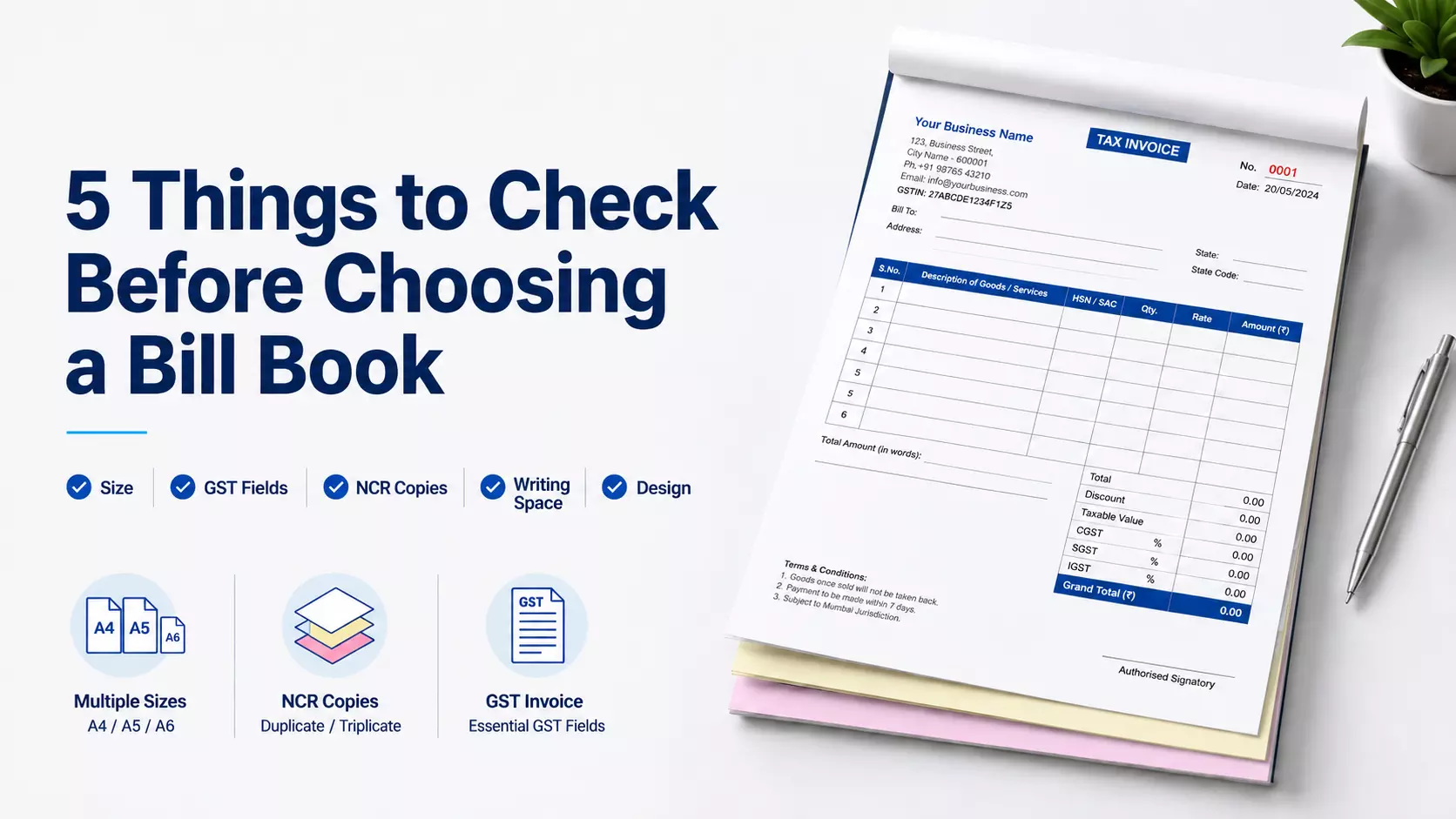
5 Things to Check Before Choosing a Bill Book for Your Business
Choosing a bill book for a business involves more than selecting a design and placing a company logo at the top.
The right format should match the way invoices or receipts are actually prepared during everyday business operations. Available writing space, number of copies, invoice fields, paper format and overall usability can all affect whether a bill book is convenient to use.
Before sending a bill book design for printing, consider these five practical factors.
1. Start With the Information You Need to Write
The first question should not be “Which design looks best?” It should be “What information needs to appear on every bill?”
A retail shop may need several rows for product descriptions, quantities and rates. A service business may need more space for customer details and service descriptions. A wholesaler handling larger orders may require even more itemised writing space.
Where applicable, businesses may also need fields for GSTIN, invoice number, invoice date, customer details, taxable value and relevant tax information.
The final invoice particulars should always be checked against the requirements applicable to the business and transaction before printing.
Planning these fields first helps prevent an attractive design from becoming difficult to use in practice.
2. Select a Size Based on Daily Billing
Bill books are commonly available in formats such as A4, A5 and A6, but each size serves a different type of billing requirement.
A4 provides more room for detailed or itemised invoices.
A5 can offer a practical balance between writing space and compact handling for everyday billing.
A6 may be suitable where only a small amount of information needs to be recorded, such as short receipts or cash memos.
Instead of automatically choosing the largest or smallest option, consider how many rows, fields and handwritten details are normally required on each bill.
The best bill book size is the one that provides enough space without creating unnecessary bulk.
Read: Best Digital Marketing Company in India: How to Choose
3. Decide How Many Copies You Actually Need
Another important choice is whether the bill book should be single, duplicate or triplicate.
A single-copy format may be sufficient when only one physical record is needed.
A duplicate format can be useful when the customer receives one copy and the business retains another record.
Triplicate bill books are more suitable when a third physical copy is genuinely required for an additional department, process or record-keeping purpose.
Businesses should choose the number of copies according to their actual workflow rather than assuming that more copies are automatically better.
4. Understand Whether NCR Paper Makes Sense
Duplicate and triplicate bill books commonly use NCR or carbonless paper.
With a carbonless format, pressure applied while writing on the top sheet allows the information to appear on the corresponding sheets underneath. This can make it easier to create matching transaction records without manually rewriting the same details.
NCR paper can therefore be particularly practical for businesses that routinely need customer and office copies of the same invoice or receipt.
Businesses comparing sizes, copy structures, design considerations and pricing factors may also find this practical bill book printing guide useful for understanding the available options in more detail.
5. Review Usability Before Approving the Design
A professional-looking bill book still needs to be easy to complete.
Before approving the artwork, check whether the design has:
- Enough handwriting space
- Clear rows and columns
- Readable fonts
- Correct business information
- Required invoice fields
- Appropriate copy format
- Good-quality logo artwork
- Proper alignment and spelling
- Suitable invoice numbering arrangements
Avoid allowing branding elements to consume too much of the usable billing area. A large logo or decorative header may look attractive but can reduce the space available for important transaction details.
A good bill book design should make information easier to enter and understand.
Final Thoughts
The most suitable bill book is not necessarily the most elaborate one.
For most businesses, the better approach is to start with the actual billing workflow and then select the size, number of copies, fields and layout accordingly.
A compact format may work well for simple transactions, while businesses handling detailed invoices may benefit from additional writing space. Similarly, duplicate or triplicate NCR formats should be selected only when multiple physical records are genuinely useful.
Taking a few minutes to review these requirements before printing can help create a bill book that is practical, organised and suitable for everyday business use.