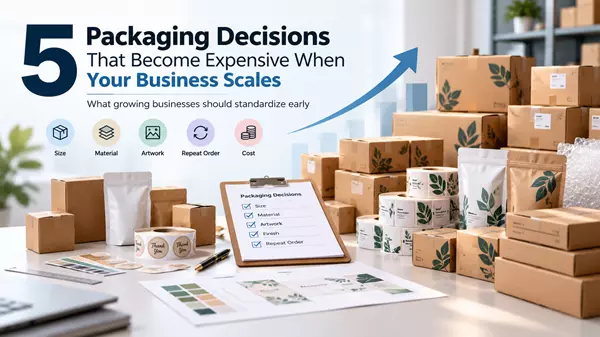
5 Packaging Decisions That Become Expensive When Your Business Scales
A packaging decision that works for 100 orders may become expensive when the same product starts selling in thousands.
At a small scale, businesses can often manage last-minute design changes, manual reorders and inconsistent packaging specifications. As order volume grows, those small issues can turn into wasted stock, delayed production and higher operating costs.
Here are five packaging decisions worth fixing before your business scales.
1. Changing Packaging Sizes Too Often
Frequent size changes may look harmless at first, but they can create problems across:
- Labels
- Boxes
- Inserts
- Shipping materials
- Storage
- Artwork files
If every batch uses a slightly different size, repeat orders become harder to manage.
Before scaling, standardize the dimensions that work best for your product.
A stable size makes it easier to reorder packaging, maintain artwork and compare future supplier quotes.
2. Not Standardizing Materials
Using different materials for the same product can lead to inconsistent packaging quality and unpredictable costs.
For example, one batch may use a standard paper label while another uses a moisture-resistant material.
Both may look similar, but they may perform very differently.
Before increasing order volume, define the material specification clearly.
That may include:
- Material type
- Thickness
- Finish
- Adhesive
- Lamination
- Colour requirements
A written specification helps ensure that repeat orders are based on the same requirements.
3. Poor Artwork and Version Control
Growing businesses often update:
- Logos
- Product information
- Contact details
- Ingredients
- Barcodes
- Legal information
The problem starts when different versions of the same artwork are stored across email, computers and supplier records.
A simple version-control system can prevent an outdated design from being sent for production.
Use clear file names, approval dates and one final master artwork file for each packaging product.
This becomes especially important when several people are involved in ordering.
Read: Why Custom Printed Bags Are Essential for Your Business
4. Ignoring Repeat-Order Consistency
The first packaging order may look good, but what happens on the third or fifth reorder?
Businesses should think about whether the same:
- Size
- Material
- Colour
- Finish
- Artwork
- Print position
can be reproduced consistently.
A small variation may be acceptable for internal packaging, but customer-facing products usually need stronger consistency.
This is where choosing the right type of packaging provider becomes important. If you are evaluating different supplier
models, this printing and packaging company comparison guide explains how providers can differ by specialization, order scale and business use case.
5. Choosing Packaging Only on Short-Term Price
A lower price per piece can look attractive, especially at higher quantities.
But unit cost is only one part of the decision.
Also consider:
- Storage requirements
- Unused inventory
- Design changes
- Material performance
- Reorder convenience
- Production consistency
A business may save a small amount per unit but lose more money later if thousands of pieces become outdated or unsuitable.
The better comparison is not simply:
“Which supplier is cheaper?”
It is:
“Which option gives us the lowest total cost over repeated orders?”
What Should Be Standardized Before Scaling?
Before increasing packaging volumes, document these basics:
- Final packaging dimensions
- Approved material
- Artwork version
- Print specifications
- Finishing requirements
- Quantity ranges
- Reorder process
This creates a repeatable system instead of treating every order like a new project.
Final Thoughts
Packaging becomes more operational as a business grows.
What works through manual decisions at a small scale may become inefficient when order volumes increase.
Standardizing sizes, materials, artwork and repeat-order requirements early can reduce unnecessary changes later.
The goal is not simply to buy more packaging at a lower price. It is to build a packaging process that remains practical as the business grows.