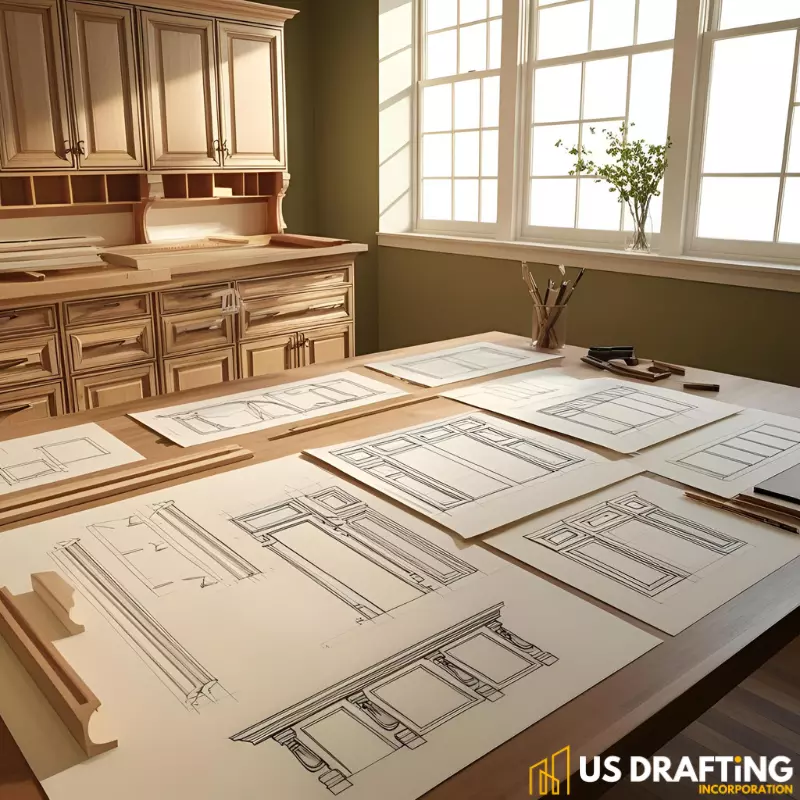
3D vs 2D Shop Drawings: Which One is Better for Millwork?
In the world of millwork, precision and clarity in shop drawings are crucial to ensuring a seamless manufacturing and installation process. Traditionally, 2D shop drawings have been the industry standard, providing essential details in plan, elevation, and section views.
However, with advancements in technology, 3D shop drawings have gained popularity, offering enhanced visualization and accuracy. While both approaches serve the same purpose—communicating design intent and construction details—the choice between 2D and 3D shop drawings can significantly impact workflow efficiency, error reduction, and project coordination.
This article explores the advantages and drawbacks of each method, helping millwork professionals determine the best option for their needs.
Understanding 2D Shop Drawings
2D shop drawings are detailed technical drawings used in construction and manufacturing. They show how a product, part, or structure should be made and assembled. These drawings include measurements, materials, and other important details needed by workers, engineers, and fabricators.
Shop drawings are different from general design drawings. While design drawings show the overall concept, shop drawings focus on the specific details required to build the item. They often include views from different angles, such as top, side, and front, to provide a complete understanding of the object.
One of the key benefits of 2D shop drawings is accuracy. They help avoid mistakes by giving clear instructions, reducing errors, waste, and extra costs. These drawings also help different teams, like architects, engineers, and manufacturers, work together smoothly.
Common industries that use 2D shop drawings include construction, woodworking, metal fabrication, and mechanical engineering. For example, in construction, these drawings are used to create doors, windows, cabinets, and steel structures.
Creating 2D shop drawings requires precision and attention to detail. They are usually made using software like AutoCAD or SolidWorks. However, traditional hand-drawn shop drawings are still used in some industries.
Understanding 3D Shop Drawings
3D shop drawings are detailed technical drawings that help builders, fabricators, and manufacturers understand how a structure or product will be built. Unlike 2D drawings, which show flat views, 3D shop drawings provide a realistic visual representation of the design. This makes it easier to see how different parts fit together.
These drawings are commonly used in construction, metal fabrication, woodworking, and mechanical industries. They include precise measurements, materials, and assembly details, ensuring that everything is built correctly. By using 3D shop drawings, workers can reduce errors, save time, and improve overall project accuracy.
One of the biggest advantages of 3D shop drawings is that they help in detecting design issues before production begins. This prevents costly mistakes and delays. Architects, engineers, and contractors can collaborate more effectively by viewing a 3D model instead of trying to interpret complex 2D plans.
With the help of advanced software like AutoCAD, Revit, and SolidWorks, creating 3D shop drawings has become easier and more efficient. These digital models can be rotated, zoomed in on, and adjusted as needed, providing a clear understanding of the final product.
In summary, 3D shop drawings are essential tools in modern construction and manufacturing. They improve communication, minimize errors, and help teams work more efficiently. Whether you’re building a house, a bridge, or custom furniture, 3D shop drawings make the process smoother and more precise.
Comparative Analysis: 3D vs. 2D Shop Drawings in Millwork
In millwork, shop drawings play a crucial role in turning designs into reality. They provide detailed instructions for fabricators, ensuring accuracy in cutting, assembling, and installing woodwork. Traditionally, 2D shop drawings were the standard, but 3D drawings have become more common with advanced software.
2D Shop Drawings
2D drawings are flat representations of a project, showing views like top, front, and side elevations. They are simple, easy to read, and widely used in the industry.
These drawings work well for straightforward projects, where skilled craftsmen can interpret measurements and details without needing extra visualization. However, 2D drawings have limitations. They don’t provide a full picture of complex designs, making it harder to detect errors before production.
3D Shop Drawings
3D drawings offer a more realistic view of millwork projects. They create digital models that show depth, making it easier to understand the final product. These drawings help detect design flaws early, reducing mistakes and material waste. They also improve communication between designers, fabricators, and clients by giving a clear visual of the project.
However, 3D drawings require advanced software and skills, making them costlier and sometimes unnecessary for simple jobs.
Which is Better?
Both 2D and 3D shop drawings have their place in millwork. 2D is great for simple, traditional projects, while 3D is best for complex and custom designs. Choosing between them depends on project needs, budget, and the level of detail required.
When to Use 2D vs. 3D Shop Drawings in Millwork
Shop drawings are important in millwork because they help turn ideas into real, high-quality woodwork. Choosing between 2D and 3D shop drawings depends on the project's needs.
2D Shop Drawings
2D shop drawings are flat, detailed drawings that show dimensions, materials, and construction methods. These are best for simple projects like cabinets, shelves, and trim work. Since they are easier to create, they save time and cost. 2D drawings are great when working with experienced craftsmen who can visualize the final product from basic plans.
3D Shop Drawings
3D shop drawings create a more realistic view of the final product. These are useful for complex projects with custom designs, curved surfaces, or intricate details. 3D drawings help clients and builders see how everything fits together before making the piece. They also help avoid mistakes by showing exact shapes and connections.
When to Use Each
Use 2D drawings for straightforward projects where measurements and materials are the main focus. They work well for production and quick approvals.
Choose 3D drawings for custom, detailed millwork where a clear visual representation is needed. If a project involves unique designs, multiple materials, or curved shapes, 3D drawings help ensure accuracy.
In short, 2D shop drawings are best for standard millwork, while 3D shop drawings bring clarity to complex designs. Choosing the right one saves time, money, and effort while ensuring quality results.
Future of Millwork Shop Drawings
Millwork shop drawings are changing fast with new technology. In the past, these drawings were made by hand or with basic computer programs. Now, digital tools like CAD (Computer-Aided Design) and BIM (Building Information Modeling) are making the process faster and more accurate.
One big change is automation. Many software programs can now generate shop drawings with just a few clicks. This reduces errors and saves time. It also helps designers and manufacturers work together more smoothly.
Another trend is 3D modeling. Instead of flat, 2D drawings, more companies are using 3D designs. These models give a clear view of how cabinets, doors, and other millwork pieces will look before production starts. This helps catch mistakes early and improves communication with clients.
Cloud-based collaboration is also growing. Teams can now share and edit drawings in real time, no matter where they are. This makes the process faster and more efficient.
Looking ahead, artificial intelligence (AI) and virtual reality (VR) might play a bigger role. AI can help create smarter, more precise designs, while VR allows clients to "walk through" a space before construction.
Overall, the future of millwork shop drawings is all about speed, accuracy, and better teamwork. Companies that embrace these new technologies will have a big advantage in the industry.
The End
The choice between 2D and 3D shop drawings in millwork ultimately depends on the project's complexity, budget, and specific requirements. While 2D drawings remain a reliable and cost-effective option for simpler designs, 3D shop drawings offer greater precision and visualization for intricate projects.
As technology continues to evolve, the industry is shifting towards more advanced tools, including automation, cloud collaboration, and AI-driven solutions, enhancing efficiency and accuracy.
Embracing these innovations will help millwork professionals streamline workflows, reduce errors, and improve communication, ensuring high-quality results in every project.