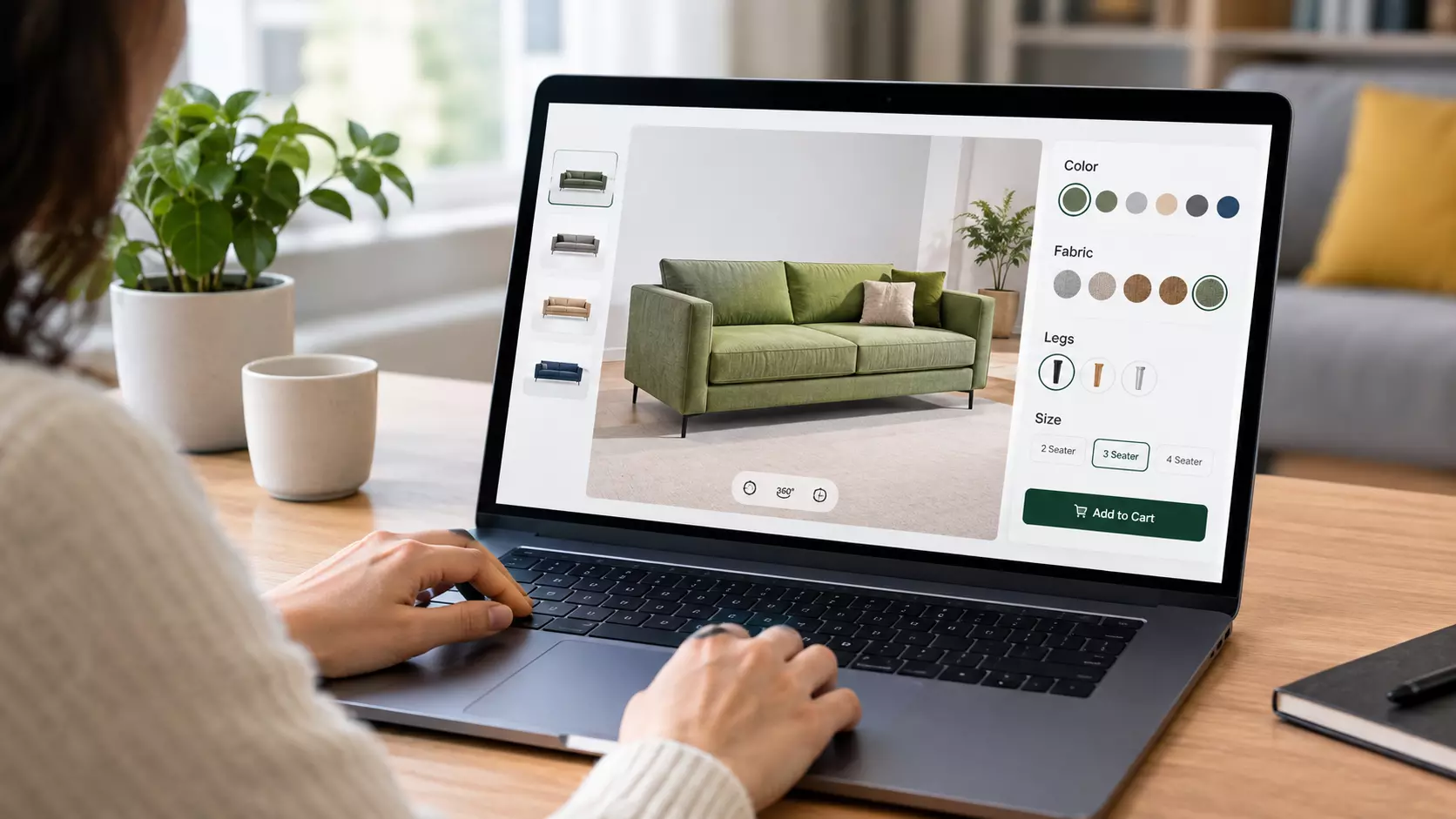
How 3D Product Configurators Turn Product Browsing Into Interaction
Online shopping has always had one problem: you can look, but you can't touch. A photo shows one angle, one color, one moment.
It doesn't answer the question every shopper actually has, which is "what would this look like as mine?" A 3D product configurator answers that question directly, and it's quietly changing how people shop for everything from sneakers to sofas.
From Static Catalogs to Interactive Experiences
For years, product pages have followed the same formula. A hero image, a few thumbnails, maybe a zoom feature if you're lucky. It works fine for simple, single-variant products.
It falls apart the moment a product has options. Ten colors, five materials, three sizes, two finishes. Multiply those together and you get hundreds of combinations that a photo library simply can't cover.
A 3D configurator solves this by replacing static images with a live model. Instead of scrolling through pre-shot photos, the shopper controls the view.
They rotate the product, swap materials, change colors, and watch the model update instantly. The catalog stops being something you flip through and becomes something you build.
What Is a 3D Product Configurator, Really
At its core, a 3D product configurator is a piece of software layered on top of a product's 3D model. It reads the available options (color, size, material, add-ons) and renders each choice on the model in real time.
No page reloads, no waiting for new photos to load. Change the leather color on a bag and the model updates before you finish clicking.
This is where product visualization earns its keep. A static image can only ever show what the photographer chose to shoot. A configurator shows what the customer chooses to see. That shift, from photographer's decision to shopper's decision, is the whole point.
Why Product Visualization Changes Buying Behavior
People don't buy products. They buy the version of themselves that owns the product. That's why a wedding ring buyer wants to see their exact stone shape and band width, not a generic sample. It's why a car buyer wants their exact trim, paint, and wheel combination before signing anything.
When someone can preview their specific configuration, hesitation drops. They're no longer imagining a gap between the photo and the final product.
They've already seen it, at least virtually. This matters more than it sounds. Uncertainty is one of the biggest reasons carts get abandoned. Anything that closes the gap between "I think I'll like this" and "I know I'll like this" tends to move people toward a decision faster.
The Mechanics Behind Real-Time 3D Customization
Real-time 3D customization sounds complex, and technically it is, but the shopper experience is simple by design. Behind the scenes, a base 3D model is built with modular parts and material slots.
Each option the customer selects, a new color, a different fabric, an added feature, swaps a texture or a mesh component without rebuilding the whole model from scratch.
This modular approach is what makes the "real-time" part possible. Instead of rendering thousands of pre-made photo combinations (which would take forever and still miss combinations), the software renders one flexible model that adapts on the fly.
It runs in the browser, so no app download or special hardware is needed. Someone can open a link on their phone and rotate a fully customized product with a swipe.
Where Configurators Are Already Doing the Heavy Lifting
Automotive
Car buyers have gotten used to building their vehicle online before ever visiting a dealership. Paint color, interior trim, wheel style, tech package. All of it gets previewed digitally, which shortens the in-person visit and sets expectations before money changes hands.
Furniture and Interior Design
Furniture is a category where fit and finish matter enormously, and photos rarely capture either. A configurator lets a shopper see a sofa in their preferred fabric, or a cabinet in the exact wood tone they want, without guessing from a swatch chart.
Apparel
Custom sneakers, personalized bags, made-to-order jackets. Apparel configurators let shoppers mix colorways and materials in ways that would be impossible to photograph in advance, since the combinations are nearly infinite.
Construction and Real Estate
Buyers choosing flooring, countertops, or fixtures for a new build can preview finishes inside a rendered space rather than staring at a sample tile and imagining the rest of the room.
Reducing Returns and Building Confidence
One underrated benefit of 3D customization is what happens after the purchase, not before it. When a customer configures a product themselves and sees an accurate preview, the finished item rarely surprises them.
That has a direct effect on return rates, particularly in categories like furniture and apparel where "it looked different online" is a common complaint.
Confidence at checkout also tends to raise average order value. Someone who can see exactly what an upgrade or add-on looks like is more willing to say yes to it than someone guessing from a bullet-point description.
Challenges Worth Knowing
None of this comes free. Building accurate 3D models takes real production time, and every material or color option added to a configurator multiplies the testing needed to make sure it renders correctly.
Performance is another concern. A configurator that lags or loads slowly on mobile can undo the exact trust it's meant to build. Getting the balance right between visual detail and loading speed is an ongoing design problem, not a one-time fix.
What This Means for the Future of Shopping
The direction is pretty clear at this point. As more categories adopt 3D product configurator tools, static product photography will keep shrinking to a supporting role rather than the main event.
Shoppers are getting used to interaction, not just observation, and once that expectation sets in, it doesn't really go away.
Product visualization is no longer a nice add-on for luxury brands with big budgets. It's becoming table stakes for any business selling products with real variety.
The businesses paying attention now, building configurators that are fast, accurate, and genuinely useful, are the ones setting the standard everyone else will eventually have to match.