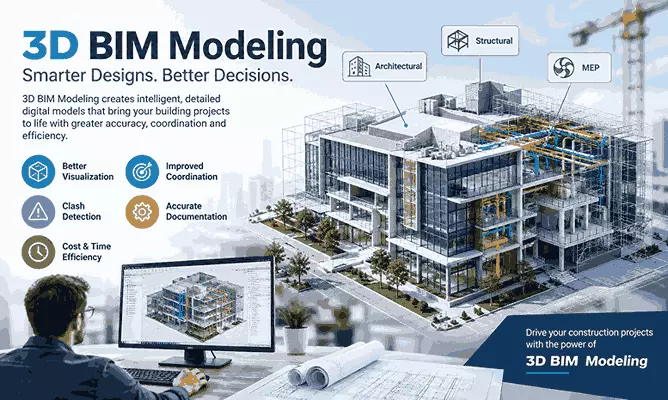
3D BIM Modeling: Transforming Modern Construction and Design
The construction industry is rapidly adopting digital technologies to improve design accuracy, coordination, and project efficiency.
Among these technologies, 3D BIM Modeling has become an essential solution for architects, engineers, contractors, and building owners.
It creates a detailed digital representation of a building, allowing project teams to visualize, analyze, and coordinate different building components before construction begins.
What Is 3D BIM Modeling?
3D BIM Modeling is the process of developing a three-dimensional digital model of a building or infrastructure project using Building Information Modeling (BIM) technology.
Unlike traditional 2D drawings, a BIM model contains both the physical geometry and relevant information about building elements such as walls, doors, windows, structural components, mechanical systems, electrical systems, and plumbing.
This information-rich approach enables project stakeholders to understand how different components interact throughout the project lifecycle.
With accurate 3D BIM Modeling, teams can identify potential design issues early and make informed decisions before they become costly problems on-site.
Benefits of 3D BIM Modeling
One of the biggest advantages of 3D BIM Modeling is improved visualization. Architects and clients can view the proposed building in three dimensions and better understand its design, layout, and spatial relationships.
This makes it easier to review designs and communicate ideas among stakeholders.
Another important benefit is better coordination. Architectural, structural, and MEP models can be integrated into a coordinated BIM environment.
This helps identify clashes between building systems before construction begins. Early clash detection can reduce rework, material waste, construction delays, and additional project costs.
3D BIM Modeling also improves documentation accuracy. Changes made to the BIM model can be reflected across associated drawings and documentation, reducing inconsistencies between different project deliverables. This creates a more reliable source of project information for everyone involved.
Read: Top Concrete Contractors NYC for Every Project
Applications of 3D BIM Modeling
3D BIM Modeling is used across various stages of the construction process. During the design phase, it helps architects and engineers develop and evaluate building concepts.
During construction, contractors can use coordinated models for planning, sequencing, quantity estimation, and site coordination.
It is also valuable for renovation and retrofit projects. Existing structures can be converted into accurate digital models using technologies such as laser scanning and point-cloud data. These models provide a reliable foundation for renovation planning and facility management.
Why Choose Professional 3D BIM Modeling Services?
Professional 3D BIM Modeling Services can help project teams create accurate and information-rich models while maintaining industry standards and project requirements.
Experienced BIM professionals can develop architectural, structural, and MEPF models with the appropriate level of detail for design development, coordination, construction, and documentation.
By integrating 3D BIM Modeling into the construction workflow, companies can improve collaboration, minimize errors, and make better project decisions. As construction projects become more complex, BIM-based modeling is increasingly becoming an important part of delivering projects efficiently, accurately, and cost-effectively.
Conclusion
3D BIM Modeling is more than a visual representation of a building. It is a powerful digital approach that connects design information, coordination, construction planning, and project management.
By providing a shared and detailed model, it helps stakeholders identify problems earlier, improve communication, and streamline the overall construction process.
For modern construction projects, adopting 3D BIM Modeling can provide a strong foundation for better accuracy, coordination, and project performance.