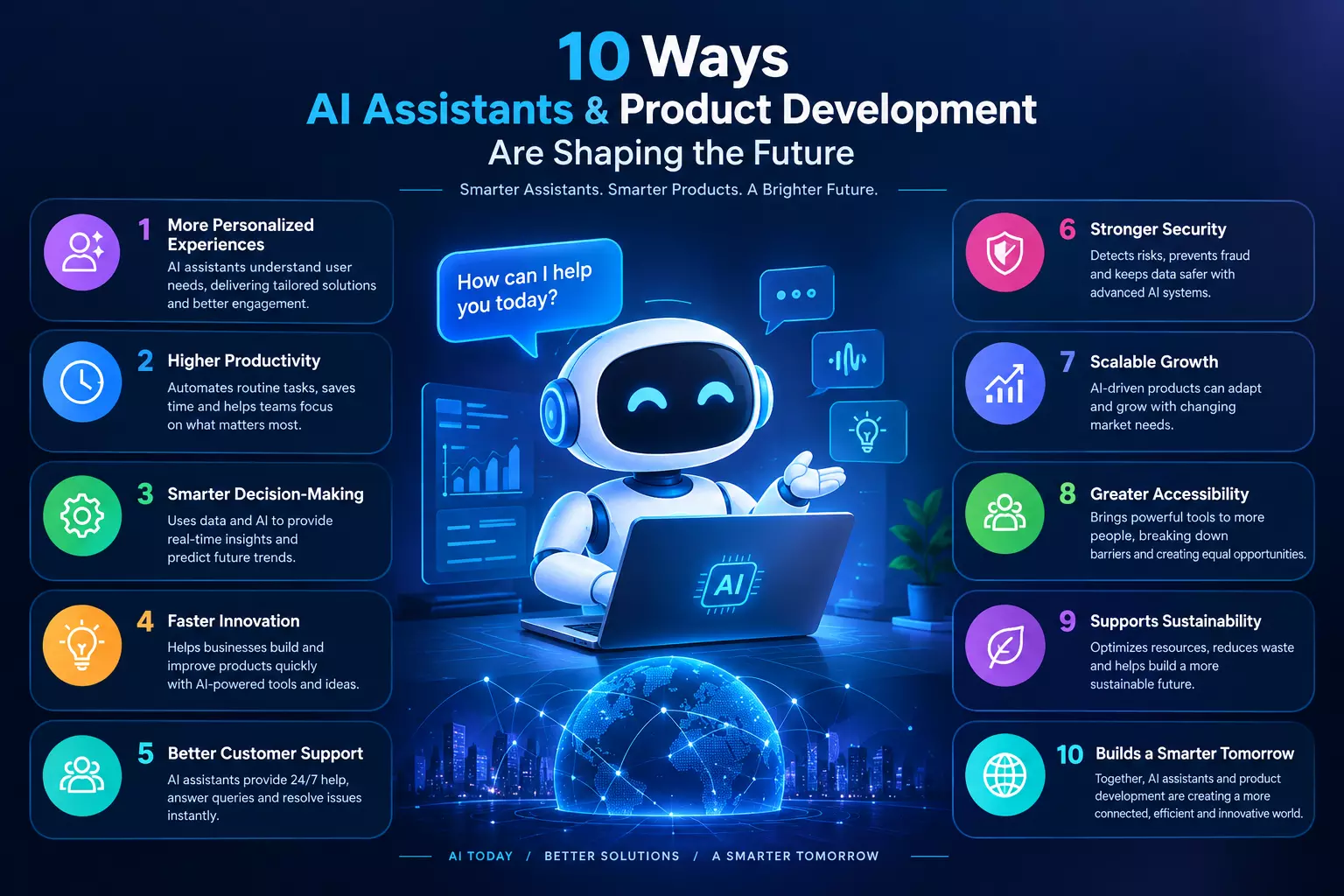
10 Ways AI Assistant Development and AI Product Development Are Shaping the Future
Artificial intelligence is changing how businesses create digital products, serve customers, automate repetitive work, and make decisions.
What was once limited to experimental projects is now becoming part of everyday software, from intelligent customer support tools to AI-powered business applications.
Two areas are particularly important in this shift: AI Product Development and AI Assistant Development. While AI products can address broader business and customer needs, AI assistants focus on interactive experiences that help users complete tasks, access information, and make decisions through natural language.
As these technologies continue to mature, businesses need to understand not only what AI can do but also how to develop reliable, useful, and scalable solutions.
This article explores ten ways these two areas are shaping the future and provides practical considerations for organizations planning AI initiatives.
1. AI Is Creating More Intelligent Digital Products
Traditional software generally follows predefined rules and workflows. AI-powered products can analyze data, recognize patterns, understand language, and adapt their responses based on context.
This makes it possible to create applications that do more than simply process user inputs. An AI product might recommend relevant information, identify unusual activity, summarize large amounts of content, or automate a complex workflow.
The modern AI Product Development Process therefore often involves more than conventional software engineering. Teams need to consider data quality, model selection, evaluation, security, user experience, and continuous improvement from the beginning.
2. AI Assistants Are Changing How Users Interact With Software
One of the most visible applications of AI is the intelligent assistant. Instead of navigating multiple screens or searching through large amounts of information, users can communicate with software using conversational language.
From Commands to Conversations
An AI assistant can potentially help users:
- Find information quickly
- Summarize documents and reports
- Draft emails and content
- Answer product or service questions
- Complete repetitive tasks
- Analyze business information
- Guide users through complex processes
This shift makes AI Assistant Development an important part of modern digital experiences. The objective is not simply to add a chatbot but to build an assistant that understands context and provides useful responses.
3. Businesses Can Automate More Complex Workflows
Automation has traditionally focused on repetitive, rule-based activities. AI expands these possibilities by helping software handle tasks that involve language, classification, summarization, prediction, or decision support.
For example, an AI-enabled application could analyze incoming customer requests, identify their intent, summarize the issue, and route it to the appropriate team.
This combination of AI and automation can reduce manual effort while allowing employees to spend more time on activities that require human judgment and creativity.
4. AI Assistants Are Becoming More Context-Aware
Early conversational systems often relied on simple question-and-answer patterns. Modern AI assistants can work with larger amounts of contextual information and can be connected to business data and software systems.
Why Context Matters
A useful assistant needs to understand more than the user's latest sentence. Depending on the application, it may need information about:
- Previous interactions
- User preferences
- Business rules
- Available documents
- Account information
- Current workflows
- Relevant organizational data
The AI Assistant Development Process should therefore include careful planning around context, data access, permissions, response quality, and fallback behavior.
Read: Top 10 AI/ML Development Companies to Watch in 2026
5. AI Product Development Is Becoming More Data-Driven
Data plays a central role in building effective AI products. The quality, structure, availability, and governance of data can directly influence the usefulness of an AI system.
During AI Product Development, teams may need to determine what data is available, where it comes from, how it should be processed, and which information an AI system is allowed to access.
Practical Data Considerations
Before development begins, organizations should evaluate:
- Data sources and ownership
- Data quality and consistency
- Privacy requirements
- Security controls
- Data access permissions
- Monitoring and maintenance requirements
Strong data foundations can make AI applications more reliable and easier to improve over time.
6. AI Assistants Are Moving Beyond Basic Customer Support
Customer service remains an important use case, but AI assistants can support much broader business functions.
For example, internal assistants can help employees search company knowledge, understand policies, prepare reports, or find information across multiple systems.
Meanwhile, customer-facing assistants can help with product discovery, troubleshooting, onboarding, scheduling, and common service requests.
As these applications become more sophisticated, AI Assistant Development Services increasingly involve integrations with existing business platforms rather than operating as isolated chat interfaces.
7. AI Products Can Deliver More Personalized Experiences
Personalization is another major area influenced by AI. Instead of presenting identical experiences to every user, AI systems can analyze available context and provide more relevant information or recommendations.
For example, an AI-powered learning platform could adapt content to a learner's progress. An e-commerce application could provide personalized recommendations. A business intelligence product could highlight insights relevant to a particular role.
However, personalization should be designed carefully. Organizations need to balance relevance with transparency, privacy, and user control.
8. AI Development Is Becoming More Iterative
Building an AI-powered product is rarely a one-time process. Models, prompts, data sources, integrations, and user expectations can change over time.
For this reason, a practical AI Product Development Process should support continuous testing and improvement.
A Practical Development Cycle
A typical approach can include:
Step 1: Define the problem
Identify a specific user or business problem that AI can realistically address.
Step 2: Validate the use case
Determine whether AI provides meaningful value compared with traditional software approaches.
Step 3: Prepare the data
Identify, clean, structure, and secure the required data.
Step 4: Build a prototype
Create a limited version to test the concept with real users or realistic scenarios.
Step 5: Evaluate performance
Measure accuracy, relevance, latency, usability, cost, and failure cases.
Step 6: Integrate the product
Connect the AI capability with the required applications, databases, APIs, and workflows.
Step 7: Monitor and improve
Track performance after launch and continuously refine the system.
This iterative approach can help teams identify problems earlier and avoid investing heavily in an unvalidated concept.
9. AI Development Requires Greater Attention to Trust and Security
As AI systems gain access to business information and perform more tasks, security and responsible implementation become increasingly important.
An AI application may interact with sensitive customer information, internal documents, financial data, or proprietary business processes. Poorly designed access controls can therefore create significant risks.
Both AI Assistant Development Services and AI Product Development Services should consider security throughout the development lifecycle.
Important areas include:
- Authentication and authorization
- Data encryption
- Access controls
- Privacy protection
- Prompt and input validation
- Output monitoring
- Audit logging
- Human oversight
- Model and system evaluation
Trust is not something that should be added after development. It should be considered from the architecture and design stages.
10. AI Product and Assistant Development Are Converging
Perhaps the most important trend is the growing connection between AI products and AI assistants.
An AI assistant does not have to exist as a standalone chatbot. It can become an intelligent interface within a larger AI-powered product.
For example, an enterprise platform could include an assistant that helps users analyze information, generate reports, navigate workflows, and take approved actions. In this model, the assistant becomes an interaction layer for the wider product.
This convergence creates new opportunities for software teams while also increasing the importance of architecture, integration, usability, and governance.
How Businesses Can Prepare for AI Development
Organizations considering AI should start with practical problems rather than technology trends alone.
1. Identify High-Value Use Cases
Look for processes where AI can reduce repetitive work, improve access to information, or create a better user experience.
2. Start With a Focused MVP
Instead of attempting to automate an entire business process immediately, begin with a clearly defined use case that can be measured.
3. Define Success Metrics
Establish measurable goals such as response accuracy, task completion rate, processing time, user satisfaction, or operational savings.
4. Plan Integrations Early
Determine which APIs, databases, CRM systems, knowledge bases, or internal platforms the AI solution will need to interact with.
5. Build Evaluation Into the Process
AI systems require ongoing evaluation. Create realistic test cases and monitor both successful and unsuccessful interactions.
6. Keep Humans in the Loop Where Necessary
For sensitive or high-impact decisions, AI should support human decision-making rather than automatically replacing appropriate human oversight.
The Role of Specialized AI Development Teams
Successful AI projects require a combination of product strategy, software engineering, data expertise, cloud infrastructure, UX design, and AI engineering.
Companies offering AI Product Development Services may help organizations move from initial idea and validation through development, integration, deployment, and ongoing optimization.
Similarly, AI Assistant Development Services can cover areas such as conversational design, knowledge integration, tool connectivity, workflow automation, evaluation, and deployment.
For organizations evaluating development partners, it is useful to examine their technical capabilities, previous project experience, development methodology, security practices, and ability to support a product beyond its initial launch.
CodeCones, for example, works across AI product development and software engineering, making it relevant to organizations exploring how AI capabilities can be incorporated into practical digital products.
The right development approach, however, should always depend on the organization's specific requirements, users, data, and technical environment.
Conclusion
AI is moving from an emerging technology into a practical component of modern software development.
AI Product Development is enabling businesses to build applications that can analyze information, automate processes, and deliver more intelligent experiences.
At the same time, AI Assistant Development is changing how people interact with digital products through natural language and contextual assistance.
The future will likely involve deeper integration between AI products, assistants, business systems, and automated workflows.
Organizations that approach these technologies strategically—with clear use cases, reliable data, strong security, measurable outcomes, and continuous evaluation—can build AI solutions that provide meaningful long-term value.
If your organization is exploring an AI initiative, start by defining the problem, identifying the users, and determining where intelligent automation or conversational experiences can provide measurable benefits.
From there, a structured development process can turn the initial idea into a scalable AI-powered product.