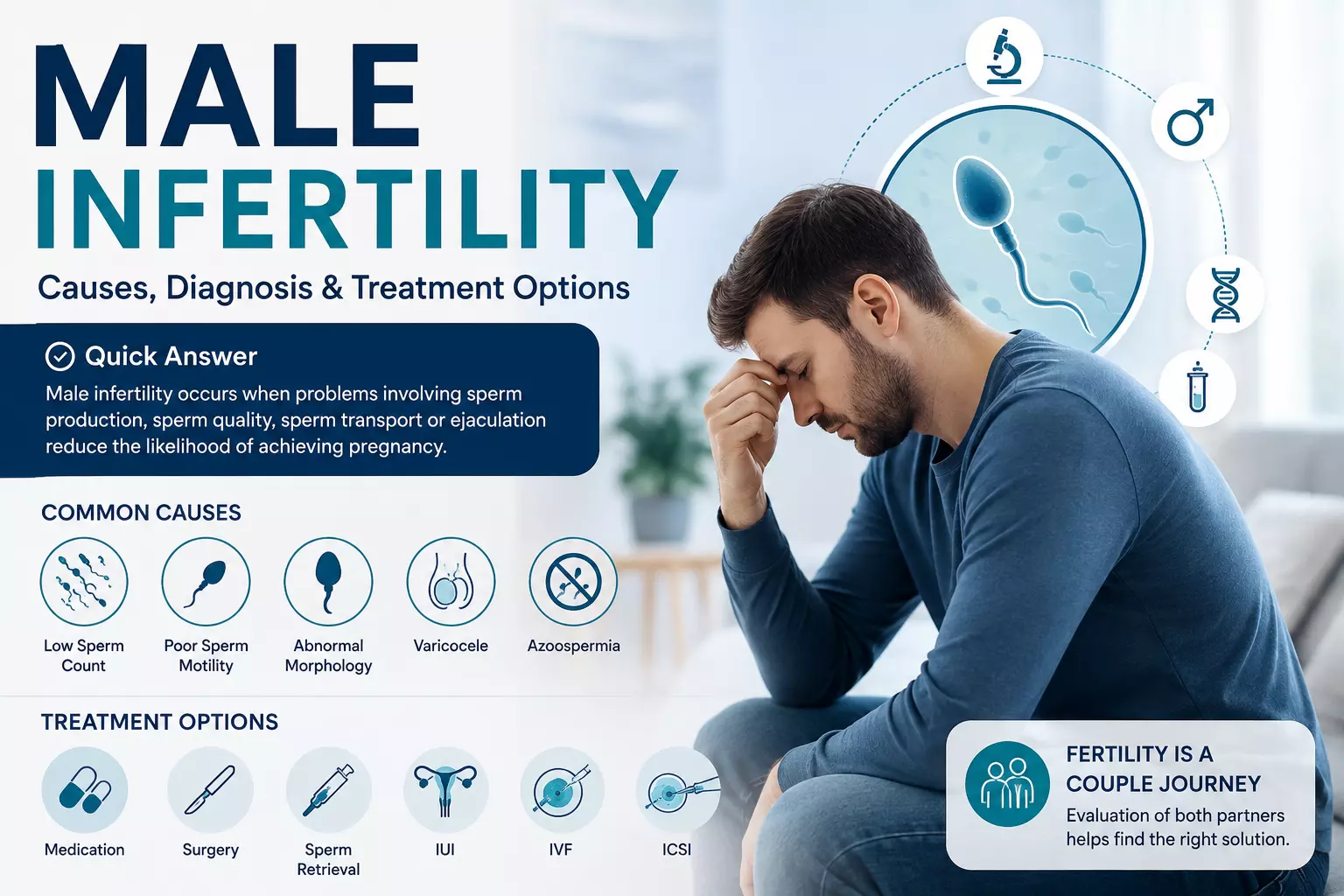
: Male Infertility and IVF: Understanding Semen Analysis, ICSI, and Treatment Options
Male factors contribute to infertility in a substantial proportion of couples, so fertility evaluation should not focus only on the woman.
A semen analysis is a key early test when a male partner is contributing sperm. It can provide information about sperm concentration, movement, and morphology, although one test does not always tell the whole story.
Treatment depends on the underlying cause and may include lifestyle changes, medication for selected conditions, surgery, IUI, IVF, or ICSI. ICSI is particularly relevant when sperm quantity or quality creates a significant fertilization problem.
What Is Male Factor Infertility?
Male factor infertility refers to problems involving sperm production, sperm function, ejaculation, or the male reproductive tract that reduce the chance of conception.
Causes can include varicocele, hormonal disorders, previous testicular injury or surgery, infections, genetic conditions, certain medications, environmental exposures, and unexplained abnormalities.
In some cases, no clear cause is identified. Because fertility is a couple-level outcome, evaluating both partners early can prevent unnecessary delays.
Why Is Semen Analysis Important?
Semen analysis is commonly used to assess the male partner during an infertility evaluation. The report may include sperm concentration, total count, motility, and morphology. Results can vary between samples, so a single abnormal result may need clinical interpretation or repeat testing.
A specialist may also review medical history, sexual function, medications, previous surgeries, childhood conditions, and other factors. The goal is to understand whether a correctable or treatable cause exists.
Can Lifestyle Changes Improve Sperm Health?
General health behaviors can support reproductive health, although they cannot guarantee improved fertility.
Avoiding tobacco, limiting excessive alcohol, maintaining a healthy weight, staying physically active, managing medical conditions, and avoiding unnecessary exposure to heat or reproductive toxins may be discussed with a clinician.
Do not assume that over-the-counter male fertility supplements are proven to improve live birth. Supplements should be considered carefully, especially when they may delay evaluation or treatment.
When Is IUI Used for Male Factor Infertility?
IUI may be considered when sperm abnormalities are mild and there are enough motile sperm after laboratory preparation. The treatment places concentrated sperm closer to the site of fertilization.
IUI is not appropriate for every semen abnormality. If sperm numbers or motility are severely reduced, or if other fertility factors are present, IVF with ICSI may provide a more suitable route to fertilization.
What Is ICSI?
Intracytoplasmic sperm injection, or ICSI, is a laboratory fertilization technique used during IVF. Instead of placing sperm around the egg and allowing fertilization to occur, an embryologist injects a single sperm directly into an egg.
ICSI was developed particularly to address male-factor infertility and problems with low or absent fertilization. It can be highly useful when conventional insemination is unlikely to achieve adequate fertilization.
Does Everyone Doing IVF Need ICSI?
No. ICSI should not automatically be treated as an essential upgrade for every IVF patient. A 2026 ASRM committee opinion states that routine ICSI for non-male-factor infertility is not recommended.
The decision should be based on the clinical indication, such as significant male-factor infertility, previous fertilization failure, or selected situations involving cryopreserved oocytes or genetic testing. Patients should ask why ICSI is being recommended and what additional benefit is expected in their case.
What If There Are Very Few or No Sperm in the Ejaculate?
Severe sperm problems require specialist assessment rather than immediately assuming that donor sperm is the only option. Depending on the cause, a urologist or reproductive specialist may investigate hormones, obstruction, genetic factors, or testicular sperm production.
In selected cases, sperm retrieval procedures can obtain sperm directly from the reproductive tract or testis, after which ICSI may be used. The correct approach depends heavily on the diagnosis.
How Male Factors Affect IVF Planning
Male-factor infertility can affect which laboratory fertilization method is chosen, but it is only one part of the IVF plan. The female partner's age, ovarian reserve, uterine factors, and previous treatment also influence outcomes.
A good treatment plan therefore integrates both partners' information. Couples should ask how the semen results affect fertilization expectations, whether ICSI is indicated, and whether a male fertility specialist should be involved.
Read: IVF Treatment in Ethiopia: A Guide to Fertility Clinics in Addis
When Should a Couple Seek Help?
Do not wait for a full year if there is a known condition that may affect fertility. Earlier evaluation can be appropriate when there is a history of testicular surgery or injury, chemotherapy, sexual or ejaculatory dysfunction, very abnormal semen results, or other known reproductive conditions.
For couples without known risk factors, the timing of evaluation also depends on the female partner's age. ASRM guidance recommends evaluating both partners rather than postponing male assessment.
Bottom Line
Male infertility is common, medically important, and often treatable or manageable. A semen analysis is a practical starting point, but abnormal results should be interpreted in context.
Depending on the diagnosis, treatment may involve correcting an underlying problem, IUI, IVF, or IVF with ICSI. ICSI is a valuable technique for selected male-factor cases, but it should not be presented as a universal add-on. The most useful next step is a coordinated evaluation of both partners.
FAQs
Does low sperm count mean IVF is necessary?
Not always. Mild abnormalities may be managed with timed intercourse or IUI, while severe abnormalities may make IVF with ICSI more appropriate.
Is ICSI the same as IVF?
No. ICSI is a fertilization technique performed as part of an IVF cycle.
Can sperm quality improve?
It depends on the underlying cause. Some factors are treatable, while others may be persistent. A male fertility specialist can assess the cause.
Should the male partner be tested even if the woman has PCOS or another diagnosis?
Yes. Infertility can involve more than one factor, so both partners should be assessed when appropriate.
Suggested External Evidence
ASRM practice guidance on fertility evaluation, ovarian reserve, unexplained infertility, PCOS-related ovulation treatment, and ICSI should be reviewed when publishing or medically updating this article.
Medical disclaimer: This article is for educational purposes only and is not medical advice. Individual treatment decisions should be made with a qualified fertility specialist.
How Endometriosis Is Diagnosed and Assessed
Endometriosis can be suspected from symptoms and medical history, but evaluation often involves pelvic imaging and, in selected cases, surgery.
Transvaginal ultrasound can identify some endometriomas and deep endometriosis findings, although a normal scan does not exclude all disease. The extent and location of disease matter because they can influence pain, pelvic anatomy, ovarian reserve, and fertility.
A fertility-focused assessment should also consider the male partner, ovarian reserve, tubal patency, and age. This prevents the endometriosis diagnosis from becoming the only explanation for infertility when another factor may also be present.
Should Endometriosis Be Treated Before Trying to Conceive?
There is no single answer. The appropriate approach depends on pain, disease location, ovarian reserve, age, tubal function, previous surgery, and the desire for pregnancy.
Hormonal suppression can be useful for controlling symptoms but does not help someone conceive while ovulation is being suppressed.
Surgery may be helpful in selected patients, but ovarian surgery can also reduce ovarian reserve.
For this reason, patients who want pregnancy should discuss the reproductive consequences of treatment before starting a major intervention. The question should be: What is the expected benefit for my fertility and symptoms, and what is the potential cost to ovarian function?
When to Discuss IVF Earlier
A more proactive IVF discussion may be reasonable when there is significant tubal disease, advanced endometriosis, repeated unsuccessful treatment, reduced ovarian reserve, older reproductive age, or another major infertility factor. IVF can bypass the fallopian tubes and can create embryos outside the pelvic environment before transfer.
Moving to IVF earlier does not mean that natural conception is impossible.
It means the clinician is balancing the probability of success against the time available. This distinction is important for patients who have been told simply to 'keep trying' without a defined review point.
Endometriosis Fertility Consultation Checklist
Ask your specialist: Where is my endometriosis located? Is there an endometrioma? Are my tubes open? What is my AMH and antral follicle count?
Would surgery improve fertility or mainly treat pain? Could surgery reduce ovarian reserve? How long is it reasonable to try naturally? Is IUI appropriate? When would you recommend IVF? If IVF is planned, should surgery happen first or after embryo creation?
Having these questions answered can help patients make decisions that protect both current symptoms and future reproductive options.